
Where some see pain, others see opportunity. Matt and Noah Colvin saw the latter and acted upon it.
On March 1, the day after the first coronavirus death in the United States was announced, brothers Matt and Noah Colvin set out in a silver S.U.V. to pick up some hand sanitizer. Driving around Chattanooga, Tenn., they hit a Dollar Tree, then a Walmart, a Staples and a Home Depot. At each store, they cleaned out the shelves.
Matt Colvin stayed home near Chattanooga, preparing for pallets of even more wipes and sanitizer he had ordered, and starting to list them on Amazon. Mr. Colvin said he had posted 300 bottles of hand sanitizer and immediately sold them all for between $8 and $70 each, multiples higher than what he had bought them for. To him, “it was crazy money.” To many others, it was profiteering from a pandemic.
And then it ended.
The next day, Amazon pulled his items and thousands of other listings for sanitizer, wipes and face masks. The company suspended some of the sellers behind the listings and warned many others that if they kept running up prices, they’d lose their accounts. EBay soon followed with even stricter measures, prohibiting any U.S. sales of masks or sanitizer.
Was it the Colvin’s fault that there was a scarcity of masks and sanitizer? Was it wrong to see an opportunity and seize it? Was it wrong to run up prices to as high as the market would bear? Was it wrong to leave the Colvins sitting with 17,700 bottles of sanitizer in their garage with no place to sell it when so many people want it?
“Price gouging is a clear violation of our policies, unethical, and in some areas, illegal,” Amazon said in a statement. “In addition to terminating these third party accounts, we welcome the opportunity to work directly with states attorneys general to prosecute bad actors.”
Nobody likes profiteers, people who take advantage of a crisis for their own gain. It’s unseemly. It’s indecent. Many would argue that it’s immoral. But in a capitalist society, why should the vigilant person not be allowed to seize the opportunity to sell goods that others demand at the price they’re willing to pay?
The flip side of the disgust for crisis profiteering is that sanitizers and masks, so much in demand, exist in the Colvins’ garage where they help no one. To punish the Colvins, those seeking what they have are denied.
There are laws prohibiting profiteering from crises, and on a gut level, it’s hard not to approve of them.
To regulators and many others, the sellers are sitting on a stockpile of medical supplies during a pandemic. The attorney general’s offices in California, Washington and New York are all investigating price gouging related to the coronavirus. California’s price-gouging law bars sellers from increasing prices by more than 10 percent after officials declare an emergency. New York’s law prohibits sellers from charging an “unconscionably excessive price” during emergencies.
Had the Colvins (and to be clear, they’re just the poster boys of this story, not the problem) limited their profit to 10% over normal retail, most people would accept their actions as not outrageous, even if they didn’t like it. But what makes 10% an acceptable amount of price gouging rather than 5%, or no percent at all? And what makes 20%, or 150%, wrong? The argument is that an item is worth whatever someone is willing to pay.
Mr. Colvin does not believe he was price gouging. While he charged $20 on Amazon for two bottles of Purell that retail for $1 each, he said people forget that his price includes his labor, Amazon’s fees and about $10 in shipping. (Alcohol-based sanitizer is pricey to ship because officials consider it a hazardous material.)
He’s not entirely wrong, as the price charged, the only price the public sees or cares about, fails to take into account the associated costs. Amazon makes its piece. The postal service gets its share. That’s not to say that the Colvins still didn’t make “crazy money” off their sales.
He thought about it more. “I honestly feel like it’s a public service,” he added. “I’m being paid for my public service.”
While market “inefficiencies” happen, calling price gouging a “public service” isn’t going to warm anyone’s heart. But at the same time, that doesn’t mean what he did was evil, but merely opportunistic. Does the existence of a crisis, real or perceived, change the equation sufficiently to make normal and lawful conduct, the sale of desired goods at the price the market will bear, wrong? And before anyone proffers the notion that this is why capitalism is evil, would there be any product to sell without it?
Discover more from Simple Justice
Subscribe to get the latest posts sent to your email.
What irritates everyone about this is he didn’t go to a (the) manufacturer and order it in bulk for sale, but ran in front of everyone else to deplete the existing supply at the retailer, denying people the opportunity to buy it from an existing retailer, and exacerbating the shortage of it to make a quick buck.
If he was ordering it from AliBaba or some other distributer and selling it, this wouldn’t be a problem. This guy didn’t bring any more product to the market, but took someone else’s work (and risk), and created a barrier to it, an artificial shortage. It’s like ticket scalping, and then some.
Pricing works when, say, they’re out of generators and plywood at Hurricane Magnet, FL, someone goes to a store in Atlanta, buys a truckload, drives them to Florida and offers them to sale. There’s no shortage, the seller didn’t deplete the local market. He didn’t buy them up where there’s already a shortage, but brought more to the market, ahead of the more cost-efficient distribution. Although someone will scream it’s just as much gouging as the first example.
While I can understand your distinction, I don’t think anybody would be good with selling santizer for $50 per bottle because they bought it from AliBaba.
He went out of his way to deny others important health supplies during a global pandemic for his personal profit. He created a market inefficiency. This is evil. Capitalism is generally good and produces great benefits to society, but can also be used for bad. This is one of those times.
“This is evil” isn’t a reason. It’s a value judgment.
Tennessee’s Attorney General seems to think the Colvin brothers’ actions were unlawful and wrong.
They’re being investigated under the Tennessee Consumer Protection Act as of yesterday. The justification comes from a price-gouging law enacted in 2002 to discourage “excessive and unjustified increases in the price of consumer goods” following an “abnormal disruption for economic goods and services” in the market.
The AG’s notice also orders the Colvin brothers to turn over their stockpile to the Chattanooga area investigator’s office.
From the moment I saw that article in the Times, something told me those folks were going to get robbed. Looks like the State just thought they should do the robbing before any of us Volunteer State people tried first.
I’m left with the image of pallets of sanitizer and masks safely stored in a government warehouse with the lost ark.
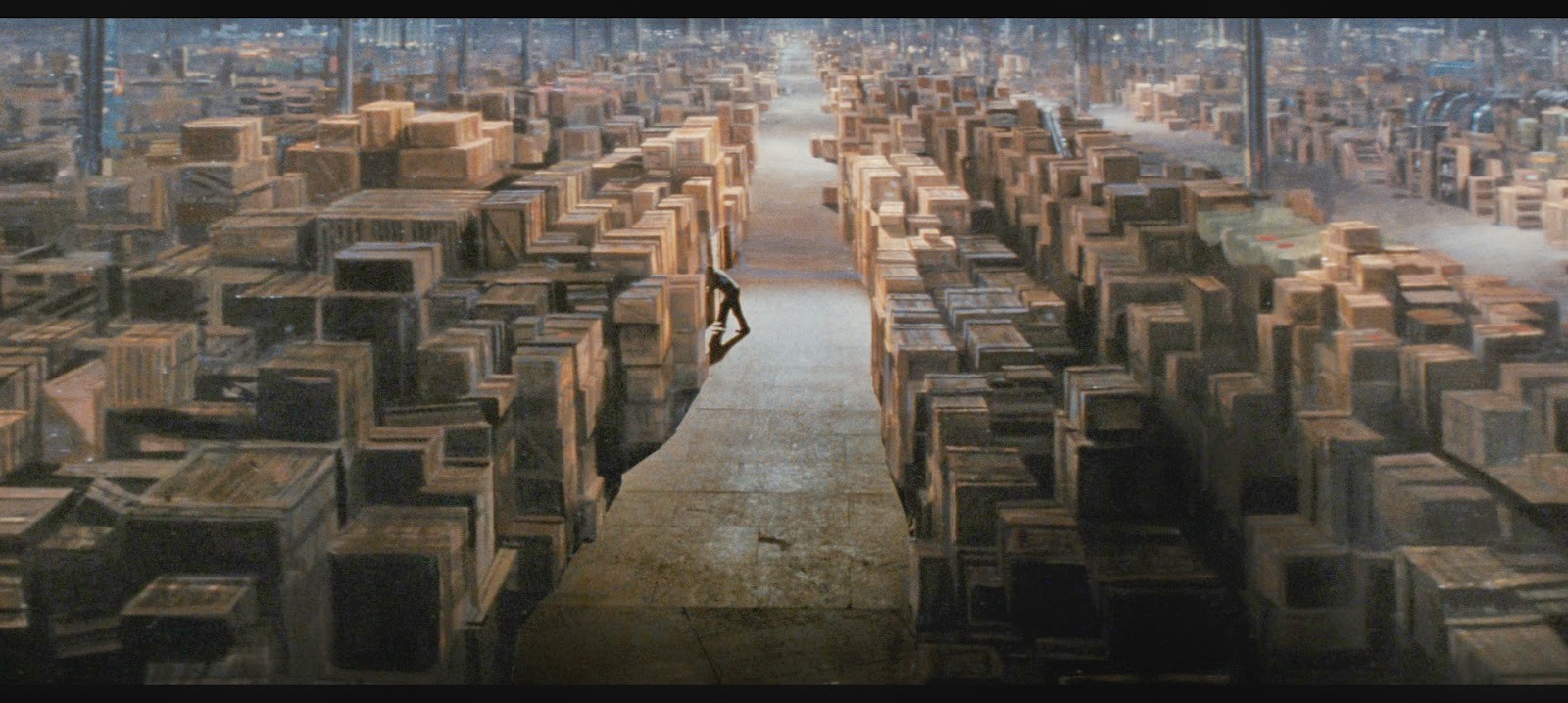
Now you’ve gone and done it. I won’t have the Indiana Jones theme out of my head all day.
Ah, the cartoon of the three women in jail..
“I’m here because I charged less than everyone else and was charged with dumping.”
“I’m here because I charged more than everyone else and was charged with price -gouging”
“I here because I charged the same as everyone else and was charged with price-collusion.”
You’re never going to win with a Socialist Govt in charge.
You have hurt the feelings of two Roosevelts at once.
Charging what the market will bear is the most efficient way to distribute suddenly-wanted items to those who need them most.
If prices are frozen at their previous “normal” levels, shelves will be bare instantly as people buy many more than they actually need because … just because that’s human nature, and because they can. If people have to wait in line, as during the gasoline shortage of decades ago, then, cumulatively, a huge amount of time is wasted. Again, people will buy more than they need because “Better safe than sorry.” And so those who truly need the product will be forced to do without. If you don’t like having the means to pay as the method of rationing, then provide monetary help to those in need.
If prices are free to rise, then new providers are given incentive. This is most obvious in cases of local disaster, such as hurricanes or widespread fires, where entrepreneurs from out of the area are motivated by price to collect and transport suddenly-scarce items into the affected area.
“First come, first served” rationing that anti-price-gouging measures enforce is the least efficient method. To support price control is to support the fastest emptying of shelves.
I was going to say this. I saw people buying six dozen rolls of paper towels because they were 7.99 a pack, the regular price and so they stocked up. Everyone who came later got zilch so you wind up with a couple of well stocked households in the community and everyone else sucks it. If those paper towels were $30 that first guy would have had to make some choices.
I mean if there was any sense in the world there would be a law where if any emergency is declared the prices of specific items are to rise automatically to create that distributive effect and also prevent resellers from running around depleting local supplies.
Why should I pay $50 for a bottle of sanitizer? Because there’s not enough to around? I mean duh?
The concept sounds fine, until the details catch up to it.
Everyone who can’t afford “it” (“it” does a lot of work here) got zilch and sucks it. Either way, somebody gets burned. It’s efficient if you can afford it but sucks if you’re cam’t.
Like Grandpa said, “Rich or poor, it’s nice to have money.”
This article is not about stores raising prices to discourage hoarding, nor people making a profit by bringing in supplies from outside the affected area. This is about a guy buying up all the local supply, raising the price dramatically, thus denying the locals much needed supplies. He is making the system more inefficient.
Walter Block, and a number of other economists, would stand up for them. I think there’s a good case to be made.
The Real Kurt
There is no viewpoint , other than the Colvin’s pure self-interest, by which the Colvin’s behavior produces any beneficial outcome. The moral justification for capitalism usually claims that people are entitled to the value they create, and a free market of buyers and sellers is the fairest way to set that value. The efficiency argument is that producers are motivated to produce by profit, and consumers are motivated to buy by need and value, and the most efficient way to calculate the intersection of these competing values is a free market. Neither theory provides a justification for the Colvins. They are like high-frequency traders – inserting themselves in a transaction, but not adding value or efficiency*. Instead, they are making the market inefficient by extracting a value that otherwise would go to the producer or consumer without providing any benefit to either the producer or consumer. The world is full of people who, motivated by pure self-interest, figure out a way to extract value from other’s transactions without providing a benefit to any other party – many of them are named Moose or Rocco. These knuckleheads may or may not have stayed on the right side of the law, but that doesn’t make then upright, honorable people. Evil may be a bit of a stretch — no-one NEEDS** hand sanitizer — but they are still parasitic. If people start dying off in numbers, though, I wouldn’t want to be in their shoes. You can’t have tragedy without blame.
*in the absence of a life-threatening pandemic, one could argue that they are more like options traders, but I think the current circumstances makes that a stretch too far.
**soap and warm water work better.
“There is no viewpoint , other than the Colvin’s pure self-interest, by which the Colvin’s behavior produces any beneficial outcome.”
“No” viewpoint? “Any” beneficial outcome? How about the viewpoint that recognizes the outcome that, by raising the price, Colvin still had inventory available for purchase to any customer willing to pay the price?
The alternative is rationing, which comes with its own transaction costs. Someone has to monitor how many each person buys, whether it’s a government agent passing out gas coupons or an extra employee standing in the Costco toilet-paper aisle. Just because it keeps the price low doesn’t mean it is “efficient.”
I don’t get the hate the Colvin brothers have received for their scheme, although I agree it’s shady and unethical. My uncle is somewhere on the prepper scale, and of course he was freaking out about the virus at the end of January back when most people were obsessing over the latest news cycle fodder; he did the same on a lesser scale over H1N1 and ebola. He bought half a lifetime’s worth of face masks and nitrile gloves online and in big box stores. He looks smart now, but he’s still never going to need all those masks and gloves, at a time when a lot of people and medical professionals are desperately hoping to buy them. He’s not selling them, but his hoarding is denying people necessary medical supplies all the same. How is it any better than the Colvin brothers selling supplies to people, albeit at a marked up price?
Likewise, richer people where I live have been driving down to the discount supermarkets in poorer areas to clear out the shelves and bulk up on basic foodstuffs; they’re not reselling it, but the hoarding means poor people can’t buy from their usual grocers, which are additionally often the most accessible by public transport. Doesn’t seem any better than the Colvins.
In a free market, prices change as the supply/demand ratio changes. In this mythical free market that we hear about from the media, Mr. Profiteer would not have had an opportunity to clear shelves because the stores would have raised prices. In a socialist managed economy, changing prices to match the supply/demand ratio is called profiteering or dumping, and it is punished. One result of this overruling of the free market by government is that supplies run out in emergencies, because people buy more than they need. In a free market, people would buy only what they need enough to pay the higher price. Mises talked about this a century ago, but they keep doing it. Why? Hayek explains it pretty well in The Road to Serfdom.
“In a free market, people would buy only what they need enough to pay the higher price.”
Lots of reasons to think this is not true, especially for goods considered essential. Suppose for example, you need product X in order to survive, and the price of product X has just risen sharply due to a sudder shortage of supply. Are you going to buy just one week’s worth trusting it to still be available next week? Or are you going to but a larger supply anticipating that, next week, either the price will be higher or the product will be unavailable?
I would buy as much as I needed enough to pay the higher price. If I thought I needed a larger supply, then I would pay the higher price to buy it. What I would not do is buy way more than I need, based on a price that is now substantially lower than the value. This is what happens in a managed market. The profiteering and hoarding that is happening now is an inevitable consequence of the price distortion caused by central planners.
Somebody should launch a new comic strip, “Colvin and Hobbes.” It could be nasty, brutish and short.
At least it would smell good and not kill anybody.
Easy answer for this issue: The boys should sell their inventory to me. I will then get 3 tax appraisal of the current FMV, and I’ll then donate it as appreciated property and take a tax deduction at FMV since I’m not in the business of selling hand sanitizer. Everyone will love me.
No. No. And No.
I’m late to the party but I’ll take a chance because nobody has said this yet.
Some facts:
Hand sanitizer is not necessary to disinfect hands or anything else. 70% ethanol works just fine. That’s 140 proof vodka, whiskey, or your distilled liquor of choice. And alcohol is only needed if soap and water are not available.
Surgical masks are useful only when worn by those who are infected. The masks at least marginally prevent spread of droplets when sneezing. They are not useful to prevent inhalation of droplets caused by somebody else’ sneeze. For that, the World Health Organization specifies NIOSH-certified N95 or equivalent respirators. Those are expensive and must be fitted and sealed correctly.
I’ve seen lots of people wearing ordinary shop or surgical masks in public. All they do is make people look weird, moreso when you see the panic in their eyes. I’ve seen exactly one person in public wearing what looked like an N95 cert mask. I have no idea whether it was properly fitted and sealed. But it looked even more weird than a surgical mask.
The run on hand sanitizers and face masks is mass panic based on pure fantasy, with a good dollop of stupidity thrown in.
If a rumor circulated that eating gummi-bears protects you from novel corona virus, and the Colvins bought up the local supply of gummi-bears, I doubt any prosecutors would risk being laughed out of court by charging them with price gouging during a declared emergency.
Hand sanitizers and surgical masks are no more necessary than gummi-bears to protect yourself, and surgical masks are no more effective than gummi-bears.
“17,700 bottles of sanitizer in their garage with no place to sell it”
It’s at least $17,700 sitting in the garage. If they sold 300 bottles $20 per two with $10 shipping, they’ve made around $4,000 from those sales. They’ve lost around $13,500.
They can return whatever they can back to the stores. They can sell the remainder on Amazon charging $10 shipping to Amazon customers. I doubt they’ve got kicked out for a $8 price tag. An equivalent of a $1 bottle of hand sanitizer from China currently costs $8-9 on Amazon and can be shipped for less than $3. Perhaps, it’s cheaper to ship from China, but, it seems, they didn’t think about the shipping cost, failed to read the Amazon policies and got too greedy asking for $70. Capitalism not being an excuse for their failure.
You asked, “Does the existence of a crisis, real or perceived, change the equation sufficiently to make normal and lawful conduct, the sale of desired goods at the price the market will bear, wrong?” Assuming that what you really meant by the phrase “the price the market will bear” was the price that someone is willing to pay, the answer is yes.
You have used those two phrases as if they were interchangeable, but there’s a big difference between “whatever someone is willing to pay” and “the price the market is willing to bear.” The market consists of all consumers within the economy, and the price the market is willing to bear is a consensus affected by many factors, some of them situational. One such situational factor is society’s attitude towards price gouging on products considered necessary to health and safety, and another is society’s attitude towards profiteering during a crisis. The unwillingness of the market to bear exorbitant pricing in those specific situations is so profound that our society has backed it up with the force of law. In this case, Mr. Colvin charged a price that someone was willing to pay, but he greatly exceeded the price the market was willing to bear, and he did so in the context of a situation in which his action had already been defined by society as being not only socially unacceptable, but unlawful.