
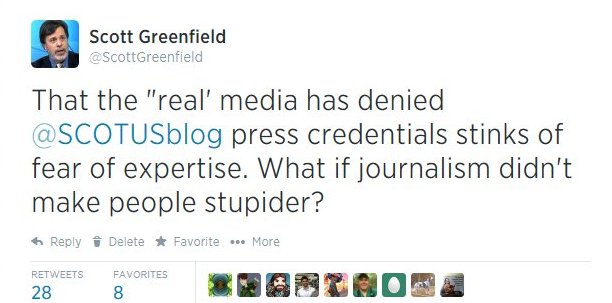
My twit, upon learning that the Standing Committee of Correspondents of the Senate Press Gallery rejected Tom Goldstein’s appeal for credentials for SCOTUSBlog summed it up.
Others have addressed the details. Eugene Volokh writes that the committee blew it, most notably in its failure to adapt its criteria to the budding reality that its definitions of worthiness for press credentials excludes those with the greatest subject matter expertise.
This essentially means that pretty much any blog on law published by lawyers (or law professors who practice in federal court on the side, pro bono or otherwise) doesn’t merit a press credential, because it’s run by people who “lobby[] the federal government” by litigating in a federal court. Likewise, a science blog published by scientists who write letters to federal agencies urging certain decisions on global warming or public health or space funding wouldn’t merit a press credential for the same reason.
But wait! The very reason many people might read these blogs is that they are published by experts who know what they’re talking about — lawyers who actually understand how the courts works, because they practice before the courts, or scientists whose opinions federal agencies might find worth considering. The expert’s day job, which makes his reporting or analysis more worth reading, ends up disqualifying the expert from a press credential.
I hasten to add that the New York Times writes editorials designed and intended to persuade elected officials to take action consistent with its editorial stance. This is far more “lobbying” than representing a client in court. But that’s different, because Times.
Josh Blackman parses the decision, and concludes that it’s technically sound:
I should stress, strenuously, that I think these policies are out-of-date, and likely an unconstitutional abridgment of the First Amendment. SCOTUSBlog should be credentialed.
With that being said, I think it is still important to consider the case, on the merits, with the rules as written. Yes, it is unfair, and perhaps unconstitutional, and SCOTUSBlog should appeal to challenge the rules. But the rules provide a basis for the denial.
Josh further interposes Tom Goldstein’s rejoinder to the committee’s rationale:
Tom writes that the Committee is denying the ability for practicing lawyers to write on blogs.
In fact, the Committee does not seem to doubt that. It does not see these rules as an obstacle, so long as every one of us now quits our jobs as practicing lawyers and commits ourselves exclusively to the same occupation as the Committee members. But so long as any of us continues to practice, we lack editorial independence. The reality, of course is that none of us – and none of the people running blogs in other fields – can afford to quit our other jobs to become full-time journalists. …
Under the Committee’s interpretation, none of that matters. Because we actually work in the field in which we write, we cannot be editorially independent about it. That seems incorrect.
This misses the point, entirely. The committee is certainly not saying that a lawyer who argues before the Supreme Court is unable to write about the Supreme Court. How many editorials or columns in the New York Times, Washington Post, Wall Street Journal, etc. are written by Walter Dellinger, Larry Tribe, Ted Olson, etc.? The problem has to do with the management of SCOTUSBlog. This fact should now be painfully obvious. Other practicing lawyers routinely write for outlets with media credentials. The difference is they are not owned and controlled by those practicing lawyers.
It appears that nobody is talking about the same thing here, perhaps because this “thing” subject to discussion is so different, yet so similar, to what we’ve long deemed media. Entities that are engaged in the business of general news distribution are deemed media, often with some flourishes that are mostly self-serving crap, such as journalistic ethics or editorial independence. It didn’t help that Tommy Supreme almost got himself a cool TV show out of the deal.
The occupation of journalism harbors a dirty little secret. One becomes a journalist by dint of getting hired by a company that produces media. Maybe the journalist writes well, or maybe he’s the scion of a media family, but if he writes for the Times, he’s a journalist. He may be utterly clueless, having no substantive knowledge of which he writes, but he will nonetheless be read by a great many people, who will believe what he says because he is clothed in the Times’ credibility. And he therefore has the power to make a great many people stupider for having read him, because they will blindly believe he must know what he’s talking about.
SCOTUSBlog offers something completely different. Actual expertise in its subject matter. The cry that Goldstein may not be independent, or may have ulterior purposes (such as marketing his Supreme Court practice) may be accurate, but irrelevant. Journalists know this, and it scares the living daylights out of them. Their refusal to let Goldstein into their self-important ranks drips with fear and loathing.
What this decision reflects isn’t an effort to maintain the high standards of journalistic independence, but the low standards of journalistic mediocrity. Bloggers who offer subject matter expertise will reveal that the big guns in the media are shooting blanks, and that’s bad for business. Never forget that journalism is a business, and if it fails as a business, what will become of all those people who spent good money on a Columbia J-School degree? We can’t have that.
Discover more from Simple Justice
Subscribe to get the latest posts sent to your email.
I heard SCOTUSblog’s press credential went to TMZ instead. Only so many to go around, you know. Real media, you know. Can’t wait until they leak the secret tape of Scalia getting fresh with Ginsburg in chambers. Ratings will be through the roof, I tell you, through the roof . . .
Cartel-like behavior by incumbent journalists? What’s new? The constitution of the Baseball Writer’s Association of America asserts it has the authority(via a “warden” with authority to work with “club-appointed monitors”) to control press box access to members, defined as writers for “daily newspapers”, local writers for The Sporting News (once the weekly print “Bible of Baseball”, now internet-only and (since 2007) some “members of internet sites”. The BBWAA is officially kind enough to “extend press box courtesies to non-members on legitimate assignment”, with apparently unbridled discretion. [As C.D. Stengel, a/k/a “The Old Perfessor” would say, you could look it up at BBWAA.com; see Constitution art. II, sec. 2(D), art. 3, sec. 4 (appointment of warden), art. 4 (membership qualifications]. While I can’t provide a definitive citation, my recollection is that the Boston BBWAA at the least stood mute and at most acquiesced when George Kimball, then writing for the weekly “alternative” Boston Phoenix, had problems obtaining Fenway Park press credentials in the 1970’s. Is the treatment by Lyle Denniston by the club in the Senate press gallery any different?
More to the point, even given that the names of Supreme Court justices come up for Senate debate once in a lifetime, why does the Clerk of the Supreme Court have to defer to the whims of a committee of members of Senate press gallery in passing out (admittedly limited) seats for journalists at oral argument or on opinion days? Isn’t the Court supposed to be an independent, co-equal branch of government authorized to make its own decisions (it sure says so when questions of placing television cameras at Supreme Court arguments are raised). Answers to this question appear to be outside my pay grade.
Talking Points Memo provides a bit more information about the rules and the logic behind them. It still sounds like they were applied with the goal of blocking accreditation.
[Ed. Note: Link deleted. Why make me do this?]
Journalists are experts in their own field. Journalism isn’t simply a matter of how well you write, but also includes such things as ethics. If you accept the fact that only a lawyer who has passed the bar can represent somebody in court, then you must also accept that fact that somebody without journalistic training cannot represent the public when reporting on the court.
With that said, journalists often suck. I’m just saying, in theory, they are experts in their craft.
Your analogy is less than analogous. “Journalists” need not be trained in journalism; they can be theoretical physicists who got a job working for a media company. They need not have a license or pass an exam. They need not have a degree. Journalistic ethics are an accumulated body of knowledge, but they are not “sworn” to uphold them. Violation of these ethics doesn’t result in the loss of a license or prohibition against writing again for another media company.
No, they are not experts in their “own field.” They are employed in the field. Anything beyond that reflects on the individual and company, but not on the occupation itself.
License, exams, and oaths are really more the definition of “profession” rather than “expertise”. I’ve done none of these, yet I’m an expert in my field. I’m pretty sure physicists don’t sign an agreement “I won’t build a doomsday device” before being admitted as an expert.
Even if a newspaper hires somebody with no training, they still have editors and such that control the output. News articles are the combined effort of an organization, not an individual, at least in theory.
At least, this is all the theory. I think the Internet has destroyed that commitment to quality, where most journalists these days are no better than bloggers (on average), and of course, exceptional bloggers being worth a lot more than average journalists.
Hey, you raised journalistic ethics as a qualifier. Don’t blame me for dealing with it.
One is an expert because they’ve earned expertise, not because they have happen to have a job in a given field. Except, of course, to journalists, who tend to call every source they use an expert, no matter little expertise they have. Ironic, no? And don’t put too much credence in editorial review. It’s not all it’s cracked up to be, and certainly hasn’t prevented a never-ending stream of mediocrity and imprecision, if not outright stupidity.