Monthly Archives: May 2009

Suck Face

Adrian Dayton explains the Slackoisie aversion to being forced to show up for work.  Adrian has become the rational voice of his generation. He’s still wrong, of course, but he gets a “B” for his efforts.  He could bring that up to an “A” if he makes sure his quotes are accurate.


Face time. It’s really just about control, isn’t it? Even if there isn’t work to be done, the boss demands that you be there, sitting at your desk, watching the minutes of your life tick away. The boss is paying you, and therefore believes he deserves you until late. How late? Late enough to prove your commitment to the company. Work Saturdays? You bet, at least half a day. Note to employers: this rubs Generation Y the wrong way.
The source of Adrian’s confusion is a definitional problem.  He sees the act of physically appearing at one’s place of work as a voluntary matter, subject to the employee’s agreement that a physical appearance is worthy and necessary.  What he calls “face time” is what others might call fulfilling the expectations of the guy who signs your paycheck.  The Slackoisie believe that they are entitled to “mail it in” when they don’t deem an appearance worthy.


I think that is the disconnect. Generation Y wants their life to mean something. They want to handle work that is significant, and they certainly don’t want to crank out the billable hours reviewing non-urgent documents on a Saturday afternoon just to line the pockets of the otherwise wealthy partners.

 The attitude in years past to this sort of brazen attitude by young lawyers would have been, “tough sh**, deal with it.” Bosses, you should realize you could get away with that in the past, but I am going to let you in on a little secret.


WE AREN’T AFRAID OF YOU ANYMORE


Brazen indeed, but in defiance of the basic premise of law firm economics.  Contrary to Adrian’s understanding, law firms do not exist to provide jobs for young lawyers.  They exist to provide legal services to clients.  They hire associates in order to perform some of the work needed to provide these services, subject to the overview and approval of the partners of the firm.  In the course of billing out the services of the employees, the partners seek to recover not just the salaries paid to these fine young men and women, but the fixed and variable costs associated with the provision of services.

Then comes the “line the pockets of the otherwise wealthy partners” issue.  The wealthy partners are the owners of the law firm.  Owners are, in a capitalist society, entitled to make money off their business.  How much money is none of the employees business.  The owners do not need their employees approval to become wealthy.  It’s just not part of the deal.

If the partners do not earn a premium on their associates time, so that they “line the[ir] pockets,” then there is little purpose to taking on the additional work that clients bring to the firm.  Law firms are not charities for their clients.  Did you think otherwise?  The partners take on new work for the purpose of increasing the profitability of the firm for the benefit of the owners of the firm.  The owners, you may recall Adrian, are the partners, not the associates. 

So each associate, if a firm is properly managed, should be a profit center for the partners.  If an associate is not a profit center, then there is no reason to employ him.  After all, it’s not nearly as much fun managing whiny, questioning, demanding, complaining associates as you think.  They are tolerated because they bring additional profit to the firm.  Not because they are good looking.  Well, for the most part, anyway.  There are exceptions, though this is probably very wrong.

As for fear, which you emphasize through the use of all-caps and bold face type, I’m not sure what you mean.  Slavery is no longer permitted in the United States.  No one, even the wealthiest partner at a law firm, can force you to do something you don’t want to do.  You have nothing to be afraid of.  Of course, you can always be fired, as you have no right to a job or paycheck if you refuse to follow the directions of your employer. 


We can start our own firm, build our own company, or go work for someone that knows how to motivate us. We are the largest demographic since the boomers, and you raised us to fear nothing, and for that we thank you. Learn to live with us, or learn to live without us- either way, once you are long gone or retired, we will run this country.
It’s not quite that simple.  If you think hanging out a shingle is all it takes to make people throw money at you while enjoying life on your own terms, most of you are in for a shock.  It takes more, not less, time and effort to run a successful law practice.  There’s no guarantee that clients will flock to you, no matter how hard you puff yourselves on your website or blog or how many SEO words find their way into your every post.

Worse still, even if you get a client, your then stuck with actually having to represent that client.  Oh My God!  What do I do now!

When your client calls you in the middle of the night, will you tell them to go away?  When your client demands to see you at the very moment you planned to have dinner with your girlfriend, will you tell him to get lost?  When there is a do-or-die court appearance in the morning and you have just completed a night of serious partying with your BFFs, will you show up?

We can all understand how much more pleasant life would be if we could just work in our pajamas and bathrobe from home whenever spare time allowed.  It’s not that we don’t get it.  But when we took the responsibility of representing our clients, plus feeding our beautiful children who demand to eat day after day, we realized that we cannot have everything the way we want.  It’s time for the Slackoisie to come to that realization as well.  We’re sorry that it’s not turning out to be nearly as convenient as you hoped, but that’s the best we can do.

With A Side of Spam

Over the past two weeks, I’ve deleted literally hundreds of spam comments here.  This is in addition to the ones I normally delete, from those who want to use the comments here as their soapbox or to expose their own blogs or posts to a different audience.  There are some very tenacious people posting comments that they hope will see the light of day, one particular commenter who was responsible for nearly 300 spam comments in the past week.

It’s not going to happen.  As much of a waste of my time as it may be, I will not allow the comments section to become your billboard, no matter how nice your comments may be (they are usually along the lines of, “great post . . .”) or how devious your challenge (“I will consider being a regular reader if you respect my point of view”). 

Amongst my many peculiarities is that I have not shown much concern over whether any particular reader loves or hates what I write here.  Nor have I cared a whit whether a reader shares my sensibilities on a particular issue; I’ve been as quick to delete a rant against the death penalty as one that ultimately proposes the efficacy of a drug to correct penile dysfunction.  I realize that commenters often find my rules hard to understand, seeing their comments are both informative and interesting when I see them as tangential and self-promotional.  The rule is:  My blog, my rules.  They aren’t subject to democratic approval.  I know this because I control the delete button and you don’t.

Deleting a few hundred purely spam comments is not merely a pain in the butt, but a waste of time.  Having a blawg isn’t nearly as glamorous as many think.  It requires that I keep an eye on things, as they can spin out of control quite quickly at times, particularly when a post draws a bunch of day-trippers who are unfamiliar with SJ, my rules, my prickly ways, my snarkiness and the limits of my tolerance.  Most of these comments I allow, even though I find them unbearably assumptive, a typical trait of many younger readers.  It’s a fault of the Slackoisie, the characterization they deny vehemently, who mistakenly project their shallowness and egocentricity on me because, well, that’s what the Slackoisie do.

I recently saw a comment about me on another blawg that struck me as interesting.  The comment, clearly by a new lawyer, said that I was a “decent” blawger, except when I went on an off topic rant.  I would be fine, the commenter said, if I stuck to criminal law.  This falls into the pigeonhole of readers who believe that my purpose here is to please them and provide posts that suit their interests.  Readers of this ilk can bite me.  Simple Justice is about whatever I decide it’s about, and until you pay for the privilege, you get no say in what that might be.  I’m not courting your approval, and you can stop reading at any time.

On Twitter, I am now at about 500 followers.  Some are young women with webcams showing them engaged in sex acts.  Why they follow me is unclear.  I doubt they are interested in much of anything I say or write about.  I have no plans to watch their webcams.  I also have many followers who are “consultants”, all of whom are “available for speaking engagements.”  They may or may not be interested in something I write about, but I am unlikely to consult with them, and I have no speaking engagements for them at all. 

One young lawyer wanted to engage me in a twittering discussion of my posts here.  I suggested he post his thoughts in a comment, as I won’t discuss my posts in twits, to which he took offense.  He complained that I was telling him what not to twit, and that nobody, but nobody, told him what not to twit.  I was telling him that I wasn’t going to engage in a twittering discussion.  He can twit whatever he wants.  I’ll just ignore it.  And I do.  It’s really easy to ignore people on Twitter.

There are lists of “must-read” blogs and “must-follow” twitterers.  I don’t think I’ve made either.  They are mostly put together by those with a marketing-bent, both as a promotional tool and a means of capturing attention.  Blawgers and twitterers have a obsessive thing about lists which eludes me.  When they make a “top 10” list put out by the Chopped Liver Association of America, they will promote themselves shamelessly for having been so honored. 

The more I think about it, the more I understand why I’ve been deluged with spam comment lately.  They aren’t necessarily different in kind from much of the flotsam and jetsam that finds its way onto the blogosphere or twittersphere, but merely more unabashed about it.  Being an unapologetic capitalist, I can appreciate the tenacity of someone who would make 300 tries to post a commercial comment on Simple Justice.  In fact, I can better appreciate that than the kids who argue that they truly deserve to have the world revolve around them.  I may rethink my definition of spam.

A “Wise Latina” Herring

Most of believe that our life experiences run the gamut, enabling and entitling us to believe that we understand the full spectrum of experiences.  We are, of course, delusional.

Our experiences are ours.  Not being a “wise Latina,” the experiences of a wise Latina would not be mine.  Nor the experiences of a black man.  Not even an Italian man.  But I do have the experiences of a Jewish man.  The problem is that my experience as a Jewish man is likely to be different than Joel Rosenberg’s, also a Jewish man, but far better armed.

The latest blawg rage is discussion of a statement by Sonia Sotomayor, which made the New York Times’ editorial page today.


The talking point conservatives pushed hardest last week — to the alarm finally of some Republican senators — was a 2001 speech in which Judge Sotomayor said she hoped a “wise Latina woman with the richness of her experiences would more often than not reach a better conclusion than a white male who hasn’t lived that life.”

The context matters: she was pointing out that throughout history even esteemed white male justices like Oliver Wendell Holmes voted to uphold race and sex discrimination. She said accidents of birth inform people’s views, but judges must strive to look beyond them.

The Times pointed out similar expressions by Justices Alito and Thomas in their confirmation hearings.  This makes two points that are very important, and should take the wind out of the both sides of the discussion.  Each brings experiences that others, who don’t share their ethnicity, race or color, won’t have in their bag of tricks. 

None of these Supreme Court Justices or nominee, on the other hand, is the exclusive source of experience for their ethnicity, race or color.  None speaks for all Italians, all blacks or all wise Latinas.  Even more to the point, none reflects the median experience of their identified groups.  If you were hoping that a black judge, any black judge, would sit on the court to be the root source, the go-to guy, for black issues, you are likely disappointed by Justice Thomas.  He is not the poster boy. 

Sonia Sotomayor went to Princeton and Yale Law School.  Not the norm for Latinas, I’m afraid.  She was a prosecutor.  Also not the norm.  She never succumbs to life on the street in the Bronx.  Not the norm.  The mere fact that she is Hispanic from the Bronx will confuse many who believe that she must, by virtue of her experience, understand what life is like for Hispanics from the Bronx.  I suggest that anyone who thinks that she brings that perspective to the table will be as disappointed in Sotomayor as others are in Thomas.  These individuals are the exceptions. 

If you want someone who understands the experience of a Hispanic in the Bronx, I would be a better choice than Sonia Sotomayor.  Not because my life experience is that of a “wise Latina,” which it obviously is not, but because I’ve spent the past quarter century with Hispanics from the Bronx and gotten to know some quite well.  I’ve listened to them tell me what life is like for them, how they are treated by the cops, what they think and believe, for better or worse.  I may not always agree with their view of life, but I can appreciate why they do certain things based upon their life experiences.  I can say with certainty that the life experiences of many of the Hispanics I’ve known will not be shared by Judge Sotomayor. 

We want to believe that merely by being a Latina from the Bronx that she gets it.  Lord knows the Supremes, particularly after the decisions in Montejo and Ventris, could use someone who has a clue how things really happen outside of the marble hallways.  But to assume that one’s race and ethnicity are enough to assume an understanding and shared range of experience would be a mistake.  Judge Sotomayor was an SDNY and 2d Circuit judge.  That’s not the typical experience of Hispanics from the Bronx.  And to anyone who has spent much time in that courthouse, the vision of Judge Sotomayor strolling the Grand Concourse in search of amigas and cervesas, no less diablita, is ludicrous.  That’s not her experience.

I know that I suggested that there isn’t really much to discuss about Judge Sotomayor’s nomination, so I apologize for doing so anyway.  But this is less about Judge Sotomayor than it is about those who are busily ruminating on the subject of her nomination, both for and against, writing furiously about every detail of her life that comes up from one side or the other.  This discussion is all in the abstract, replete with assumptions being made by people for whom the real Judge Sonia Sotomayor isn’t part of their life experience.  That doesn’t seem to stop them.  It doesn’t even slow them down.

The other day in court, a friend of mine whose practice is primarily before the 2d Circuit told me how hard he’s been laughing about all the Sotomayor commentary.  He’s also been crying, because he knows that Judge Sotomayor is not even close to being the liberal judge we keep hearing about from those who oppose her.  The irony, he notes, is that if they had a clue what they were talking about, the conservatives should be applauding the nomination and rushing it through before the liberals figured out how off-target their assumptions are.  When it comes to criminal cases, personal freedom and civil rights, Judge Sotomayor is not exactly empathetic. 

Indeed, if one really wanted to understand why such a stink is being made of Ricci v. DeStefano, one need only look at who represented the plaintiff in the case to realize that it was a wacky radical neo-conservative loud-mouthed lawyer with deep connections in the uber-conservative movement who has a personal grudge against her and has no doubt planned for the past year to rally the fellow-travelers against her nomination.  It’s not like it hasn’t been expected.  Aside from that, the per curiam circuit ruling was your basic deference decision, which would hardly be worth a second look.

If you are amongst those who are hoping for someone on the Supreme Court to reflect the experience of a wise Latina, or deathly afraid of it, don’t be too sure that Judge Sonia Sotomayor is the one to watch.  Maybe if she was characterized as the “wise Latina” who was raised in the Bronx and then went to Princeton and Yale Law School, then became a prosecutor, and later sat on the SDNY bench until elevated to the 2d Circuit, people would have a better idea of who they were talking about.  But even that doesn’t properly cover it.

Why We’ll Never Know

Police Officer Andrew P. Dunton will never be the same.  In an instant, a black man with a gun turned after Dunton yelled “police, drop the gun.”  Did he yell that?  Did Omar Edwards turn? Could Dunton have done something differently so that Police Officer Edwards wouldn’t be dead by his six shots? 

The story is everywhere, Whether the true story will ever be known is another matter.  The fact is that in a flash, two decisions were made on dark street in Harlem, one by each officer.  One of the decisions was wrong, but which one will depend on who you talk to.  Under the circumstances, the stories could all be true, as far as the witnesses to the event are concerned.  It’s almost impossible when shots ring out unexpectedly in the night to get the details straight.  The mind plays games to make sense out of situations that make no sense.

One television news report noted that the New York Police Department patrol guide has a policy to deal with this situation.  The police provides that the burden is on the off-duty officer to stand motionless and not turn when he hears the on-duty cop yell “police”.  It’s a policy that makes perfect sense, since the on-duty cop has no idea that the guy with the gun is a cop as well.  The problem is that it defies human nature. 

The off-duty cop, in this case Edwards, is pumped with adrenaline chasing the perp.  His focus is on getting the guy in front of him.  Suddenly, from behind him, he hears something that his brain tells him he ought to pay attention to.  But his mind wasn’t on the unanticipated shout from behind, but the guy in front.  It doesn’t quite register.  He hears it, but doesn’t really hear it.  It takes a moment to process.  So he turns . . .

Officer Dunton sees an unidentified man with gun running down a dark street.  He yells “police, drop your gun.”  What else can he yell (ignoring minor variations on the theme)?  The man with the gun turns toward him.  Maybe a full turn.  Maybe just a partial turn.  But any turn puts the aim of that gun closer to his heart.  He need not wait for the muzzle flash to decide what to do.  He fires six rounds at the gun pointed toward him.

It’s a conundrum.  We won’t know what Dunton actually yelled.  We won’t know what Edwards actually heard.  We won’t know what role, if any, the fact that Edwards was black played in Dunton’s decision.  At this point, everyone is playing catch-up, trying to piece things together in a way that causes the least exacerbation of the damage.  But none of it resolves the basic conundrum.  The policy sounds right, but doesn’t work.  Policy doesn’t supplant human experience.  Policy doesn’t trump human nature.

None of the post-hoc efforts to sort out this disaster strike me as credible.  The fix is always in when a disaster happens and it turns out that the dead body is a cop.  When it’s not a cop, they check his rap sheet so they can demean the dead man because of his priors.  That way, the public is informed that his death at the hand of a cop is no big deal.  He was a worthless criminal anyway.  That doesn’t work when the dead man is a cop.

But the needless death of a cop is no more, nor less, tragic than the death of any other human being.  And so we share in the grief of Officer Omar Edwards death as we do with any other person who was killed by mistake.  It’s unfortunate that the need to make it appear that no fault can be levied will cause us to gloss over the problems that gave rise to this tragic mistake.  It’s happened before and it will happen again, until someone figures out a better way to address a black man with a gun on the streets of Harlem.

Nino’s “Things That Rarely Happen”

In both the  Montejo and Ventris decisions, one of the substantive foundational explanations offered for overruling Michigan v. Jackson was, as Justice Antonin Scalia stated, that there would be “few if any” confessions resulting from post-appointment of counsel badgering by police.  Now I’m a fan of Nino’s as much as any criminal defense lawyer.  Heck, more than most.  But he doesn’t have a clue how life works on the street.

It didn’t take long for the Texas Tornado, Mark Bennett, to make the point, taking his cue from Dallas’ favorite son, Robert Guest.  From the Texas prosecutor website, some helpful internal ethics advice:

From Lisa Tanner:


So here is a question that’s come up among lawyers and officers from other states on a listserve I’m on.

Near as I can tell, it looks like SCOTUS has said that the police can initiate contact with and take a run at talking to a suspect/defendant, even if he is represented by counsel, so long as he clearly and unequivocally waives his right to silence and counsel. Right?

I, probably like everyone else on this board, get asked pretty regularly by officers to weigh in on whether they can take a run at interviewing a suspect/defendant. And if the guy is known to be represented, the standard answer is, of course, that he’s absolutely off limits (unless he should happen to initiate the contact himself, but that’s a whole ‘nuther issue). Now, under Jackson, it seems that the standard answer must change.

But, here’s where it seems to get tricky:

Disciplinary Rule 4.02 says that we cannot communicate or cause or encourage another to communicate with a person we know to be represented by counsel about the subject of that representation unless it is consented to by the representing lawyer or is “authorized by law”….

So how does that factor in? It seems to me that if we advise an officer that it’s now ok to take that run at that suspect that we know is represented, we might just be running afoul of 4.02, or does the “authorized by law” language kick in and permit it?

So if an officer approaches us for advise, would our safest bet just be to tell them that we cannot advise them what to do but direct them to Jackson?  Calling Chip, the Ethics Guru!


Back at ya:


JB
Member
posted

05-29-09


With the change by SCOTUS, the contact is now authorized by law. The constitution and SCOTUS opions are certainly the law, even in Texas.


Posts: 5924  | From: Williamson County, Texas | Registered: 01-25-01


Lisa Tanner
Member
posted

05-29-09 


That was my thought too, but I figured I’d throw it out there — there’s a fairly high degree of concern about it amongst the other discussion group.


Posts: 244  | Registered: 10-24-02


JB
Member
posted

05-29-09 


Ahh, they are just disappointed.


Posts: 5924  | From: Williamson County, Texas | Registered: 01-25-01

The interpretation of Montejo amongst these prosecutors is that representation no longer plays a role in the determination of whether the cops can interrogate a defendant with a lawyer, whether requested, assigned, retained or otherwise.  Their read is that they can go back to the interrogation well at their leisure until a defendant clearly and unequivocably invokes the right to refuse to speak with cops without an attorney present. 

It took the cops what, maybe 30 seconds, to figure out how to make good use of Nino’s “few if any” opportunities?  Does this mean that Nino doesn’t get out enough, or Nino knows exactly what he’s doing by sending the message to the troops in the streets about how to get confessions when the going gets tough.  Who would be so cynical as to think that?

And as long as we’re talking about Nino’s cluelessness, the only fault that he sees is police “badgering” represented defendants into confessions.  What about lying to them?  What about using finely honed psychological techniques to deceive them into talking?  What about negotiating backroom deals with defendants who don’t realize that it can’t happen that way?  Do these things not happen in Nino’s world?  They surely happen in ours.

It must be nice to rule from the sanitized world of Washington, where bad things are never done by cops on a mission.  But while the Supremes prestend that this isn’t an issue, cops and prosecutors are busily figuring out how to game the situation under Nino’s new rules of engagement.  That didn’t take long.

Everyone Screwed Up, But Only McNair Is Executed

One of the most perversely bizarre stories I’ve seen, culminating in the execution of Willie McNair, this is an example of how the levels of failures resulted in the execution of one man.  It’s stories like this that make me disgusted by those whose biggest complaint about the law is that they don’t get enough “me” time. 

Willie McNair was executed last week after courts refused to review the trial judge’s decision to sentence him to death even though the jury decided he should be sentenced to life imprisonment without parole.

McNair was convicted after his first trial based on “illegal evidence, inflammatory comments, and name-calling,” bad enough that even an Alabama appeals court reversed the conviction and sent it back for retrial. 


At the second and final sentencing, the jury returned a verdict of life imprisonment without possibility of parole. The trial judge, without explanation, rejected the jury’s verdict and sentenced Mr. McNair to death.


Alabama, apparently, is the only state in the nation where a judge can reject the jury’s sentencing decision and order execution on his own. 


In 2004, the United States District Court for the Middle District of Alabama found that Mr. McNair’s death sentence was unconstitutional because his trial lawyers – who knew what had happened at the first trial – nonetheless failed at the second trial to present crucial information that would have explained the crime and persuaded the judge to follow the jury’s life verdict.

The problem here was that McNair’s indigent defenders were limited to $1,000 for out-of-court work, and claimed they couldn’t manage to do the work needed within the budget.  This is clearly a two-part failure, from the state’s ridiculous low limit for out-of-court work in a death case to the defense lawyers absolute failure to provide effective assistance, compensation notwithstanding.  So the criminal defense lawyers were prepared to let a man die because they weren’t paid enough?  Don’t get me started.


People who had known Willie McNair his whole life testified that such behavior was highly out of character for him and that he was held in extremely high esteem in his community. Expert witnesses explained that this offense would not have happened but for Mr. McNair’s tragic and severe substance addiction.


The federal court found that Mr. McNair’s lawyers failed to fulfill their constitutional duty to represent him effectively, and vacated his death sentence.

One of the primary mitigating factors in a death case is aberrant behavior.  But of course, if you don’t present the mitigating factors, then it doesn’t exist.  Well done, fellows.  Are you proud of yourselves?

But the district court’s decision was reversed on appeal, not because it was inherently wrong, but based upon the procedural flaw of presenting evidence at the hearing that was neither new nor unavailable at the trial.  It’s unclear why this wasn’t permitted as evidence of ineffective assistance, rather than in mitigation of the sentence, but it was rejected nonetheless.


That ruling was reversed by a federal appeals court on procedural grounds. The appeals court did not disagree with the findings about the poor quality of Mr. McNair’s legal representation, but held that the federal trial court should not have allowed additional evidence to be presented in federal court.
McNair sought leave to appeal to both the Alabama Supreme Court and the United States Supreme Court.  Both turned him away.  On May 14, 2009, Willie McNair was put to death by lethal injection.

And this is really the best system there is?  Tell it to Willie McNair.

H/T Lee Stonum

Officer Simoes Never Meant to Hurt Her (Update)

Having followed the trial of Yonkers Police Officer Wayne Simoes in the Southern District of New York, it would be wrong to leave you hanging.  The jury returned.  Was justice done?

Interest was peaked in the case when Simoes, accused of body slamming Irma Marquez after a bar fight involving her niece, ended up on the wrong side of the thin blue line.  The trial started with fellow officer John Liberatore testifying that, contrary to Simoes claim that he accidentally dropped Marquez, body slammed her to the group, causing her substantial injury.

Of course, it didn’t help that Liberatore didn’t find religion until the video tape of the conduct came out.  Before that, he saw nothing.

Then, the defense called an expert to deconstruct the video via a frame by frame parsing which, in the opinion of the expert, proved that Simoes didn’t body slam her on the ground, as it clearly appeared in the video, but merely dropped her when he slipped.  Unintentionally, of course.

The defense’s videotape expert had been precluded, after an in limine motion, from answering the ultimate question for the jury, but the question was asked anyway.  And the prosecution neglected to object.  “It came out of the blue,” the prosecutor explained.  The judge nonetheless struck the testimony afterward, and no doubt the jury forgot all about it since the jury does whatever the judge says.  Always. 

As all trials do, this one came to an end.  From LoHud, the outcome:


The jury of eight men and four women deliberated for a little more than five hours yesterday in U.S. District Court in White Plains before finding Simoes not guilty yesterday of the lone charge against him, violating the civil rights of Marquez.

“We watched the video and we watched the frame-by-frame,” Jhonna Van Dunk said, “and we could not determine that he intended to hurt her.”
While an acquittal is usually a cause for celebration, showing that not every arrest demands a conclusion of guilt, and that our system of trial by jury remains vital, I again find myself posting about an acquittal involving a cop.  Not merely the acquittal of a cop, but one where there was a videotape showing, as conclusively as one could dream possible, what happened.  And still, the officer was acquitted.

Don’t blame Wayne Simoes for the acquittal.  No one, cop included, wants to be convicted, and no one can blame a defendant for fighting the charges.  Certainly his lawyer, Andrew Quinn, did his job well.  But if you want someone to blame, blame ourselves.  Blame the fact that we can see a video of a cop body slamming a woman to the ground and still give the cop the benefit of the doubt. 

In New York, the jury is instructed that a person intends the natural consequences of his act.  Slam a woman to the ground and one intends to cause her harm.  If not, then don’t body slam her.  It’s not a difficult instruction, nor conclusion to reach.  Except when the slammer is a cop. 

Wayne Simoes is not guilty of the charges against him.  That’s how the system works.  But if you’re not a cop, I wouldn’t try to copy Simoes, because it doesn’t seem the system works the same for others.  And it will continue that way for as long as we can’t seem to get it into our heads that police officers, like anyone else, sometimes do harm.  And when they do, they should be subject to the same “benefit of the doubt” as anyone else, for better or worse.

Update:  In case you were wondering what an accident by Wayne Simoes looks like, here a photo of Irma Marquez, courtesy of BlackListedNews via Karl Mansour. 

Imagine what she would have look like if he meant to hurt here.

Oh, That Memo

I’ve been meaning to post about this since Jdog first twitted about it, but there was a hole in my racket, the sun was in my eyes, the dog ate my homework.  Okay, I just didn’t get around to it.  But it’s too important to ignore, so I’m back to it now.

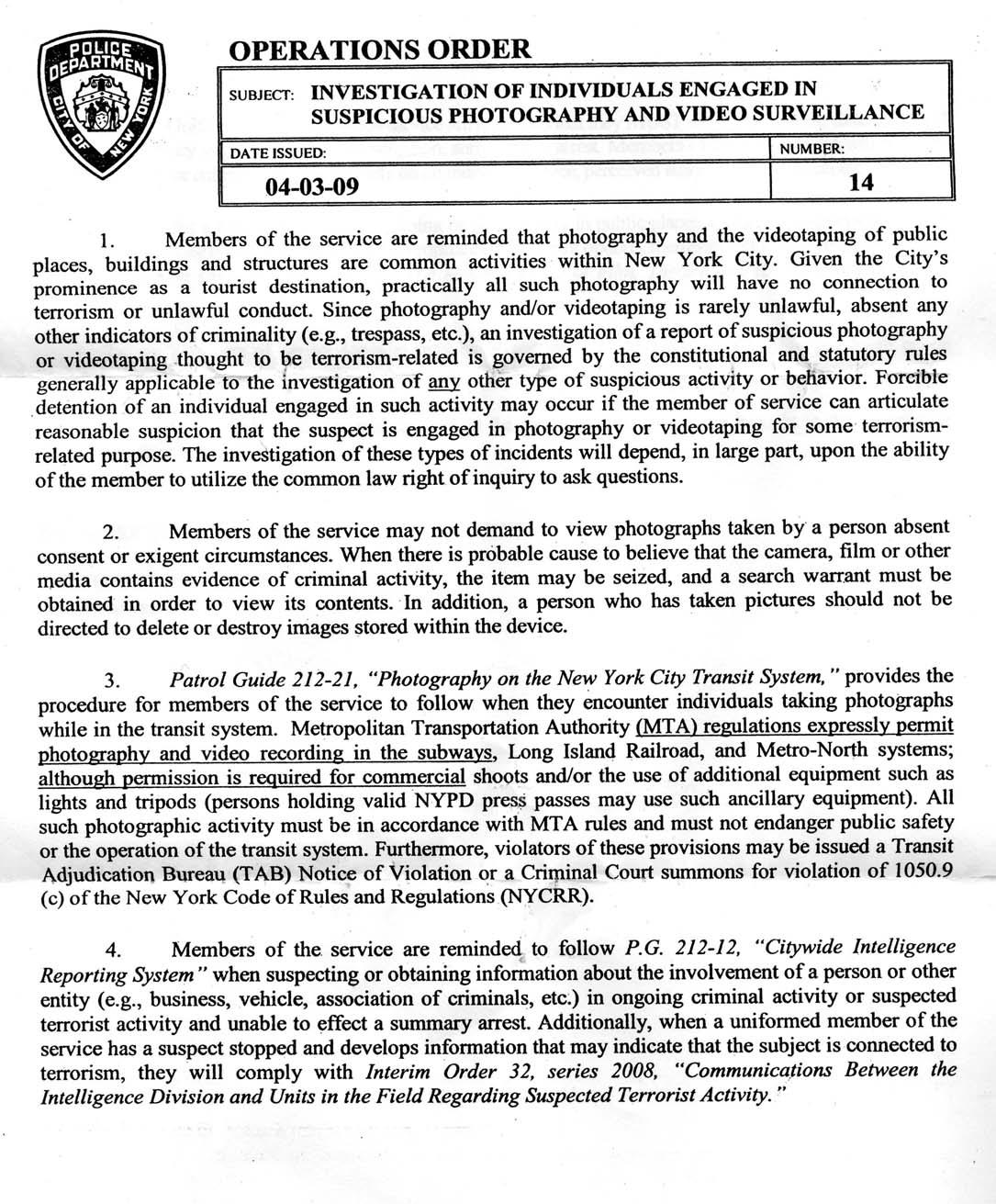
From the Northern Muckraker via Boing Boing, somebody let slip an internal police memo from the New York Police Department.  For those who may not know, New York City has a police force with more officers than most cities have residents.  They have a cute nickname, New York’s Finest.  They considered calling themselves New York’s Brightest, but were unable to find anyone amongst that very large group of officers who would go along. 

Just to be clear, there are many police officers who are well educated, smart and dedicated, in the service of the City of New York.  There are a whole lot more, however, who make rocks look brilliant.  The standards have slipped a bit over the years, much to the consternation of the more intelligent officers, who are now forced to do send out things like this :


We await next month’s Memo, Investigation of Individuals Engaged in Suspicious Winking.  I know, it makes me proud to be a New Yorker too.

Anyone Can; Everyone Shouldn’t

I was never much of a fan of inspirational posters.  I can remember that ubiquitous poster of a kitty cat hanging on a tree limb, with the words, “Hang in there, baby.  Friday’s coming,” in almost every woman’s dorm room at college.  I was also never much of a fan of cats. 

While the old poster is a cheesy reminder of the past, inspirational posts live on.  A particularly inspiring one comes from Susan Cartier Leibel, at her recently moved blog, http://buildasolopractice.solopracticeuniversity.com/2009/05/26/stop-telling-me-what-i-cant-do/.


As new lawyers, we are told over and over again that “we can’t” open our own practice right out of law school. Like my fourth grade teacher, these naysayers in the form of professors, career counselors, other lawyers, judges and family members are just projecting their fears upon you, maybe the very same fears that stopped them from venturing out on their own and pursuing their dreams. Find out why they are so fearful of you, so you can address the obstacles to the success they perceive to be insurmountable, one hurdle at a time.

You can open your own legal practice. Some perceived hurdles might present challenges you’re not willing to take on. That, however, is very different than saying, “I can’t.” If you’re just not willing to make those hard choices, that’s perfectly alright. But you absolutely can open your own law practice if you want to.
She’s right.  You can.  Anyone can open their own solo practice right out of law school.  While there are a number of things you might want, there are really very few things you absolutely need.  A telephone and a computer will largely cover it, provided you aren’t living out of a car.  Maybe a pen, but you can usually find one lying around the courtroom and nab it when no one is looking.

There is one more thing you’re going to need.  Clients.  You will need to find people who are willing to pay you for your services.  It’s not the easiest thing to do, but it too can be done.  There are plenty of people happy to show you, the newly-minted lawyer, how to sell yourself as the best thing since sliced bread to the public.  For a small fee.  If they can get a few people with cash to call your telephone number, then you’re in business.

Almost.  There is still one dilemma.  What do you know about actually representing a client?  Maybe you can find your way to the courthouse with Mapquest, but do you know what to do once you get there?  Some of you may have an idea, having either clerked your way to prosperity or paid attention in a law school clinic.  It’s a start.  Others wouldn’t know a notice of motion if it bit them on the butt.  Of course, this doesn’t stop you from putting up a fetching website extolling your virtues, but it does present a dilemma when it comes to earning the money that those nice people want to throw at you.

There is a gap in Susan’s otherwise very inspiration post.  It’s only focus is on your will to take a chance.  But the chance you are really taking is with some other person’s life.  There’s nothing in there about the damage you could do to someone if you take on a case that you’re not yet equipped to handle.  You get paid.  They get screwed.  Is that okay with you?

Not to nitpick, but there is one “threat” posed by Susan with which I take issue.  The naysayers aren’t fearful of you.  As full of yourselves as you may be, you don’t pose a threat to us.  We are, however, fearful of the potential for harm you can do to others and to the profession.  Once you’ve got your ticket, you are a lawyer.  You are entitled to hold yourself out as a lawyer, to offer your services as a lawyer, to stand up in court as a lawyer.  But you are also expected to recognize your limitations as a lawyer.  This is why there are a bunch of ethical considerations and disciplinary rules that apply to what you do going forward. 

For the worst arguers in the bunch, the retort is that there are lawyers who have practiced for years who are utterly incompetent.  Very true.  Very unfortunate.  Very problematic.  Perhaps even more so than you going into private practice when you haven’t a clue.  But two wrongs don’t make a right.  You are responsible for yourself, and the fact that some other lawyer is an incompetent fool doesn’t make you a competent lawyer.

In tough times for those beginning their legal career, the lure of hanging out a shingle may well prove to color the vision of young lawyers to the extent that they care only about their own circumstances.  Loans to pay off.  Mouths to feed.  Years of lost opportunity to catch up on. Business school friends making fun of your clothing.  Maybe a BMW.  Whatever.  It’s hard to turn down the opportunity when a few hours and a cheesy website can turn you into the greatest lawyer ever.

But you need to ask yourselves whether you, if you were in trouble, would want you to be the person standing beside you.  Somebody cares about that client who called, and they will entrust you with their loved one.  Are you really prepared to take on that trust?  Are you really?

Some will be able to represent clients right out of the box, at least with a little help and support.  Most will not.  With a little experience and a lot of effort, most will be capable of fulfilling their role as lawyer and performing adequately to take on the representation of human beings.  There’s no shame in falling into the latter category; indeed, there’s honor in respecting the solemnity of your duty to be competent. 

Don’t feel badly if you’re not one of the very few who should open your own practice on day one.  Hang in there, baby.  Competency’s coming.


If Unpopular Rights Can Be Undone

The California Supreme Court’s decision in Strauss v. Horton upheld the referendum to amend the state Constitution to do away with the court’s own decision holding that denial of marriage to gay couples was unconstitutional in In Re Marriage Cases. Aside from it being a silly exercise in futility that will ultimately prove embarrassing to California, as other states pass laws entitling gay couples to marry, it raises an uglier question.

It is axiomatic that the Constitution, whether state or federal, protects the minority from the tyranny of the majority.  Granted, most people don’t realize this concept, being schooled in the idea that the will of the majority should always prevail and often confused when courts don’t seem to rule the way that the masses think it should.  But for those familiar with the concept, and those who have the capacity to understand it once explained, the idea that there are basic rights guaranteed by the Constitution to all, and these cannot be taken away because the majority doesn’t like the minority, it seems an awfully important protection.

What if the majority of this country, perceiving itself to be good, law-abiding folk, decides that it’s had enough of coddling criminals, appreciates the fine work done by law enforcement in protecting us, and concludes that it’s a terrible waste of time and effort to handcuff the police in doing their job when it comes to career criminals. 

Somebody offers an amendment to the Constitution that any person who has been previously convicted of a serious violent crime will not be entitled to due process thereafter, but if determined by a police officer to have committed a second serious crime may be summarily punished according to law.  Don’t quibble about  the details of the amendment, as they aren’t important.  What’s important is that a majority could amend the Constitution to deprive an unpopular citizen of what was previously considered a fundamental right.  Sure, it would be wrong to upend due process, but recidivist serious criminals have few friends, and they do take a toll on society.

Why not?  If the fine people of California can decide that gays don’t deserve equal protection, why can’t criminals not deserve due process?  We can go down the list of groups we don’t like and identify which of our fundamental rights should be denied them.  I bet the 4th Amendment would be gone in a flash; after all, law-abiding folks have nothing to fear from the cops.  And the 6th is just a full-employment for lawyers amendment, and nobody likes lawyers. 

The California Supreme Court’s Strauss decision dealt with a technical issue, whether Proposition 8 was an amendment or a revision.  Typical of the limited focus of lawyers and courts, it didn’t deal with the heart of the problem.  Is our constitutional democracy so fragile that a well-financed group that is able to muster a majority of votes, that disapproves of rights being given a discrete and unpopular group, can change a Constitution so as to deprive that unpopular group of a fundamental right?

Apparently so, as I’ve seen no one consider that if gays are not entitled to equal protection in marriage, then they can be denied equal protection as to any other right by dint of majority vote.  If the tyranny of the majority is constitutionally permissible, what group is next on the agenda?  I’m probably a member of a few groups that might not fair well.

According to who you talk to, there’s a long list of minority groups in this nation who are looked at askance by the majority.  Can an angry majority decide to eliminate the basic rights to people we don’t like?  Are due process and equal protection that fragile?