Monthly Archives: March 2017

The Empathetic Textualist

After the close of Day 3 of the Senate Show, I noted on the twitters that the winners for the day were Sen. Chris Coons for the Democrats and Sen. Ben Sasse for the Republicans, both of whom stood on opposite sides of an island of intelligence in a sea of partisan idiocy. In response, Cristian Farias pointed out that Sasse had made a curious point:

Sasse said something about empathy having absolutely no place in judging.

Among the things Judge Gorsuch made clear during his few moments of speaking in the midst of Senators being Senators was that his approach to statutory interpretation was texualist, meaning that he looked to the words of a law to interpret what the law means. This has an originalist component, in that the definition of the words should be based not on their new definition last week, but their definition at the time the law (or Constitution) was enacted.

At the same time, originalism has largely been the target of a misinformation campaign, by people who should know better but have an agenda which justifies lies to promote their cause. Originalism isn’t voodoo, the ability to look into the minds of long-dead Founding Fathers to discern what they really, really thought. Rather, it’s about adhering to the meaning of words at the time they were chosen rather than the coolest social justice version of the past hour or two. Continue reading

Tennessee’s Indigent Representation Task Force: We Win

Ed. Note: This is a post by former Fault Lines contributor and Knoxville criminal defense lawyer, Chris Seaton.

Indigent representation is a topic near and dear to my heart. If you are truly poor enough that you can’t afford reasonable attorney fees, you should have a competent attorney appointed to zealously represent you. That attorney should also be fairly paid for his or her time.

Unfortunately for Tennessee attorneys and defendants, the General Assembly doesn’t share my enthusiasm. It’s easier to appease your constituency and look tough on crime by deciding to not give a shit about people charged with a criminal offense. That’s why Tennessee, for a very long time, kept indigent representation on the low end of the state’s budget.

Turning a blind eye to Tennessee’s indigent defense crisis saw a mass exodus of experienced attorneys from taking court appointed cases. Creating a contract bidding system for juvenile court cases and capping indigent representation at 2,000 hours per year made it more viable for lawyers to focus on marketing and networking instead of taking court appointments. Continue reading

The Rubric Of The Border Excuse

It’s called the border search exception to the Fourth Amendment, but it’s a misnomer. It’s not an exception at all, but rather a Constitution-free zone. When you come to the border of the United States of America to seek entry, you are here but not here. You may have gotten off the plane at an airport, stood in line to speak with one of the pleasant people in a bullet-proof booth, but until you pass through the gate, you aren’t “technically” in America.

A legal fiction, obviously, since your feet are touching American terrazzo, but a fiction that no one has really struggled to understand. Our border guards have to be somewhere when they do their job, and given the existence of air travel, airports seem a pretty fair place.

The reasons behind the controls at the border, the limits for this Constitution-free zone, are deeply embedded in the law. We control customs duties, the introduction of things we don’t want brought into the country, like dangerously invasive plant species, and people who are neither entitled to enter nor deemed undesirable. You may not like the idea, but that’s what it is. Continue reading

Cross: Kathryn Kase, Fighting Death In Texas

David Meyer-Lindenberg and I crossed Kathryn Kase, past-Executive Director of Texas Defender Services, now back to the trenches fighting Texas’ love of execution.

Q. Maybe unexpectedly for such a worldly person, you took your first step towards becoming who you are today as a journalism major at the University of Kansas. Previous Fault Lines interviewees describe KU as an oasis of calm in the middle of the insanity that is the Sunflower State. How’d you find it? Why’d you choose to go there? And why journalism, which can be a fairly gritty and thankless profession, especially if you do it right?

A. Kansas had a great J-school, terrific college basketball and, best of all, it was 9 hours away from home, which seemed a good distance for that first step into the world. Continue reading

The Senate Show

There are a few things that should be understood in advance. First, Neil Gorsuch will be confirmed as the next associate justice of the Supreme Court, as he should. Second, Neil Gorsuch would not be my choice for associate justice of the Supreme Court if I was president, but then again, I’m not. Third, the confirmation hearing in the Senate Judiciary Committee is a dog and pony show put on to play to an audience.

Fourth, if it was not a dog and pony show, it might serve some public utility by asking serious questions, getting serious answers and conveying a better understanding of how our tripartite government works. Unfortunately, this is unsatisfying to the various senators’ constituencies, and it would be an enormous risk to be deliberative. The game of gotcha plays far better to an audience of angry groundlings.

SNL-alum-cum-senator Al Franken had a great line: “I had a career in identifying the absurd.” He was trying, desperately, to get Judge Gorsuch to admit that his dissent in the frozen trucker case was absurd. Not because of the law, as Franken is no lawyer and, despite his remarkably comedic timing, has no interest in nuanced legal analysis, but because he knows the outcome felt wrong and, yes, absurd.

Franken pushed Gorsuch as to what would he have done if he was the frozen trucker. Gorsuch deflected, as he wasn’t the frozen trucker but a judge deciding whether a specific law, as written, provided a remedy for what everyone conceded was a bad situation. Franken was having none of it. Franken’s supporters would have none of it either. Lawyers, watching Franken try to harangue Gorsuch into submission, cringed. Continue reading

Vengeance Is Mine, Sayeth Kopf

Ed. Note: I’ve opened the door at SJ for posts that would otherwise have appeared at FL.

I am fond of saying that I do law, not justice. That sounds amoral. Perhaps it is. But I have a fallback position. I am certain that I know the converse of justice and that is evil. I write today about an example of evil[1] and why I desperately desire vengeance.

Let’s start with some basics. Legal philosophers who believe in retribution as a proper function of punishment eschew vengeance as a legitimate reason for punishment. Rather they believe retribution has a higher calling. Boiled down, here it is:

(1) that those who commit certain kinds of wrongful acts, paradigmatically serious crimes, morally deserve to suffer a proportionate punishment; [and]

(2) that it is intrinsically morally good—good without reference to any other goods that might arise—if some legitimate punisher gives them the punishment they deserve.”[2]

Retributive Justice, Stanford Encyclopedia of Philosophy (Jun 18, 2014).

Continue reading

Chevron Creep

As my almost-adopted son, Cristian Farias, twitted:


So why shouldn’t Chevron remain precedent? What’s changed? This arises in the context of confirmation hearings for Tenth Circuit Judge Neil Gorsuch to the Supreme Court, as he’s no fan of Chevron deference.  But Cristian is right. It’s precedent, that the court must defer to the administrative agencies charged with the execution of a law to resolve any ambiguity in the law. So why change?

In the early days of a duly enacted, but perhaps vague law, there are administrative issues to hash out, application of the law, whether the words or, in many instances, the purpose, as left by Congress in the hands of the “experts.” And indeed, Congress often did a lousy job, whether because they were lazy, needed political cover, couldn’t reach consensus or just didn’t really know what the right answer was, in enacting laws that would demand some serious expertise in executing.

But that’s the early days. Continue reading

Attack of the Killer GIFs (Update)

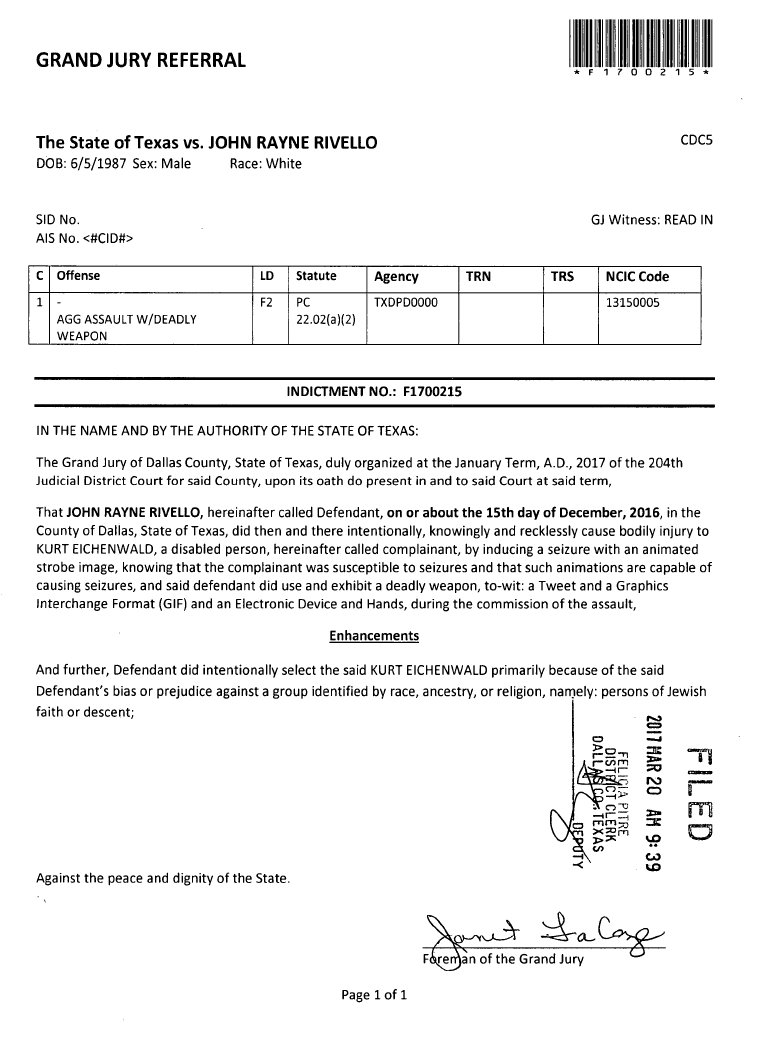
The charges against John Rayne Rivello* for sending Newsweek writer Kurt Eichenwald, “a disabled person,” a twit with a flashing GIF raise a great many issues that, beyond whatever twisted notions compelled Rivello to do such a thing, create challenges for criminal law. Rivello has been indicted federally, and locally. The latter jurisdiction has charged him with aggravated assault with a deadly weapon.

A deadly weapon? The indictment provides a laundry list of possibilities. A tweet. A graphic interchange format. An electronic device. Hands.

Under Texas law, a “deadly weapon” is defined as: Continue reading

The Iceman Cometh

It was a mere month ago that Sam Bieler took Ed Whelan to task for his post at The National Review blaming “liberal judicial activism” for the murder of a police officer. To his credit, Whelan retracted his post. There are different views of how law should be interpreted, but vilifying views with which you disagree as the cause of evil, even death, goes beyond dispute into the insane. People commit crimes sometimes. Constitutional interpretation is not to blame.

Yet, the opening day of speechifying by the Senate Judiciary Committee at the confirmation hearing of Tenth Circuit Judge Neil Gorsuch for the United States Supreme Court saw the other team pulling the same crap, latching onto the “frozen truck driver” case as proof of the evil in his heart.

Yet there are other adjectives for Gorsuch’s dissent. Obtuse, callous, elitist,and cruel are contenders. He displays a manner of thinking that might disappoint — if not shock — many of the white, working-class voters who turned out for Trump in November.

The case involved a truck driver whose truck had broken down. He was told to either drive the truck with locked brakes or wait for help. He waited, his cab lacking heat, in the cold. He finally decided to unhitch his load and drive to warmth. He was fired for disobeying his employer’s orders. Continue reading

Selling Diversity, New And Improved!

It’s not that people are so stupid that they will believe anything wrapped up in the pretty pink bow of diversity and inclusion, or any other flavor of social justice rhetoric. Okay, it is. Toss in a bunch of idiotic jargon and you’ll buy anything because your pretense of critical thinking is total nonsense. That’s not just me saying so. Elie Mystal says so too.

This month, Bethune-Cookman, a historically black university in Daytona Beach, Fla., announced an “affiliation” deal with Arizona Summit Law School, a for-profit institution in Phoenix. A joint scholarship program will send Bethune-Cookman students and students from other historically black colleges to the law school. Other programs, including intensive LSAT prep classes, have been announced as part of the deal.

More black lawyers! Yay! Isn’t that what everybody keeps saying we need, we should have? Hell, this has been the foremost initiative of that merry band of social justice warriors, the ABA, along with counting labia in the courtroom.

So aren’t we thrilled? Not so much. Continue reading