
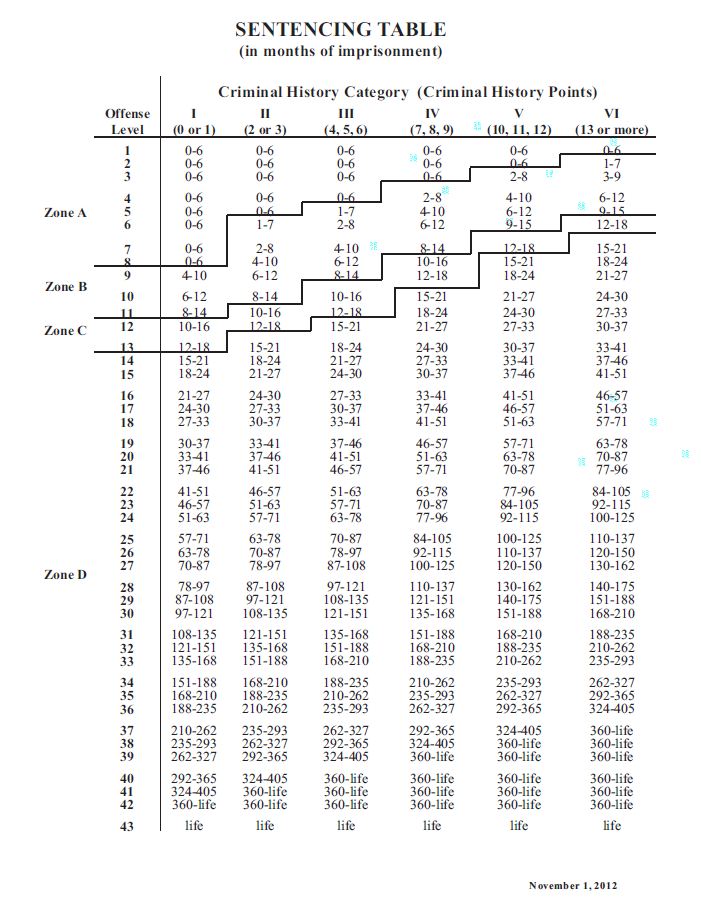
Judge Denise Cote sentenced former United States Representative and New York City mayoral candidate Anthony Weiner to 21 months in prison. The government asked for a sentence between 21 and 27 months*. The defense sought probation.
Cote, an appointee of President Bill Clinton, seemed to struggle with the decision she was about to make. One the one hand, she acknowledged she was dealing with a defendant who is unwell: “He has a disease that involved sexual compulsivity. Some call it a sex addiction,” she said, as she credited the treatment he’d been receiving, which she considered “effective.” For a moment, it seemed as though she was leaning toward probation — especially when she suggested that Weiner could “make an enormous contribution to society” and provide a “true public service” if he somehow became an advocate for people suffering from his same disease.
But on the other hand, she recognized Weiner committed “a serious crime that deserves serious punishment.” And that the “strong compulsion” that had already led to two very public downfalls had reared its head once again. Treatment and probation alone may not suffice to cure him this time around. Something more was needed.
Much is wrapped up in Weiner’s crime, his downfall, those whose lives were implicated as a result, and his sentence. His inability to control his behavior was manifest; he refused to stop engaging in his “dalliances.” It’s not as if the price wasn’t enormous, for him, his former wife and, possibly, others. Not that any of this seemed to make any difference to Carlos Danger.
He was a ferocious voice in progressive politics, to the point of engaging in “tantrums” on the floor of Congress. He was smart and witty, and nasty and off-the-charts arrogant. He could have been a contender had he not imploded.
As painful as it is to watch a life in ruins, Mr. Weiner brought degradation upon himself. No public penance on his part, no acknowledgment of a sexual addiction, no level of commitment to rehabilitation, no expressed regrets for having turned lives upside down, could absolve him of grave sin. This former New York congressman had repeatedly exchanged lewd texts with a 15-year-old girl. That made him not just a moral transgressor. It made him a criminal.
Anthony Weiner was a criminal, as the New York Times editorial spit out in disgust. But this is the same editorial board that loves criminals and feels empathy toward them, except when it doesn’t.
He could have been sent to prison for 10 years. The year and nine months given him by Judge Denise Cote qualified as an act of grace, as did her hope that, once freed, he would find a way to be “engaged productively.”
Referring to the statutory max is silly, an indulgence the ignorant use to justify their opinion, here that the sentence was an “act of grace.” Do you get the impression that progressive failure, traitor, Hillary-ruining Weiner isn’t well-liked at the Times?
To put it bluntly, Anthony Weiner — smart, often witty, politically deft, at one time plausibly a strong candidate for New York mayor — proved to be a pathetic jerk. But few jerks do as much damage as he did in his recklessness. He may even be responsible for Donald Trump being president.
Being a jerk isn’t a crime. Being a jerk isn’t a reason to be sentenced to prison. But maybe, just maybe, being responsible for Trump being president?
In the courtroom where Mr. Weiner was sentenced sat his parents and his brother. His wife was not there. She filed for divorce in May — more wreckage from his behavior. In her book “What Happened,” Mrs. Clinton described how “Huma looked stricken” on learning that Mr. Comey’s new focus on those emails were a byproduct of the federal investigation into Mr. Weiner’s texting habits. Mrs. Clinton wrote that Ms. Abedin burst into tears and said, “This man is going to be the death of me.”
Judge Cote was obliged by law to consider the factors set forth in 18 U.S.C. §3553(a). There is no mention in there of how the offense impacted Hillary Clinton. Not even Huma Abedin. The law does concern itself with the impact of Weiner’s crime on the 15-year-old to whom he did the dirty, but whatever harm he caused his victim wasn’t sufficient to concern the Times editorial board.
He certainly was the ruination of himself. “I was a very sick man for a very long time,” he told the judge before she sentenced him. Not many would have disagreed when he then said, “I have no excuse.”
One might expect the New York Times to not look for an excuse for a person who committed a crime because he was sick. After all, is a sick person at fault for being sick? Then again, to the extent Weiner may have been responsible for Trump, he deserved anything he got as far as the Times is concerned.
*Presumably, this was the Sentencing Guidelines range, an offense level 16 with a criminal history category I.
Discover more from Simple Justice
Subscribe to get the latest posts sent to your email.
I had a feeling the “probation” thing would get short shrift. The “blame him for Hillary” thing seems to have blown up from nowhere.
Apparently, Weiner is on the long list of reasons why Hillary didn’t win, buried somewhere in there. Who knew?
People have been femsplainin’ for a very long time that she lost because she didn’t have Weiner.
Is Anthony Weiner being scapegoated, because he is so well-known? Anything that helped Trump become President is bad, but…wouldn’t Weiner have served the public by getting probation, better than to throw him in jail? After all, his life is ruined, hasn’t he suffered enough- disgrace, branding as a sex offender, loss of his wife, his status, his very life? He said he wanted to be there to father his child-doesn’t he deserve that, and doesn’t his child? And what about the fact that the “victim” admitted she was setting him up, so as to take Hillary down? Why is she given a “pass”, and he is stripped of everything? There are Catholic priests who- rather than being jailed- are simply transferred to another archdiocese, after committing actual rapes and physical abuse of their “flock”…Weiner never laid a hand on anyone, except himself!
Is asking rhetorical normative questions informative or a complete waste of bandwidth?
I see what you did there.
Heh. Yeah.
His crime was doing it on the internet (ethe-real), instead of in person, like Billary. For that, he is a grave danger to the public safety. Did the judge throw in cancer? Are there appeals? Of coarse there are. Problem is, the appellate courts rubber stamp the trial courts, if you catch my drift?
Appeal what, Bill? An objectively reasonable, within-guidelines sentence?
Ok, so he pled guilty? My bad. Big mistake. Deny, deny, deny. We’re predicting a recidivist in the making. Judge Cote has a lot to learn.
Weiner didn’t ‘exchange lewd texts’ with a 15-year-old. According to the news side of the Times, he videochatted with her over Skype, where he “used graphic and obscene language to ask the minor victim to display her naked body and touch herself, which she did.” Usually — at least for offenders not so well-connected — the feds call that ‘production of child pornography,’ which is a level 33 offense. Used to be, you knew the fix was in when the feds declined to take over the case (on day 87 or 88, of course), leaving it opn for a state judge to pass a sentence of time served or six-months home detention, but I guess with a creative-enough AUSA, everybody gets to play.
I have to wonder at the loud, angry shrieks of outrage over Senor Danger’s having been singled out for unacceptably harsh treatment. WTF do these people think happens in our courts, day in, day out, to defendants who, say, work as a cocktail waitress or a bar back or a sysadmin or live in a town with fewer inhabitants in 2010 than in 2000?
The most fucked-up thing about this sentence — like that of Henry Nicolas, former CEO of Broadcom — is that, for once, we have a sentence that’s likely appropriate to the crime… and I find myself *this* *close* to outrage that its not longer.
Of course, I know the solution *isn’t* to subject high-profile defendants to the same
This was one of those posts that could have gone in about ten different directions. I expected to end up in Schadenfreude, frankly, which would have been such a warm and comfy fit.
There is a considerable element of randomness arising from what gets charged and where (which, indeed sometimes seems to be connected with who the defendant is and knows). As a result, some defendants who actually had sex with children have escaped prison, while others are serving long federal stretches for having inappropriate images of children.
Law is funny that way.
According to the plea agreement, Weiner and DOJ agreed that the offense level was 33 with category I history. The plea agreement called for the Feds to recommend a sentence between 21-27 months, as if the conduct did not trigger the sex trafficking cross reference under U.S.S.G 2G3.1(c)
Was 33 the net on the plea or post trial? So exposure was 135-168 months under the Guidelines, and they agreed to a recommendation of 21-27? That’s one hell of a deal, either way.
https://www.documentcloud.org/documents/3727178-U-S-v-Anthony-Weiner-Plea-Agreement.html
On the plea. Since sex trafficking kicked it over the statutory maximum his max exposure was 10 years. The plea agreement specifically lays out the recommendation is made by ignoring the cross reference. Unfortunately, I’ve only done CJA mentee work, so don’t have enough experience on how unusual this form of plea is.
As I don’t do child sex defense, I’m not familiar either with the SDNY’s “usual” handling of these cases, but relative to drug prosecutions, for example, their dropping the cross-references seems like an incredible deal. That was a huge swing, particularly given how draconian the sentence could have been and how strong the evidence was.
To be honest, I’m just glad Tony Penis entered a plea. While I have little doubt that he would have been convicted at trial, SDNY’s track record doesn’t make me super confident it wouldn’t have been tossed on appeal.