
Last week the house was full of young people, my son’s roommates who graduated college with him and remained to get advanced degrees. They talked, we talked, they talked some more. They were very smart kids, but very much kids.
One of the things discussed stemmed from another young person who was killed doing something foolish. It wasn’t so much about the activity itself, but about how he did it, failing to take the usual precautions students took to be safe. From there, the discussion digressed to their foremost concern for safety.
As a parent, I was torn. No parent wants to see harm come to his child. But at the same time, I didn’t want to bubble wrap my kids, for they needed to take chances and tempt the possibility that they might be harmed. But there was a force preventing them from tempting fate. There were rules, there to protect they were led to believe, and rules must be obeyed.
This is a small thing, but it’s one I keep noticing.
When the crossing light is red, and there are no cars nearby, I am the only person who crosses the street against the light.
When I was in my 20s, back in the 80s and early 90s, I was not the only one.
I find this rule-obeying when it makes little sense disturbing. This just was not the case when I was young. It was even less the case in the 70s when I was a child.
People are obeying rules when the rules make little sense.
It is a small thing, but it’s also indicative of a mindset of obeying rules for no better reason than they are rules. The point about crossing the street against the light, even when there are no cars anywhere to be seen, is that it is a clear, flagrant, violation of the rules. If the light is red, you wait until it’s green. Except you can see clearly that crossing poses no potential for harm, even though it’s a clear violation of the rules.
For some, this may seem to be a poor example, an inapt analogy. You cross when it’s safe but the light’s red, and so it doesn’t apply to you. But many do not, cannot bring themselves to break rules because they’re rules. We have raised a generation of people who obey rules, even when the rules aren’t sensible, even when the rules no longer connect to their purpose.
But it’s not just parents, who don’t have nearly as much influence over their children as we think or hope. It’s a society of rules, and rule makers, and rule enforcers. There is no topic, no issue, for which there isn’t someone, some group, determined to create rules for others to live by. People really, I mean, really, love rules. And others obey them, whether for fear of harm, for fear of being shamed for their failure to adhere to rules, or just because they can’t bring themselves to be noncompliant, as if the rules hold some magical power over their ability to move their appendages.
One critical aspect of the problem was the inability to rationally weigh risks. It’s one thing to cross against the red light when there are cars on the road, but when you’ve looked left and right, and observed that there isn’t a car in sight, there is no risk. You’re just doing what a light tells you to do for no reason other than rules.
This is reflected in the obsession with active shooter drills in schools, with putting armed officers in schools just in case of the infinitesimal possibility that any particular school will be the site of a school shooting. The risk posed by school cops to students is far greater than the risk of a shooter, yet the latter is deemed sufficiently significant to risk the former.
But safety isn’t the only concern. Our dinner conversation turned to a dorm called Senior House, where I bemoaned the loss of the dorm’s cultural peculiarities. One of my guests explained to me that they broke the rules. They were given a chance to clean up their act, to homogenize their culture, to obey the rules. And rather than fall into line, they responded by flouting the rules, being non-compliant, and were crushed for their insolence. This, I was told, was as it should be.
Certainly, there are rules that serve us well, they prevent us from harm, if not death. Keep to the right is the basic rule of the road, entirely arbitrary but absolutely necessary to prevent us from crashing into one another. It’s not that the right is the better side to keep to, but that a side had to be chosen and right was as good as any other choice.
But this slavish adoration of rules is disconcerting, as if the explosion of rules to cover every aspect of daily life, going beyond any consideration of safety into mere micromanagement of other people’s behavior. These rules are often rationalized as having some theoretical connection to safety, such as words that might hurt someone’s feelings, which (we’re told) is just as real as a punch to the face even though it’s nothing of the sort despite a million teeny-boppers repeating the lie that’s been drilled into their heads.
This isn’t a polemic against rules, per se, but a challenge to critical thinking about the need for rules and the compulsion to adhere to them even when their purpose, to the extent they actually have one, is clearly not served. We’re losing the ability to distinguish between rules that matter and rules that don’t, when rules that matter, given the circumstances, no longer matter, we are left with a society of people who simply obey for no particular reason except that someone made up a rule.
There used to be a saying, “rules are made to be broken.” Can you? Can you bring yourself to break a rule, even if it can be done safely, even if the rule is pointless?
Discover more from Simple Justice
Subscribe to get the latest posts sent to your email.
Can I?…the question, for my type( Adrenalin junkie) should be,” when don’t you break rules?” I may have been this guy in a former life….
That would explain a lot.
First! Remember, you invited it.
What passes for radical activity among the young is really hyper-conservative. Us old folks broke all the rules; so did our parents. They don’t want to be like us, so their radicalism is conformist. They don’t see the humor.
To answer your question, yes. I was in the office at 6:30 this morning. I broke at least a dozen rules getting here because speed limits are dumb at that time. By noon, I’ll break another dozen legal rules because some of them are dumber. In fact, you inspire me: I’m going out front and cross the street diagonally.
I’d rather laugh with the sinners than cry with the saints.
A Twainist?
Heaven for the climate, Hell for the company?
Kurt
I decided to engage him on Twitter. He never saw it coming. Here, I’ll break my rule not to post before coffee, just leave this link that explains my point.
I’m guessing a lot of people never make it past Level II.
Including We old folks.
SHG,
What a delightful and insightful post! As I march into my ’70s, I second your point.
The world will not spin out of control if I cross against the light when there is no traffic, although doing so still makes me uncomfortable. Hell, I might even impose a sentence below the Guideline range!
All the best.
RGK
“Hell, I might even impose a sentence below the Guideline range!”
Pretty mundane when it comes to rule-breaking. But if you put something on your head during sentencing–maybe something floral–it would be more radical.
Skink,
Given some recent disfiguring surgery on my face, I have taken to telling CDLs before sentencing that they may want to warn their clients that Freddy Krueger is not sentencing them. Instead of Nightmare on Elm Street, it’s now Nightmare on the Fifth floor. In short, I have already addressed your suggestion.
All the best.
RGK
PS The floral swim cap that you gave me sits atop my bust of Lincoln for all to see.
You mean this one, Judge?
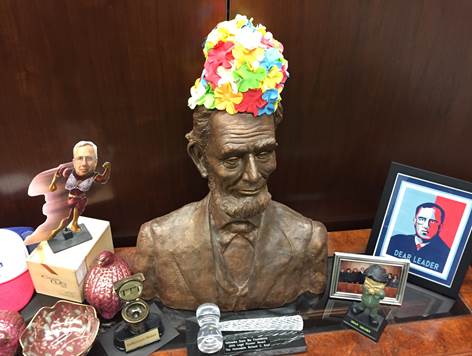
SHG,
Why yes that’s the one. This collection is displayed in my conference room so that lawyers understand that I take their cases, particularly criminal cases, very seriously. I strive to be comforting.
All the best.
RGK
PS Notice the small bowl like figurine in the bottom of the photo next to the gavel? It a reminder from a former law clerk that I preside over a third-tier toilet.
I thought it was an Oklahoma reference.
You may be the last bastion of wilderness in the heartland.
I have to admit I’m a generally rule-following kind of guy. However, I’m afraid the case of rules not being necessary or not serving their intended purposes is a rather mild case of dysfunction. I often encounter rules that either paralyzingly onerous or directly contradict other rules. Some of them must be broken if anything at all is to be accomplished. This happens a lot when there are so many rules that even those making the rules can’t know or understand them all. It also happens when a hard decision must be made, because two valid concerns are in tension or different risks must be weighed, and rulemakers lack the will to make it.
When rules conflict, the problem doesn’t exist, as a choice has to be made and regardless of choice, a rule will be broken. It’s when you choose to be compliant with pointless rules that tests you.
Or is it more than it appears? Traffic cameras are becoming ubiquitous, and China has begun issuing jaywalking fines to those caught on tape. Back home, is it just me, but are police enforcing jaywalking statues more aggressively than during the latter half of the 20th century?
A phenomenon similar to this has cropped up in my hometown, a city that shares a border with Chicago, in the last eight years. High school students began walking in the street despite sidewalks existing on both sides of the motorway in all cases.
It followed another strange phenomenon, where joggers began running in the streets despite the ubiquity of the same sidewalks. This too was unusual until this decade commenced.
The high schoolers no longer walk in the street, perhaps because parents walking their children to elementary schools willingly berate the older kids, but there has also been a marked increase in police patrols around the high school over the last two years.
Yet the joggers continue to run in the streets, even on busier roads, despite easy access to sidewalks. This obviously doesn’t add any insight, yet a question lingers…
There is actually a legitimate reason joggers run in the street and not the sidewalk. Other than just breaking the rules.
Getting them to follow orders is all about control, and keeping them from thinking about what they are doing. When they all learn to follow the rules, no matter whether they make sense or not, then you know that you are in control.
And there are definitely times when you want people to NOT follow the rules. People who operate complex equipment are trained to follow the rules, but there may come a time in an operator’s life when it is necessary to do something that goes against what the rules dictate. And the operator needs to understand the machinery well enough to be able to violate the rules, in order to save lives or prevent a serious accident. The best training programs include this sort of training, at the very end, in order to ensure that the newly minted graduates realize that they must, above all, THINK about what they are doing. Doing something stupid just because the rules say you should do it, is dangerous.
I happen to think that it is good that people cross against the red when there are no cars in sight. It is silly to just stand there waiting for a mindless indicator to change state.
As has been said before, training is learning the rules. Experience is learning the exceptions.
Seems like our society has gone out of its way to remove the experience part from our children.
It is being done deliberately. (Tin foil hat)
“WHAT DO YOU THINK?
I allow thoughtful comments, but please keep yours civil and respectful. There are rules here. I reserve the right to delete or edit any/all comments. Links are not permitted in comments and will be deleted. If you don’t like the rules, comment elsewhere. Volenti non fit injuria.”
-SHG
I can’t wait for you to work your way further down the sidebar. It’s gonna be lit!!!
Did the conversation get into speculation as to what might have motivated the guy to climb the dome?
There was no need to speculate. It’s a common thing to do.
Did the boys calculate the distance their classmate fell in feet, meters, or smoots?
What a ridiculous question. Are they from the second best engineering school on Mass Ave?
He is a guy engineer. Women and girls are off-limits, he already has lots of computer toys to play with, and he probably doesn’t own a car, living in Boston. They (we) do stuff that other people would consider to be unwise. Because we can.
In my role as a local public official, I got a request several weeks ago regarding our “Walk / Don’t Walk” signs. The new signage doesn’t display the “Walk” signal unless you press the little button on the pole. That’s fine for most folks, but on Friday nights & Saturdays, the local Jewish population doesn’t press buttons, and it led to a lot of people standing on the corner — waiting — for a signal that never came.
I’ve found that one of my daughters falls into the rule-abiding category, while the second kid seems to take pleasure in breaking every rule we can establish. Is it learned behavior? It’s too early to know if the former is affected by school rules (which seem to exponentially self-perpetuate) or if there’s a natural tendency at work, but I’ve certainly found the trend our host has noticed to be alive and well — as I step into the empty abyss and cross while the phalanx of onlookers gawk at the corners.
The psychologist Kholberg spoke of levels of moral reasoning and his chart certainly resonates with the actions of many I’ve come across. His Heinz Dilemna” spells it out in a way that makes a lot of people scratch their heads at the “rule-abiding” folks.

The short version: if a pharmacist has a drug that will save your wife and won’t give it to you because you can’t afford it, are you right or wrong for stealing it, to save her life?
If you think the answer is obvious and that can’t possibly answer that question differently than you, you would be just like my dad. And not at all like his girlfriend at the time. Boy, that was an awkward moment.
Ironically, self-actualization doesn’t appear anywhere on that chart.
Something you didn’t cover here… When you are looking at rules to break, you don’t just look at whether the rule is nonsense, you also look at the penalties – legal and Darwnistic – for breaking it. When you decide to break it, you have to take responsibility for what happens next.
Perhaps kids these days are less willing to be responsible.*
* From a distance, you can’t tell if someone doing something stupid took responsibility, or simply has someone holding his beer. This makes for great news.
Sometimes I don’t cover something by accident. Sometimes, on purpose.
One wonders if this greater tendency for rule following has (or will have) an impact on defendants? If people assume that breaking a rule, regardless of situational merit, is bad, then will it follow that the rule-breaker is a bad person and deserving of being, as you described it, crushed for their insolence? Your 11/25 post about the Greek school cleaner sentenced to 15 years for an otherwise inconsequential fib on her application is another illustration of where this tendency can lead.
If you look carefully, you might note that there is no mention of defendants or crimes in this post. There’s a reason for that.
When I lived in Slovakia a few years ago, I noticed that I was the only one crossing against the light. Passersby looked on in horror as I sauntered across the street. This was a full twenty years after the wall came down. Those are deep scars.
I am one of those people who will stand there at the crosswalk waiting for the light to change even when I can see it’s safe to cross.
My reason is that I could be wrong. …Okay, with the crosswalk on a two-lane street where I have good visibility in both directions, I know I’m not going to be wrong. But, it’s not about that particular crosswalk. It’s about cultivating a habit where I remain aware of the possibility that I may have mis-assessed the situation.*
Driving in DC, there’s a very common practice I see just about every time I go to or from work: Someone will try to do something which violates a clearly posted rule, most commonly illegal left turns, but often going through blinking red crosswalk lights without stopping. These people have come upon the situation, determined it was okay for them to proceed despite what the rules were telling them, and then acted. They’re wrong a lot. To go Maurie Povich here: “You said it was fine to make a left turn even though the sign said you could not. The mile of traffic backed up behind you determined that was a lie.”
I also see this with my students when it comes to formatting rules. “Staples? Double spacing? MLA? Whatevs, I considered your stupid rules, determined it was safe to ignore them and proceeded using my own judgment!” That’s quickly followed with “I don’t understand why I failed this class even though I did all the work.”
This isn’t of course to argue that we should always blindly follow all the rules. I set my cruise control to 79 when the speed limit is 70. I ignore the shit out of copyright. I recently, after asking a free cashier if it was okay, went through a 10 items or less express lane with 15 items.
I think what’s really missing today, not just with the damn kids, but with the adults as well, is the ability (or willingness) to think through what the purpose of the rule is, how it came to be, who made it, and whether the rule is likely to reflect some wisdom deeper than their own understanding. If the rule is coming from some tyrannical busybody, like your HOA, ignore it to the extent it doesn’t cause you more hassle. If it’s coming from a technical expert or a long-standing tradition, we may be wise to substitute their judgement for our own.
*The exception is when I’m with someone else. I’m not going to subject them to a pointless delay. I don’t mind losing the 30 seconds, but I assess the cost of delaying someone else as much higher.
Is it hard to breathe inside all that bubble wrap? Does the popping sound annoy you when you sit down?
Robert Heinlein.
“I am free, no matter what rules surround me. If I find them tolerable, I tolerate them; if I find them too obnoxious, I break them. I am free because I know that I alone am morally responsible for everything I do.”
Perhaps equally apropos:
“There’s no way to rule innocent men. The only power any government has is the power to crack down on criminals. Well, when there aren’t enough criminals one makes them. One declares so many things to be a crime that it becomes impossible for men to live without breaking laws.”
Someone wrote that…
Kurt
Did you pick the Captcha?
I had to select all the photos that contained crosswalks.
We try to turn the theme into an experience, like Universal Studios, but without the fun.
Some of it may be regional, or college specific. An informal poll of my son and his friends at Oregon State school of engineering indicated they see school rules as inhibiting fun, so they break rules when they see them as pointless. OSU also has a tradition of climbing on roofs so their critique of the poor MIT student was poor technique rather than being where he shouldn’t, just as one doesn’t jaywalk without being aware of traffic.
They make a rational analysis of risk and consequences, rather than blindly following, so loaded guns are always pointed in a safe direction, and they unload and show clear before handing them around On the other hand Benson Hall’s roof is seen as fair game, if it’s dry and one is wearing non-slip shoes.
The consensus was poor technique plus he did it during a high wind rain storm, which is generally considered a very poor choice.
After being involved (being a member and being an attorney on House Corp) in a fraternity for the better part of 10 years. I am surprised at how kids are so compliant with the arbitrary rules sent down from the Dean on Mount Sinai.
Thesw kids are so afraid of their own shadow and making one of the 25 deans upset about something. I would often sit and talk about things “they shouldn’t do” in order to give them some inspiration for rebellion.
I think there’s related push factors and pull factors at work. First, transgressive behavior is no longer cool. It used to be that people who broke the rules were inherently cooler and more awesome than people who didn’t, an effect that seems to have for whatever reason long since faded from youthful imagination. Second, there’s a sense of self-satisfaction that comes with the notion “I follow the rules, and that makes me better than you” that previous generations deeply distrusted and the current generation mostly doesn’t. There’s probably a lot of underlying factors that have caused this shift in consciousness but I don’t think my speculations against those would be particularly useful.
Who decides which rules and/or when a rule becomes pointless?
In most cases there is a good reason: The cost of non-compliance has been made so unreasonably onerous that no sane person would dare cross that line. However, I get your point, and in some instances it’s a case of Pavlov’s Monkeys.* Regardless, the world is a much more complex and scarier place than either of us grew up in. As complexity increases, so does the likelihood of real-world consequences, resulting from whatever actions the rules were there to prevent.
So the next question is, by ignoring the rules, do the punitive consequences exceed the real-world consequences, and by how much? (I’m assuming any rules were written with a genuine concern for harm reduction, and not primarily as a “gotcha” revenue generator). Different folks will have different thresholds for any imposed economic pain. Will any fines be proportional to the income brackets of those whom they are imposed upon? Will jobless, full-time students, experience the consequences of their actions? Or will it only wind up punishing the family breadwinners? Therefore, it’s presently considered “best practice” to get the little darlings conditioned to following rules, as early as possible.
In any case, things are rarely as clear-cut as your red light example. Even then, in a given instance, when a rule may seem inappropriate, it’s there for the often non-obvious exception. What happens when someone comes scooting around a corner at a high rate of speed? (I’ve had ER docs tell me “if I had a dollar for every surviving [pedestrian] MVA patient that said ‘he just came outta nowhere!?!?’, I’d be a rich man!”)
There are also cases, like where an experienced resident, who’s sure of their assessment, is sure they haven’t missed some hidden, unseen red flag, is sure they have the answer, and then decides it’s appropriate to break protocol. Care to guess how that usually works out? Let’s explore:
When it works, they’re praised for having performed above and beyond, while simultaneously being chastised [with a wink] for having “broken the rules”. They might even receive a few days of
vacation timeunpaid leave, as a slap on the wrist. (They’ll often wind up getting extra shifts to compensate for the economic loss).The not-so-subtle message is “when you’re reasonably sure, take chances”.
When it doesn’t work out, and someone is harmed, they will be told by every supervisor, the risk manager, corporation counsel, and the disciplinary committee, “The rules exist for a reason! Who the hell do you think you are? Do you think your judgment exceeds the collective experience of [insert particular rule-making body or bodies]?”
The message here is “Don’t you dare take chances and expose us to liability! (Not to mention what it’s going to do to our insurance rates!)” In some rare cases the chastisers might even have some genuine remorse for the permanently injured or dead guy. But don’t wager on it.
Mixed messages of this sort don’t help. When you’re standing before the disciplinary committee, having used the same judgment in an identical scenario, where everything worked out, but this time it didn’t, you will be reminded of why the rules exist, and the consequences of not following them.
Experience has its limitations and Occam’s Razor often shaves “too close for comfort”. I’ll skip the lengthy math and probability explanation. Just know that, for a given set of circumstances, the number of tries before probability begins to favor an alternate (often negative), outcome, is roughly equal to pi (3.14).
*For those unfamiliar with Pavlov’s Monkeys, see my reply to PseudonymousKid in the “Josh Blackman: The Supremacy Sham?” thread. Speaking of breaking rules…
https://wp.me/p3KGJc-9vu/#comment-162740
Since this is an older post, I’ll post your exceptionally long comment, but that doesn’t mean I (or anyone else) will read it.
At risk of sounding older than I am, this isn’t a new take. Even Frosty the Snowman knows we aren’t worth the trouble if we unduly wait at the intersection:
“Down to the village, with a broomstick in his hand,
Running here and there, all around the square,
sayin’, ‘Catch me if you can.’
He led them down the streets of town, right to the traffic cop;
and only paused a moment, when he heard him holler, ‘Stop!’
For Frosty, the Snowman, had to hurry on his way,
But he waved goodbye, sayin’ ‘Don’t cry, I’ll be back again some day.’ ”
That is. The magical snowman escaped because kids back then just followed the rules too darn well.
Sorry for introducing holiday cheer so early in the month.