I remember taking the final in college. It was traumatizing, not because of the subject matter (which might well have been traumatizing had I been inclined to be traumatized), but because I forgot that I was registered in the class and never went to a lecture or read the books. It wasn’t until I received notification of when the final was to be held that I realized my error. It was too late to drop the course, so I had no other option than to show up for the final and do my best to pull it off.
I should have gone to Sheffield University.
Professors already give “trigger warnings” when using images from video games, war photographs and depictions about the crucifixion of Jesus Christ or when organising discussions about underage sex, homelessness and religion.
Sheffield students complained last year of being “distressed and anxious” and “in tears” after sensitive material was covered in their English literature studies.
The mental health society, part of the students’ union, raised concerns about the discussion of sexual abuse in a module on Restoration literature and said “disturbing material had arisen in other modules”.
Reading lists for the degree include Toni Morrison’s The Bluest Eye, which features violence, rape and racism.
I was distressed. I was anxious. But still I had a final exam to take. If only they were more sensitive to my feelings.
The students’ letter argued students should not have to “put their own mental health at risk to receive an education”.
A separate email claimed that “one girl left crying and later had a panic attack”.
To remedy this horror, this infliction of trauma on students, Sheffield will allow students to not take tests, not write papers, not have to endure the trauma of . . . education. And if a student says they can’t bear to suffer the horror of reading Toni Morrison, the profs must accept it without question.
Instead, they are warned “it should not be necessary for students to explain their back story” to have the option of a safer topic.
Some academics, however, take issue with their marching orders, even arguing that the subject matter of their courses, their tests, shouldn’t be negotiable.
Frank Furedi, emeritus professor of sociology at Kent University, warned that to label content as potentially dangerous “cultivates the sense of fragility of students”.
He added: “This focus on the possible emotional response of a student loses sight of the centrality of the course.”
By “centrality,” perhaps he means the subject matter of the class. It’s not as if one can teach biology but leave out the lady bits, or teach crim law and leave out rape, even though prawfs may be doing just that to avoid the inevitable backlash of the perpetually outraged.
But Furedi raises the question of whether this inane policy protects students from trauma or “cultivates” fragility. After all, dealing with unpleasant topics is often a part of education, as well as a part of life. By giving students a free pass whenever they anticipate the potential of “trauma,” are they not missing a valuable piece of their education, both in the subject matter as well as the capacity to deal with occasional unpleasantness?
Critics said exams should not be up for negotiation because it could lead students to anticipate being traumatised by material.
Had this been the rule when I learned of my inadvertent failure to attend a course for which I was registered, you can bet your bottom dollar I would have invoked the “don’t trauamatize me, bro,” rule. And that I wouldn’t even have to make up a story about why is the cherry on the sundae. As it turned out, I got a D in the course, as the prof knew I had never shown and took pity on me. But to this day, I can’t quote Toni Morrison, a stain that can never be washed out.
Discover more from Simple Justice
Subscribe to get the latest posts sent to your email.
I’ve had that dream a few times, but you’re the first person I’ve ever met who’s actually done it in real life. Maybe they should start granting degrees “cum condescensio” rather than “cum laude”, so that prospective employers can tell those who proved they can overcome challenges from those who merely avoid them.
There’s a Doonesbury comic where Zonker is informed that he just missed his final. He stares out the window and
mumblesthinks to himself, “bummer.” I wish I could find that comic. I think about it often.Edit: With my deepest appreciation to kushiro who found it for me, here’s the strip:
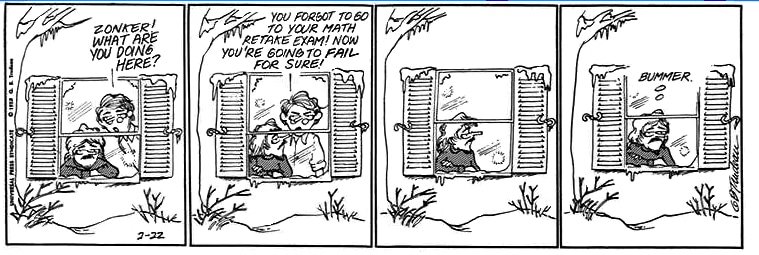
Important correction: I have dated that strip incorrectly. It is from 1973.
Now I can sleep tonight.
Ditto. It’s about the only dream I’ve ever had that I remembered when I woke up.
I kept expecting to read “but of course this only happened in a dream” or some such reverie. Never came.
Same here. I only had it once, and it was months after I had graduated. It’s the only time I can remember waking up in a cold sweat.
My twist: our school had an attendance policy, and so I was going to not only have to take an exam for a class I’d never attended, but first I had to get the prof’s dispensation. This was (of course) the prof I had butted heads with while on the board of a student org. I woke up as I was preparing to go grovel. When I jumped out of my bed, I thought I’d overslept and missed the meeting.
I had that dream through college and law school. After I became it morphed into “I have a case I didn’t know was set for jury trial for tomorrow and it can’t be adjourned because the prosecutor flew in a witness from Uzbekistan.”
You’re alive? Nice of you to let me know.
BREAKING: Old guy is concerned about ‘these kids these days’
It’s just financial. After all, they did pay for an education and they’re getting stiffed.
Now that’s an understatement. Wait until these kids find out degrees don’t even exist for half the jobs that will be available when they get done incurring 100’s of thousands of dollars in debt for an education they could have gotten at the library.
Thanks Will, now get back to cleaning floors.
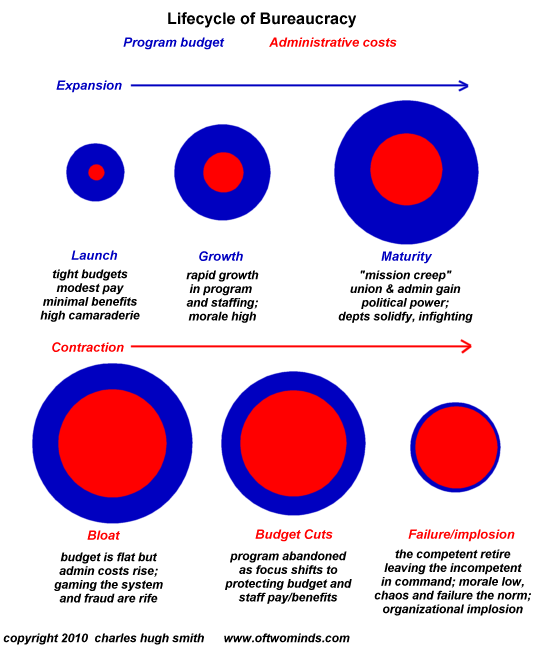
When the inmates are running the asylum, it is a waste of time to hyperventilate over every different bit of insanity. Our bloated crony-infested university system is nearing the “Budget Cuts” stage of the bureaucracy lifecycle; failure is not far behind. The only thing keeping them alive is the student-loan scam that saddles people who are too dumb to know better with a lifetime of debt. If anything happens to that pipeline of dumb dollars, they will be finished.