Tuesday Talk*: When Is When Released?

The opinion in Nielson v. Preap would naturally be dreaded, given that Justice Sam Alito wrote for the majority. It does remarkably little to the law, essentially holding that “when released” under 8 U.S.C. § 1226(c)(1) means at any time after a non-citizen is released from criminal incarceration. The upshot is that once seized as deportable under a few subsections of law that cover essentially everything short of a speeding ticket, the person can be held without opportunity for bond in, essentially, perpetuity.

The opinion is beyond tedious, which may explain why this ‘splainer seems nearly unrecognizable to anyone who actually read the decision. Trigger warning: if you read this from the syllabus, you will hate yourself for not listening to my warning. Continue reading →

The Limits of Empathy In The Law

Nebraska Senior District Judge Richard Kopf took Adam Cohen to task for his review of a book about the enigmatic Chief Justice of the United States, John Roberts. What purported to be a book review devolved into a polemic:

Given the court’s current composition, anyone who does not want the law to lurch to the right in civil rights, gay rights, abortion and other areas has to hope Roberts will hold it close to its current course — either based on actual beliefs, or to protect the Supreme Court as an institution. Roberts could become the court’s new moderate center. But Obama’s insight about Roberts’s deep-seated bias against the weak, which rings powerfully true, suggests that may not be the way to bet.

Or as Judge Kopf expressed it more succinctly, “Simple enough. Roberts hates the less fortunate and that is what animates his jurisprudence.” The appeal in Cohen’s review is directed in two directions, similarly but not exactly the same. First, it’s about the law lurching to the right. Second, it’s about “deep-seated bias against the weak.” In his prefatory phrase about the court’s “current composition,” he appears to be dogwhistling about the conservative majority that has become a constant in progressive descriptions of the how courts and judges work, as being labeled conservative is tantamount to being inherently evil in the world of wokeness. Continue reading →

Kopf: Adam Cohen’s Nasty Remix of the “Empathy” Hymn

Who spends their time carping about a book review, particularly about a book that the complainant has not and will not read? That would be me.

It seems that Joan Biskupic has written a book about Chief Justice John Roberts, entitled The Chief—The Life and Turbulent Times of Chief Justice John Roberts. Adam Cohen, a former editorial page editor of the New York Times, with legal credentials to match[i] his writing chops, published a review of the book. It is entitled The ‘Enigma’ Who Is the Chief Justice of the United States.

Allow me to digress. Speaking to Planned Parenthood in July,2007, President Obama famously brought forth from the heavens the word “empathy.”  He preached the criticality of that word when it comes to judging.

He said:

[W]hat you’ve got to look at is, what is in the justice’s heart? What’s their broader vision of what America should be? Justice Roberts said he saw himself just as an umpire, but the issues that come before the Court are not sport, they’re life and death. And we need somebody who’s got the heart–the empathy–to recognize what it’s like to be a young teenage mom. The empathy to understand what it’s like to be poor or African-American or gay or disabled or old–and that’s the criteria by which I’ll be selecting my judges. Alright?

Those words could have been written by a former speech writer for New York City Mayor Bill de Blasio, like Cohen. If he had written those words, Mr. Cohen would surely be harkening back to his days at the Southern Poverty Law Center and the American Civil Liberties Union. With this digression elucidated, we now return to our regularly scheduled programming.

It is hard to tell whether Biskupic will like Cohen’s book review. He describes her book as “assiduously reported and briskly written.” But then he guts her like a fish.

Biskupic all but throws up her hands toward the end of her narrative, calling Roberts an “enigma,” but she suggests that he is pulled by two often-conflicting instincts. One is ideological: a desire to move the court rightward on race, religion and other issues. The other is institutional: an interest in the court being respected and seen as nonpolitical.

So you see, Biskupic doesn’t get it. Cohen knows the real answer. “That dichotomy is true as far as it goes, but there is another defining theme running through Roberts’ “jurisprudence” that eluded the poor woman. Roberts has “a deep-seated bias against the weak.” Simple enough. Roberts hates the less fortunate and that is what animates his jurisprudence.

What I found amusing is that someone at the Times illustrated Cohen’s ugly piece with a photo. It is a picture of Chief Justice Roberts and his son, Jack, on October 3, 2005, the day the Chief took his judicial oath.

In the photo we can see Roberts’ “deep seated bias” against the weak. By the way, Jack and his sister were adopted.[ii]

Richard G. Kopf
Senior United States District Judge (Nebraska)

[i]  Cohen obtained his undergraduate degree from Harvard College and later received his law degree from Harvard Law School, where he was the president of the Harvard Law Review.

[ii] Ironically, the Times got itself into hot water when it inquired into the adoptions during the confirmation process. See here (adoption records and footnote 9).

The Magic Beans To Stuyvesant

When the results of Stuyvesant High School’s entrance exams broke, the numbers were staggering. Not merely bad as a stand-alone number, but worse than last year, despite the “push” to improve the number of black students offered admission. And before some fool says it, the school is not too white, as Asians, unsurprisingly, make up the majority of students. The end result: only seven black kids, out of 895 freshman slots, were offered admission to Stuyvesant.

These numbers come despite Mayor Bill de Blasio’s vow to diversify the specialized high schools, which have long been seen as a ticket for low-income and immigrant students to enter the nation’s best colleges and embark on successful careers.

You can vow anything, much to the applause of those who wish unicorns could prance on rainbows, but there were only two ways to make it happen. Reduce the entrance standards, which had the obvious result of reducing the competency level of students attending the school, and thus reducing the value of the Stuyvesant’s education, as students unprepared for its rigors would fail to perform at its current level. Continue reading →

The Day That No One Watched

It’s unclear whether this is just me or this is obvious to everyone. Have you noticed that television commercials tend to show an inordinate number of mixed race or gay couples? Granted, historically they only showed Ozzie and Harriet-type families, and clearly there were other families out there who were never seen. But the pendulum has swung disproportionately far the other way.

The purpose, as I understand it, is to normalize the existence of various families and lifestyles beyond the norm, which, as far as I’m concerned, is a perfectly worthy purpose. But then, the majority of families aren’t mixed race or gay, and so this effort at normalization feels forced, wrong. Even TV commercials are now preaching at me. I realize it’s just marketing, whether to sell to the woke or, at least, not to evoke the wrath of the woke for their failure to pander to social justice, but can they force you to care by pushing it at you?

There is a show on Netflix called “One Day at a Time.” I’ve never seen it, which is no big deal as the list of shows I’ve never seen is very long, indeed. But apparently, I’m not alone, so the show is being canceled. That gave rise to an op-ed in the New York Times Continue reading →

Promiscuous Praise and Credible Criticism

The old Cult of Positivity post by Venkat Balasubramani keeps coming back to me, as people new to social media reinvent the old wheel. It happened again when lawprof Carissa Hessick twitted that she would try to give more praise than criticism.

I know that #Twitter is often used as a forum to criticize others. I certainly use it that way.

But I’m going to try and use it more often to praise people—especially people with whom I ordinarily disagree—for doing things that I perceive as positive.

As Carissa regularly offers some very interesting and thoughtful ideas about criminal law and reform, and is one of the smarter voices in the legal academy on issues dear to my heart, I offered a warning in reply. Continue reading →

A Death And An Impossible Story Regurgitated

The headline alone was either the clickiest of clickbait or a testament to the failure of journalism.

Woman shot herself through mouth while handcuffed during traffic-stop suicide, officials say

Next up, Bigfoot attacks cub scout troop? But the story isn’t a joke, and there is a dead human being who can’t be forgotten in the midst of this absurd headline.

A 19-year-old woman whose hands were cuffed behind her back when she committed suicide during a traffic stop in Chesapeake died of a gunshot wound through the mouth, according to the Office of the Chief Medical Examiner.

Continue reading →

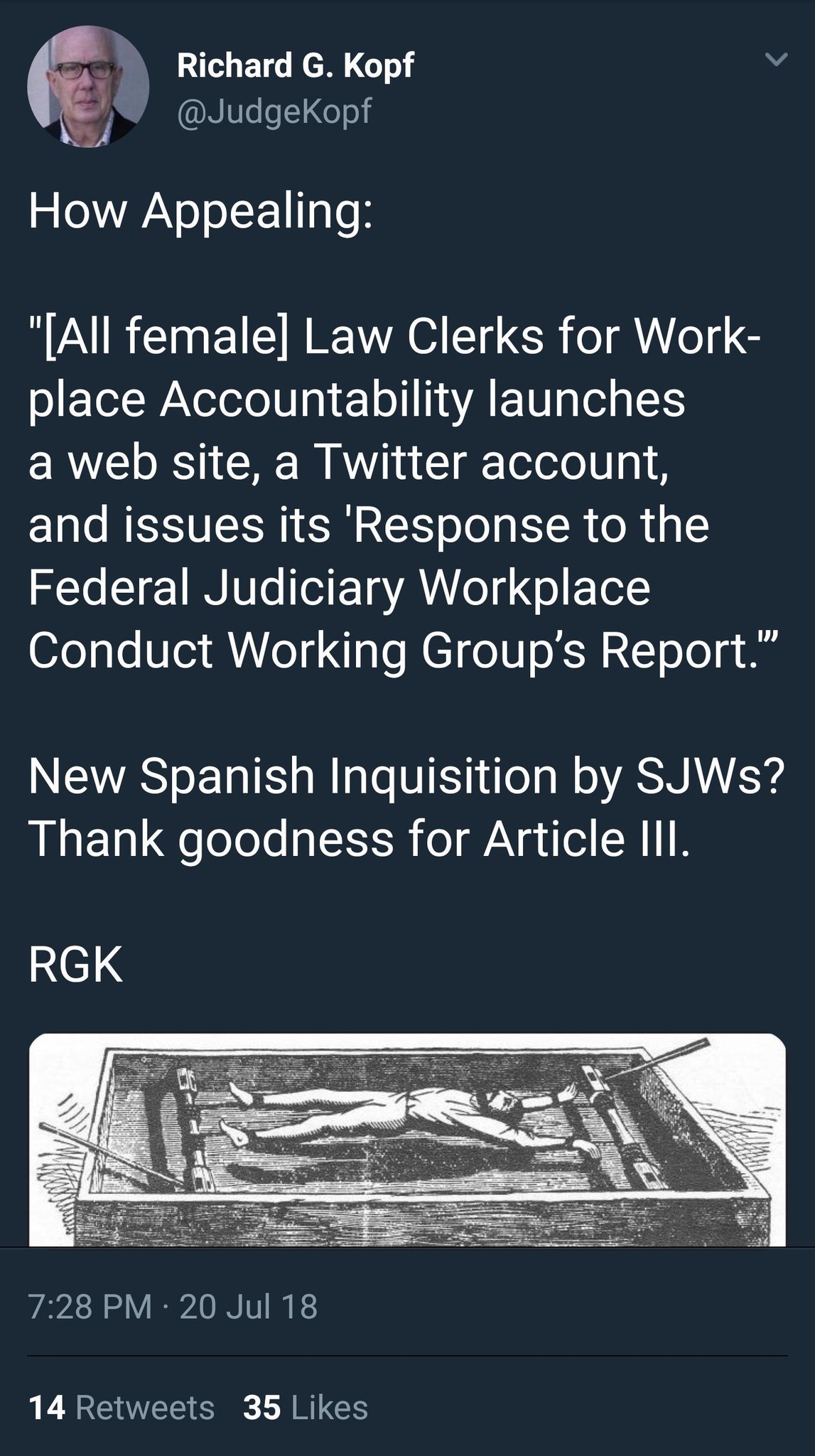
The “Unsexy” New Rules For Federal Judges

The oddity, that was only lost on the people doing the preaching, was that none of the @ClerksForChange who spoke at the hearing on changes to the rules of conduct for federal judges suffered a scintilla of harassment, sexism, misogyny, any of the evils about which they complained. Each proclaimed their judge to have been wonderful, a paradigm of propriety.

But they had stories. Other people’s stories. Where these other people were, what they were complaining about was unclear. There were the Koz clerks, who only managed to shift from their adoration and appreciation of judge Alex Kozinski to their ripping him to shreds after they served out their clerkship and enjoyed the huge benefits of having been a Koz clerk. Ironically, the only example given was of one senior judge from flyover land whose one sharply-pointed twit was proof of the particular speaker’s being sexually harassed. By a twit. One twit. Not to her.

The new rules have now been formulated and were announced by judge Merrick Garland. Continue reading →

Revenge of the Jones

My mother would have called it “keeping up with the Joneses,” the need to buy a new car when you couldn’t afford to furnish your living room because the people across the street bought a new car and you certainly didn’t want to appear less successful than them. That would be humiliating.

But like all things old that have long characterized humanity’s less admirable traits, the kids believe they’ve invented it, or at least refined it to a level of singular distinction.

Scammers and cheats are the paradigmatic figures of our age, and not just because a con man is president of the United States. Again and again in recent years, people who’ve scaled the cultural heights have been revealed as audacious frauds. The systems and institutions that confer status in our society keep being exposed as Ponzi schemes. Grift is turning into our central national narrative.

Continue reading →

Reform v. Reformers: The Poster Boy Delusion

From the moment hearts began to break for Matthew Charles, it was clear that the unduly passionate would conflate the “injustice” suffered by this one person with the problem to be cured. Charles brought two very valuable assets to the table. First, he was an unquestionably worthy poster boy for the cause. Second, the government’s demand that he be returned to prison following Charles’ mistaken release was something that everyone could agree was wholly unjustified and unjustifiable.

It was also a total outlier scenario that bore, at most a tangential connection to the norm, to the general problem facing people who had done everything they could to improve themselves while in prison and prepare themselves for a re-entry into society, where they could live happy, law-abiding lives.

It’s unclear how many “Matthew Charleses” there are in prison. Maybe a thousand. Maybe a million. But as they were never erroneously released and unceremoniously returned, they would never be Matthew Charles. And, in its relative and peculiar way, it’s good to be Matthew Charles, not because he didn’t suffer but because all the others who suffered very much like him would never get the attention he got. Continue reading →