
Labor Day, 2015: What More Can We Do For You?

Among the pervasive themes of law in general, and criminal law in particular, is that too many people lack access to justice, which has become a minor movement using the cool title, A2J. Its verity is seen on different levels, some undeniable such as the failure of society to provide adequate funding for those indigents hauled into court to face criminal accusations, and some more dubious, such as those who have the ability to pay but prefer not to and feel little compulsion to spend their hard earned money on lawyers.

But it’s Labor Day! A day to reflect on the contributions of organized labor to the betterment of our society.  Of course, the bar is organized, and most of us work for a living, even if that wasn’t quite what Congress meant when establishing the bright line test of when to stop wearing white.

And yet, the days when being a lawyer assured someone of a life of relative comfort, provided one did one’s job, pushed the pencil as far and often as necessary to provide effective representation, seem to have disappeared.

There is a disconnect between the needs of society and the demands on lawyers. Maybe it’s that we haven’t shaken off the notion of privilege that comes with being a professional, even as lawyers struggle to find work, to obtain paying clients or earn sufficient income to put food on their table every day.  So why not put another burden on the lawyer’s plate, solving society’s demand that lawyers give it away for free, or at a price that will be painless to those who prefer to spend their money on shiny things? Continue reading →
Masculinity In The First Degree

SUNY Stony Brook will be offering a master’s degree in masculinity. It will not be taught by Mike Cernovich, author of Gorilla Mindset. Rather, Michael Kimmel will be in charge, and he has a very different perspective.

“What does it mean,” the 64-year-old sociology professor asked the group, most of them undergraduates, “to be a good man?”

A series of examples follow, but I’ll cut to the chase. To Kimmel, a good man is a woman. If men were just more feminine, all would be right with the world.

There’s an irony abrewing. Feminist theory is that gender is a social construct, meaning that we take beautiful children and beat them into the monsters they eventually become, because there is no inherent difference between genders. Studies to the contrary are ignored or denied. And so, the reason guys watch football, eat bacon, get horny, are aggressive, is that socialization makes them that way.

This is problematic and wrong, and must be stopped at all costs. Continue reading →

Parole: Absolute Power Corrupts

Writing about parole in New York is akin to banging one’s head on a wall. A wall with spikes. Very sharp spikes. Lots of them. The reason is both plain and, at least amongst those familiar with the system, obvious.  The New York State parole board is comprised of political appointees with near absolute, unreviewable authority, and they wield it like a spiked bludgeon.

As noted in the New York Times editorial, the Court of Appeals will hear argument in a case that could force a change in parole.

On Tuesday, the New York Court of Appeals, the state’s highest court, will hear oral arguments in a case that may provide a rare chance to reform New York’s antiquated, ineffective and unfair parole system.

It’s not exactly correct that New York’s system is antiquated. There have been tweaks to the system intended to bring it up to speed. But these tweaks have been ineffective, because they fail to address some core problems with parole, most notably that the members of the parole board serve political ends, and their decision, provided it’s not expressed in words that are flagrantly batshit crazy, defy review. Continue reading →

FAMM’s Julie Stewart Makes Bill Otis Cry

At Reason, Julie Stewart of Families Against Mandatory Minimums goes head on against Bill Otis, the guy who never met a defendant who wouldn’t benefit from a sentence of life plus cancer.  And she rips him a new one.

Over the past two decades, Bill Otis has become the Paul Ehrlich of criminal sentencing reform.  He is always certain in his convictions and nearly always wrong.  Moreover, like Ehrlich, Otis likes to scare the public with predictions of certain and impending doom, and he is immune to feelings of embarrassment or humiliation despite being proven spectacularly wrong over and over again….

In fairness, my issues with Bill Otis aren’t sanitary and academic. I think he’s a dishonest, disingenuous, dirty sack of shit, who panders to the angry and fearful with distortions, ignorance and prejudice.  Why Otis chooses to take this path is beyond me, but for people like Julie, and me, this isn’t some game to screw people for fun and self-aggrandizement, but real people with real lives, real families, real suffering.  I don’t like Otis.

So Otis responds to Julie’s personal but substantive attack: Continue reading →

Making Gideon Cry, A Public Defender’s Confession

A pitch was sent out to the blawgosphere yesterday from a flack for the Washington Post about an op-ed by public defender, Tina Peng.

I’m a public defender. It’s impossible for me to do a good job representing my clients.

Yeah. And Generalissimo Francisco Franco is still dead. Got it. Thanks for sharing.

It’s not that anyone who gives a damn about the plight of indigent defense minds another op-ed about the inadequacy of funding.  It’s worthy of repeating, and the inadequacy impacts defendants and indigent defenders every day, day after day, because we may have screamed about the problem but it hasn’t been fixed. Not even close.

On the other hand, it would be more easily accepted if it wasn’t promoted as an epiphany, an issue no one ever thought to raise before, a lone cry in the woods of a horror that society has failed to recognize. But this is in the Washington Post, so it must be newsworthy. Cool. Continue reading →

The Grand Inquisitor (and other campus rape innovations)

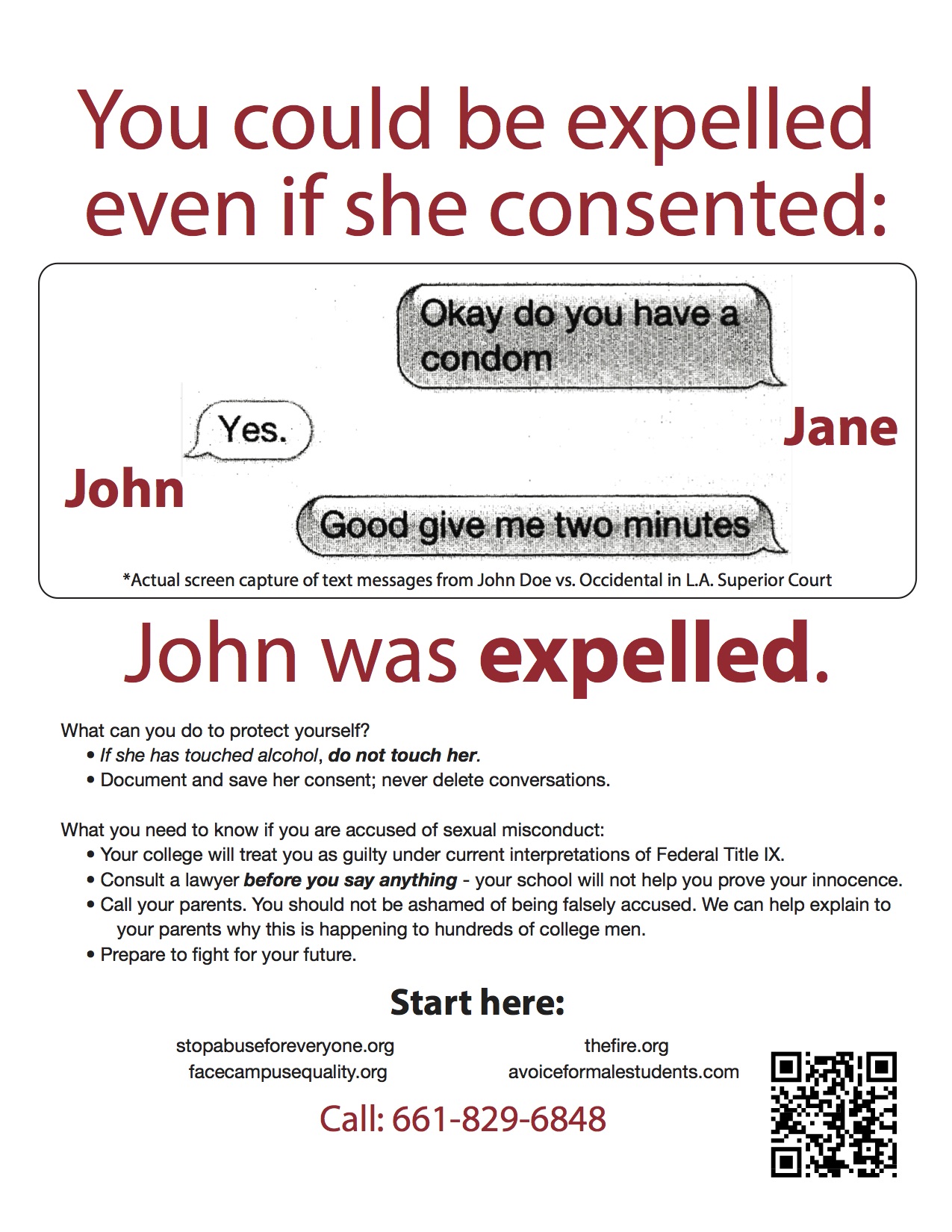
There have been a number of interesting and important ideas bandied about on the pressing problem of campus rape and sexual assault discipline, in addition to the tepid grasp of the harm deriving from a deeply screwed up process.  Since this is still in its formative stage, and real lives are at risk, it continues to be worth discussing.

To a large extent, the confusion derives from misunderstandings, either because the people discussing the issue lack sufficient knowledge and background in what they’re talking about (because that rarely happens on the internets) or they use words and concepts with which they’re unfamiliar, and choose to define them (or undefine them, if that makes their arguments work better), and no one explains why they’re not allowed to just make stuff up. So, this seems like an opportunity to try to unscrew up some of the nonsense.

Don’t Be Hating On The Inquisitor

In a twit, K.C. Johnson pulled out a bit from lawprof Paul Gowder’s comment to Tamara Lave’s post at PrawfsBlawg that looks, well, just horribly bad.

Honestly, I’m not even sure why we need an adversary process at all. In light of the fact that the fundamental purpose of such process is to exclude individuals who prey on these closed communities, it seems reasonable as a first-pass to me to have an inquisitorial process in which accusations are investigated by neutral trained professional staff, and then action is taken based on an overall conclusion as to the impact that that student’s presence would have on the learning environment.

Posted by: Paul Gowder | Sep 3, 2015 12:49:05 PM

Continue reading →

Shifting Burdens: Prawfs Take Note of Affirmative Consent Issues

While lawprofs at Harvard (where Ted Cruz learned all about constitutional law) and Penn stood up when their respective schools sought to wiggle their way out of responsibility for establishing the star chamber, there has been remarkably little discussion about the problematic mechanics within the Academy.

That changed with Miami lawprof Tamara Rice Lave’s post at PrawfsBlawg, agreeing with Chancellor Carol McCoy’s decision in Mock v. University of Tennessee that affirmative consent shifted the burden of proof to the accused, the male student, to prove consent.

When I was a public defender, I used to always remind jurors that because the BOP was on the prosecutor, I could literally say nothing, and still, if the D.A. didn’t prove the case beyond a reasonable doubt, they would have to acquit. But with affirmative consent, the accused must put on evidence. If the university proves by a preponderance of the evidence that a sex act happened, the student has violated the university code of conduct unless he can convince the fact finder that the complainant consented.

I predicted that this would devolve into a shitstorm of feelz. I was wrong. The reaction was substantive, even though it suffered mightily from the Squire of Gothos dilemma. Lawprof Paul Gowder tried to hijack the post, reflecting his need to reread Matthews v. Eldridge to avoid the “remember the rubric, forget the rationale” problem, which gave rise to this: Continue reading →

And The Winner Is . . . Screwed

Dear Mr. Rodriguez:

Congratulations! You were right, a traffic stop ends when the officer hands you the ticket, even if it’s just a warning. Done. Over.  He doesn’t get to then ask you for permission to search your car. He doesn’t get to make you wait for one of those adorable police dogs to show up, walk around your car, sniff and, well, we all know what happens from there, don’t we.

Nope, you nailed it. Dennys (may we call you Dennys?), this is big. From now on, whenever a court learns that a cop held a motorist beyond the completion of the core mission of a traffic stop, the judge is going to say your name. Yours! Maybe it’s not as big a deal as Ernesto Miranda or Clarence Earl Gideon, but it’s no small shakes either. You, Dennys, made this happen because you took the fight all the way to the Supreme Court. You da man, Dennys.

Now for a little bad news. While you’re going down in history, it’s not really going to do much for you.  I know, you stuck it out, made the right, and reached the top of the mountain. Good on you for your tenacity.  But as much as you convinced us that your constitutional rights were violated, well, you aren’t going to get the benefit of your hard work. Continue reading →

Humble Pie

At Defending People, Mark Bennett has finally pushed through his wall of disinterest, as reflected in his 72nd post of 2015* when he demonstrated his disinterest in unjustified police killings by writing about unjustified police killings.  His 73rd post quotes at length from Texas Lieutenant Governor Dan Patrick’s missive, stoking fear and loathing of those who support Black Lives Matter.

In Patrick’s eyes, the movement is an attack upon law enforcement, a war cry to kill cops.

As more details of the tragic death of Harris County Sheriff Deputy Darren Goforth unfold, a morbid reality is unveiled about America’s negative attitude toward our law enforcement officers.

This isn’t because cops needlessly kill too many people, and dogs, so they will be assured to make it home for dinner. Patrick goes on to list the usual tropes, and Bennett does his usual excellent job of debunking them. Continue reading →