
The Mugshot Conundrum

While no one argues that there is any virtue whatsoever in the posting of nude images of nonconsenting people on the internet, or that such images don’t harm the victims, the same can’t be said about a variation on the theme, the mugshot.  Unlike the gutter websites doing revenge porn, the mugshot industry operates above-board and with the acquiescence, if not approval, of the government. Where do you think they get the mugshots?

Mike Riggs does a great job of presenting the arguments by both sides of this problematic issue:

In a feature that ran this past weekend, The New York Times drew some much needed attention to a very ugly business: websites that trawl sheriff and police databases for mugshots, post those mugshots on their own sites, then charge arrestees to have their mugshots taken down. Continue reading →
New York to Revenge Porn: Any Selfies of Lawprof Mary Anne Franks? (Update x2)

Update 2 (See the bottom for update 1): Mark Bennett has done the heavy lifting in his scholarly deconstruction of the arguments in favor of a law criminalizing revenge porn, both by Franks as well as Danielle Citron.  It’s thorough. It’s researched and cited.

And unlike the arguments in favor of undermining speech, it’s accurate and does not rely on false assertions as to the state of the law. Bennett’s post authoritatively answers the questions of those who want to leap over the law to reach their endgame.

_____________________________________

I’m almost ashamed of myself for this title, because I have no doubt that University of Miami law school professor Mary Anne Franks comes by her opinion honestly, and has only the best of intentions in promoting her cause.  The problem is her cause, like so many causes wrapped up in sexual politics, is the evisceration of free speech in the name of protecting women.

Gawker brings us the news, that a few New York legislators want to hop on the left coast revenge porn train to internet Nirvana. Hey, if California can do it, why not New York?

Last week, California criminalized revenge porn. Now, New York state legislators are proposing a bill that would also target people who distribute nude photos of others without their consent. Continue reading →

A Brilliantly Fiendish Response

There is a line that asks for your relationship to the person being endorsed.  Mark Bennett picked the only answer that truthfully applied: Other.

The latest plague going around the interwebz for lawyers is the endorsement scam.  It’s happening at LinkedIn. It’s happening at Avvo.  And just in case nobody wants to endorse you for anything other than dog catcher (and maybe not even that), there are buttons to push that enable you to beg for endorsements from people you don’t know. Easy-peasy. Sleazy. Continue reading →

Another First Monday

The First Monday in October brings chills to some in the blawgosphere.  Title 28 of the United States Code, §2, commands us to care:

The Supreme Court shall hold at the seat of government a term of court commencing on the first Monday in October of each year and may hold such adjourned or special terms as may be necessary.

And so it starts. There will be stories and posts today about the important cases on the docket, and how the decisions of five people will change the course of our law. Continue reading →

Job Description: Prosecutor

When Rick Horowitz and Jeff Gamso ripped the decision of Sam D’Aquilla, District Attorney of Lousisiana’s 20th Judicial District and the brains behind reindicting Herman Wallace in the hours before his death from cancer, they noted his banal explanation:

I’m a prosecutor. This is what we do.

It was not merely heartless and infuriating, but it was also false. A blatant lie. It’s the sort of statement that adds fuel to the fire of hatred toward prosecutors, when it’s a reflection of one prosecutor, a rogue, whose exercise of discretion was used to vindictively and, in this instance, absurdly, explain the job.  Not even D’Aquilla can prosecute a dead man, as much as he may want to or think it’s “what we do.” Continue reading →

The Good, The Bad, and The Ugly of the Internet

Refusing to be a slave to spaghetti western titles, I begin with the bad.  Herman Wallace died. Freed from prison at age 71 for a bad trial for a crime he denied, after spending 41 years in solitary confinement, Herman Wallace succumbed to cancer the day after his release.

The Good comes from Jeff Gamso and Rick Horowitz, both of whom addressed how such a thing could have happened to Herman Wallace.  From Gamso:

But this isn’t just a story of love and warmth.  It’s not just a feel-good tale of redemption.  This is a story to piss you off.  As much as it’s the story of Herman Wallace, it’s also the story of Inspector Javert District Attorney Sam D’Aquilla.  Who had urged the warden to keep Wallace in prison after Judge Jackson ordered his release.  And who obtained a new indictment against him Thursday afternoon, again charging him with Miller’s murder. Continue reading →

What Law Will Be Named After Christian Adamek?

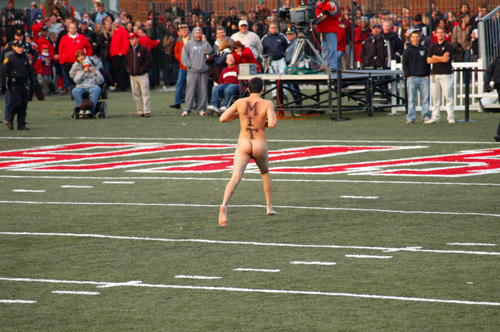
Streaking. It was a fad for a while in the 1970’s, funny, harmless and certain to piss off the grown ups.  At the Harvard-Yale game in 2006, a nostalgic MIT hacker reminded them which school had the best sense of humor.

File:MIT streaker at HarvardYale game.jpg

This isn’t to be flippant about what follows in this post, but rather to provide context to the seriousness of the offense with which 15-year-old Sparkman High School student Christian Adamek was charged. Continue reading →

Riot On Wheels Wasn’t Exactly Copless (Udate)

The video went viral as it should, given how awful the images were.  A swarm of motorcyclists driving crazy, having a grand time and then, inexplicably, one motorcyclist stopping a Range Rover on the highway. It didn’t end well for the motorcyclist, or the driver.

The motorcyclist who insanely decided to take on the SUV ended up with two broken legs, perhaps paralyzed for life, when the Range Rover tried to get away.  From the motorcyclists’ perspective, the driver of the SUV only needed to do as he was being forced to do and he would have been fine.  While that safe outcome was by no means assured, Continue reading →

Losing The Ethics Race

Some guy created a website that allows other people to click some button that says he’s a pretty cool guy and does great at his job. People the guy doesn’t know click on the button to say how great he is at his job. He’s got nothing to do with it, but he knows that the people clicking on his button don’t know him and wouldn’t have a clue whether he was any good or not.

The guy doesn’t care a whole lot about whether people click on his button or not, but doesn’t have a problem with it either. Who gets upset about people they don’t know saying unwarranted nice things about them?  But other people, the ones who regulate what he does for a living, have a rule that says two things: first, that you can’t bullshit people, Continue reading →

Standard Condition of Supervised Release: Be Flaccid

Among certain public officials, penises are all the rage. And so they impose conditions, whether to stick things in there or just to require people to offer them up as a condition of freedom.  The Second Circuit, thankfully, does not harbor such an attraction, as reflected in its decision in United State v. McLaurin.

When David McLaurin failed to register as required as a sex offender, he was sentenced to 15 months imprisonment plus, upon release, the standard conditions of supervised release, which the judge pronounced to include:

“participate in an approved program of sex offender evaluation and treatment, which may include . . . plethysmograph examinations, as directed by the probation officer.” Continue reading →