Judge Belvin Perry: I’m Still Ready For My Close-Up

One of the hardest things for a lawyer to get over following the conclusion of a high-profile case is the realization that the media doesn’t really love you and you aren’t a star.  Some lawyers try to circumvent this painful epiphany by becoming a source of constantly outrageous and intellectually vapid commentary, usually to their embarrassment and notoriety.  They don’t care, as long as they can keep a bit of the spotlight on them.

And what are judges if not lawyers with curious psychological needs?  Well, not all, but some.  As it turns out, the judge who basked in the klieg lights of the Casey Anthony reality show couldn’t bear the lack of attention after the verdict was read.

So strong was Belvin Perry’s need to be a star that the daily sycophantic “yes, Your Honor, you are so smart, funny and handsome,” no longer satisfied his yearning.  So deep was compulsion to have the world look at him in admiration again that he threw  Canon 2 of the Code of Judicial Conduct to the wind as he donned his finest suit and the tie he selected all by himself from the Just Ties store on the internet and strutted into the Today Show studios and headed straight to make-up, stopping only briefly in the green room to see what donuts were offered.

And then he did the unthinkable.  Florida’s 9th Judicial Circuit Court Chief judge Belvin Perry, Jr., with a broad smile across his ample face, in the laconic voice affectation that only judges enjoy as anyone else would be told to get to the damn point already,  gave a tell-all interview to Savannah Guthrie about the Casey Anthony case.

Some of the highlights offered by the learned jurist, via Jonathan Turley :

He explained on the Today show that “[t]here were two sides to Casey Anthony. There was the side that was before the jury, where she portrayed the role of a mother who had lost a child, someone who was wrongfully accused, and then you could notice the change and transformation in her when the jury went out. She was very commanding, she took charge of different things, and you could see her sometimes scolding her attorneys.”

He then proceeds to describe meeting with her counsel and non-public conversations with her and counsel. He relayed how Anthony reacted to an offer for a plea of aggravated manslaughter: “I will never forget that day,” he said. “All of a sudden, you heard shouting coming from the holding cell, some four-letter words coming from the holding cell, and she was quite upset. So upset that one counselor suggested that she was incompetent to proceed.”


Perry further tells the public of his “surprise,” “shock” and “disbelief” at reading Anthony’s acquittal and that “[t]here was sufficient evidence to sustain a verdict of murder in the first degree in this case.” In other words, despite her acquittal, Perry wants the public to know that he thinks she murdered her daughter.


He also described the prosecutors as “better lawyers” and, in a backhanded compliment, described the lead defense counsel as a used car salesman.

Searching for the perfect word to describe Judge Perry’s commentary left me stymied. Disgraceful? Outrageous?  Humiliating? Yet none captured to the depth of this egomaniacal need to reclaim the spotlight, to beg for the attention once held, while abandoning any shred of dignity or propriety.  Reminiscent of the Passover song Dayenu, had he agreed to be interviewed, but conducted himself in a reasonably appropriate manner, it would have been enough to violate the Code of Judicial Conduct. 

But he went on national television to speak of a matter that only came within his purview because he held the position of judge, and dished his personal views as if he was Joan Rivers on Fashion Police doing the “Bitch Stole My Look” segment.  A woman was acquitted, but Perry felt compelled, or perhaps entitled, to pronounce her guilty.  A lawyer won the case, but Perry felt compelled, or perhaps entitled, to call him a used car salesman.

As he spoke, his smile broadened, his carefully selected words resonated in that slow drawl that simultaneously makes him sound like such a Baptist preacher and the village idiot, and removed any lingering doubt that his need to extend his 15 minutes of fame was stronger than any other motivation.

Maybe Judge Belvin Perry is about to leave the bench and wanted a head start on his career as an elder statesman of the law, launching it from the Today Show studio. Maybe he didn’t care about his flagrant violation of the Canon 2, or his single-handedly eviscerating every shred of dignity that the robe gave the man.

But Judge Perry made the same mistake lawyers commonly make when the cameras are shut off and the lights dim.  He’s no star.  He’s no celebrity.  To the extent anyone cares if he exists, it was only because of his fortuitous connection to a trial that ran like a soap opera, with a nation tuning in for the next episode.  But the show is over, and he’s now sucked the last minute out of his celebrity existence.  After this interview, and his revelations that might otherwise have aired on the Real Housewives Reunion Hour, no one will do his makeup for his next close-up.  No one cares.

Hope you enjoyed your moment in the sun, Judge. It was disgraceful, outrageous and humiliating. Worse still, it was banal.  Was it worth it?


No Escape

Much as the concept of paying one’s debt to society is a quaint arcane notion for those who have done wrong (or not) and served their sentence, so too is the notion that acquittal or dismissal of criminal charges means people are returned to the place they should have been but for the mistake.  Ah yes, the good old days, when a person could walk away from a false criminal accusation to return to his rightful place in society. Gone.

Via the New York Times :


Across much of the country, sealing or clearing a criminal record after a wrongful conviction is a tangled and expensive process, advocates and former prisoners say. It can take years of appeals to courts and pleas to governors to wipe the slate clean. Even then, many felony convictions remain on federal databases and pop up during background checks or at traffic stops.

Would it shock you to learn that the government is remarkably good about making sure any charge against a person in input into its myriad databases?  It would be unthinkable, and invariably embarrassing, if an accused criminal wasn’t immediately recognizable to any law enforcement agency charged with keeping the bad people away from the good people.

Unfortunately, the government isn’t nearly as good at getting the names of those whose accusations didn’t pan out off the lists.  It’s not their fault, of course. Limited manpower. Low priority. And they’re probably guilty of something anyway.  After all, they were arrested and charged, and it’s not like the government would charge someone who wasn’t a bad dude.


Clearing a criminal record can take years and cost thousands of dollars in legal fees, and differs widely state to state. Many require that defendants return to court to prove their innocence, a higher hurdle than showing that charges were dismissed or a conviction was overturned. In some states, a governor’s pardon is needed. It can be a complex process, which advocates say is made even more difficult by a lack of support services for the exonerated.
There tends to be some common themes among the wrongfully charged. They’re poor. They have no clout. Nobody gives a damn about what happens to them after the case is tossed.  For the most part, the attitude that they got lucky and got away with it prevails, as opposed to the belief that they are presumed innocent and that presumption remains intact.  Another fine platitude, universally ignored.

And the criminal history is only a part of the problem.


Of course, blotting out a criminal record does not solve everything. Researchers have found that high percentages of the wrongfully convicted slide into poverty or substance abuse as they struggle to rebuild a life outside prison. How do you explain a 10-year gap on a résumé? How do you answer a yes-or-no question from a prospective employer asking whether you have ever been convicted of a felony?
The answer to the latter question, at least in New York, is that once a conviction has been vacated, it never happened as a matter of law, so that one can enjoy the legal fiction that you were never arrested and never convicted. But that doesn’t explain what you’ve been up to for the past decade.  Potential employers tend to pick up on those sorts of things. And the truthful explanation, that you were wrongfully convicted of rape and murder and finally released, tends not to get nearly as good a reception as one might imagine.

The Times piece omits yet another factor that can’t be ignored. Even when exercising one’s right to claim, as the law may permit, that one has never been convicted of a crime, the potential employer will run the applicant’s criminal history anyway.  They will search the internet. They will find out whether the applicant is telling the truth, at least from the distant perspective of the employer.  

No amount of official expungement or sealing of criminal records, even if done properly and diligently by the government, is going to clean up the internet.  There is now a cottage industry in providing potential employers with criminal histories of applicants, and they not only provide a decidedly unreliable source of information, but there is no way to know whether the bad stuff they purchase from the cops and courts will ever be changed or deleted when the conviction goes away.

Some see this as the price of transparency, and how cool is it to be able to go to a website to find out whether the nice couple who moved in down the block are convicted child molesters?  Yet again, those who don’t see the price as too high tend to be the ones who don’t think they will ever have to pay. Giving up other people’s rights is hardly a concern for those with clean histories. Of course, if they happen to have names similar to people with more sordid pasts, they may change their minds.

In the meantime, this creates yet another constituency of people who will comprise a permanent underclass, unable to break away from the taint of false accusation and wrongful conviction, and doomed to struggle with employment, housing and, well, basic survival.  But then, since they were arrested, they must have done something wrong to deserve a life of misery.  Right?


Son of Zero Tolerance

Rap music lyrics on the internet? A joke?  A childish prank never meant to hurt anyone?  If this was a Jeopardy question, the answer would be things that landed you in jail in 2013.  From the Christian Science Monitor,


“The bottom line is that the public wants to know, after the fact, why [an attack] was not stopped.… Most Americans are prepared to maintain a sophisticated watch on this without [government] overreach, but most Americans also feel if these things can be stopped before they begin, they want to see that happen,” says Michael Greenberger, a law professor at the University of Maryland Center for Health and Homeland Security.
Few things are more quintessentially American than simple solutions to complex problems, without the slightest thought of unintended consequences.  And few people think such thoughts better than the people charged with protecting us from threats, particularly since they really hate being blamed when a bad thing happens.
“The greatest mystery in life is the human mind. We don’t know what other people do until it becomes known. Our job is to figure it out, but we need indicators to know something’s not right,” says Sgt. Ed Mullins of the New York Police Department, who is also president of the Sergeants Benevolent Association, the city’s second-largest police union.

Mullins sounds rather existential at this point, like our very own New York City police sergeant philosopher, pondering the wonders of the human mind.  Deep thoughts, indeed, until he brings it home:


Using a zero tolerance approach to track domestic terrorists online is the only reasonable way to analyze online threats these days, especially after the Boston Marathon bombing and news that the suspects had subsequently planned to target Times Square in Manhattan, Mullins says. The way law enforcement agencies approach online activity that appears sinister is this: “If you’re not a terrorist, if you’re not a threat, prove it,” he says.

And there they are, the two little words that the cognoscenti have latched onto in the past, wreaking havoc with out world and producing some of the most stunningly absurd outcomes imaginable.  But it’s simple and nondiscriminatory, requiring no brain cells to apply:  Zero Tolerance.  It’s ba-aack.

Now for Sgt. Mullins’ money line:


“This is the price you pay to live in free society right now. It’s just the way it is,” Mullins adds.

There it is. Freedom isn’t free. The price to live in a free society is to end to freedom of speech.  Don’t think too hard about it, as it will only compel an epic double facepalm. Isn’t it amazing how something as irrational as this can be uttered without shame?

This has proven very appealing in the past, the sacrifice of a right that most will never exercise and hence don’t value highly in the name of safety?  Some will explain it as a small price to pay, as no one needs to speak of violence or anger or hatred, and therefore its use as an advance indicator of violence has the potential to protect us from a scary threat at a very reasonable price. 

The problem, of course, is the assessment of reasonableness, the small price, is made by people who fail to grasp that the point of free speech isn’t to protect the mainstream speech that most of us enjoy and few of us fear, but the ideas on the fringe, the speech that takes us outside what your mother might say.


The case of teenager Cameron Dambrosio might serve as an object lesson to young people everywhere about minding what you say online unless you are prepared to be arrested for terrorism.


The Methuen, Mass., high school student was arrested last week after posting online videos that show him rapping an original song that police say contained “disturbing verbiage” and reportedly mentioned the White House and the Boston Marathon bombing. He is charged with communicating terrorist threats, a state felony, and faces a potential 20 years in prison. Bail is set at $1 million.


As D’ambrosio’s “error” timing, or the extent of his “disturbing verbiage”?  Or was there no error at all, but rather a test of fortitude in the aftermath of an unrelated tragedy?  Not having seen or heard his rapping, I offer no opinion on its quality or merit. But then, even if it sucked and was vividly violent in its images, so what? It’s a song. As  Tim Cushing pegs it, “being-a-lousy-rapper-still-not-a-crime.”


The threat (at least the one that appeared on Facebook), as reported by the Boston Herald, reads as follows. (For best results, fill in the blanks Mad Libs-style and spell “bombing” correctly.)


“I’m not in reality, So when u see me (expletive) go insane and make the news, the paper, and the (expletive) federal house of horror known as the white house, Don’t (expletive) cry or be worried because all YOU people (expletive) caused this (expletive).

(Expletive) a boston bominb wait till u see the (expletive) I do, I’ma be famous rapping, and beat every murder charge that comes across me!”

This was posted to D’Ambrosio’s Facebook page, which looks altogether similar to thousands of teens’ Facebook pages.


Yeah.  Cool rap, bro. This points to two facets of life in the digital age that need recognition, that law enforcement is scouring the deepest regions of the interwebz for keywords that set off alarms and send out SWAT teams to stop the next bomber, and perhaps the 10,000 others who will have to take one for the team to appease Sgt. Mullins’ zero tolerance policy. 

The second is the fear that music, or preaching, or simplistic platitudes, playing on the theme of youthful alienation and dissatisfaction, will radicalize the next person who will then shoot up a school, bomb a marathon, steer a plane into a tall building.  Unfortunately, there is some merit in these concerns, even if the appearance of increasing frequency of abhorrent tragedies doesn’t begin to approach the lives lost to wrongful police conduct, or even car crashes.

But Menckenian solutions have failed before, and have invariably come at a price too steep. The shame is we never seem to realize the value of what we give away in liberty for the pretense of safety until the loss has done its damage and become ingrained in our new societal norms.  And here we go, doing it all over again.

H/T Tim Cushing

But For Video: The Trooper Asked Nicely Edition

Much as I would like to note that New York State Troopers are better trained, more open-minded in the performance of their duty and aren’t just dopes in cool uniforms, I’m afraid I can’t.  Meet the unidentified trooper from Troop F, who asks nicely while working the Charles River Lab Protest before resorting to unlawful restraint.


The good news is that his supervisor refused to back up his improper arrest for being filmed despite his having asked nicely.  The bad news is that he still hasn’t been taught how to wear his hat properly.  The problem is that the trooper, misidentified initially, has yet to be conclusively ID’d, and until he is, it will be impossible to alert him to his trooper fashion faux pas.

While he may have been alerted to his constitutional error, the hat issue remains unresolved. Don’t let this man go about his job looking like a fool. Help us to identify this trooper. Do it for the children.

H/T Carlos Miller PINAC

Former Chief Judge Makes A Rookie Mistake

Former Chief Judge of the New York Court of Appeals, Sol Wachtler, came up with a lot of good law before he lost it, and one of his ideas has been the subject of much discussion lately.  Yes, Sol wrote the NY high court decision in Quarles, the public safety exception case that allowed the feds to question  Dzhokhar Tsarnaev without Miranda warnings.  The Supremes adopted Sol’s view for their own.

Don’t hate Sol for it. He was really quite a good judge, and a very decent guy before his life fell into the toilet.  If you look behind the Quarles decision, which didn’t involve “terrorism” or prolonged questioning, it made sense, even if it was a bit too outcome oriented for anyone who is more concerned with doctrinal integrity than nailing the bad guy. So Sol wasn’t perfect.  Still, his court held firm against a Supreme Court determined to undermine anything favorable to the defense in its own jurisprudence. Give him credit where due.

We haven’t heard much from Sol lately, but he appeared last weekend in a  Newsday op-ed to defend his honor for his finger in the Quarles decision.


Some 20 years ago, when I was a judge on the New York Court of Appeals, I wrote a decision in a case where the police were told that a man in a supermarket in Queens had a loaded gun. When Benjamin Quarles was apprehended, he had an empty holster and the police asked where the weapon was. After the suspect showed the police where he had hidden the gun, he was arrested and charged with criminal possession of a weapon. It was argued that his incriminating statement about the gun was elicited in violation of his Miranda warnings.


My opinion in that case, later embraced by the Supreme Court, created the “public emergency exception” to Miranda. It allows the police to interrogate a suspect before administering the warnings, in order to protect the public in an unfolding and potentially dangerous situation.


Not to endorse the reasoning, but note that Quarles dealt with a very discrete bit of information needed for safety, the location of his gun.  They knew he had a gun. They didn’t know where it was. It presented an imminent threat.  The case Sol decided not only had a very specific “public safety” question, but a very discrete answer: here’s the gun, exception over.

Mind you, the need to find the gun and the use of the statement against Quarles at trial are separate issues. That the importance of finding the gun exceeded the concern about giving Miranda warnings is completely understandable. So don’t warn. But lose the statement. That’s life in a constitutional democracy. But no, not this time.  Not anymore.

Tsarnaev was a very different case, and concern, than Quarles.  But even so, the un-mirandized statement should not have been an issue from a doctrinal point of view.


It should be understood, first and foremost, that the failure to give the Miranda warnings does not result in a case being dismissed. It only results in the inability of the police to use an elicited confession against the accused. Indeed, the overwhelming majority of successful criminal prosecutions do not involve confessions. And no confession would have been needed to try and successfully convict Tsarnaev of the heinous crime he is accused of in Boston. It’s hard to imagine a case where so much evidence of guilt is at hand.

This is basic to Miranda analysis, that the only remedy for its violation is that the statements can’t be used at trial. This is either a flaw or feature, according to your perspective. In your concern over the violation of constitutional rights is more important that interrogation at will, then it reflects a failure of the remedy, designed with the notion that the only concern in violating constitutional rights is its subsequent impact at trial.  There is no remedy that compels law enforcement to honor the Constitution just because it’s the Constitution. You know, sworn oath and all. Instead, it’s just an obstacle to circumvent.

But then Sol slams the Magistrate Judge who appeared to do magisterial judge-type stuff.


The federal magistrate who interrupted the interrogation to administer Tsarnaev’s Miranda warnings was well intentioned, but it appears to have been an unwarranted interference with an important investigation.

This contention reflects the sort of rookie mistake non-lawyers make all the time, and even though Sol technically falls into the non-lawyer category now, it’s hard to cut the former Chief Judge a break on that count.  But since  County of Riverside v. McLaughlin was decided in 1991, a year before his fall from grace, when he was still a lawyer, not to mention Chief Judge, he’s got no excuse for not knowing it.

In McLaughlin, the Supreme Court put some meat on the bones of Gerstein v. Pugh, holding that the Fourth Amendment required a defendant in custody to be brought before a neutral magistrate for a probable cause determination as soon as reasonably possible.  In McLaughlin, the Court concluded the systemic outer limit as 48 hours.  Tsarnaev was captured Friday night. The Magistrate Judge arrived at the hospital Sunday night. Do the math.

So while Sol may be (and the word “may” is used instead of “is” deliberately) correct that his beloved Quarles public safety exception was properly invoked to interrogate Tsarnaev, though he fails to address the duration of the questioning or its invocation in the absence of any basis to believe there was any imminent harm, like Ben Quarles’ missing gun, that was so potentially dangerous, his castigation of the Magistrate Judge comes at the expense of another constitutional right, not to be indefinitely detained without a judicial determination of probable cause.

And even if Sol, as the Chief Judge of the New York state courts rather than federal, he should have known that a year before McLaughlin, Supreme Court Justice Brenda Soloff had ruled that under New York’s more protective constitutional scheme, arrest to arraignment delay was limited to 24 hours.  The ruling was upheld in a  per curiam opinion in March, 1991 by a court whose Chief Judge was still Sol Wachtler.

It’s a rookie mistake to focus on one piece of the puzzle but ignore another, and Sol Wachtler is no rookie.

Book Review: Mistrial

Much as I fought the anticipation of hating this book before even cracking the spine, I knew it was a losing battle.  After all, its primary author was Mark Geragos, whose only competition for biggest media whore ever was New York’s beloved mayor, Ed “How’m I doing?” Koch. 


Aside: Mayor Koch was available for comment, but no one asked.
Working through the introduction, my worst suspicions were realized, as Geragos explained that society needed to know the inside story of the criminal justice system, and it thus fell on his broad shoulders to explain it to them. It was just a huge void, the rest of us so utterly inconsequential in comparison to him, that the words from his fingers would enlighten a nation that otherwise lived lives of quiet desperation with the Word of Geragos.  I was thrilled at the prospect of ripping this egomaniac a new one.

And then something happened. As I read the book, I began to seethe. Dammit, the bastard wrote a good book. It was good. Despite his dalliances into the great glory of Geragos, name-dropper extraordinaire, the book is written with alarming normalcy, not the pomposity of the only guy capable of informing society of the secrets of the legal world.  It was straight forward, easy to read, and reflected a sense of humor much like one might find here.

In exposing the ugly secrets of how the criminal justice system ended up in its current state of hot mess, Geragos attributes the societal influences to politics, the O.J. Simpson trial and the Rise of the Angry Blond White Women.  The first is fairly obvious, having been beaten to death though Geragos handles it well.  The second, the O.J. trial, is the stuff that one would absolutely expect of Geragos, it having been his ticket to media stardom.  Indeed, he can’t let go, making such announcements in the book as


The verdict shocked most of the country, but it did not surprise defense lawyers in L.A. Almost the entire defense bar believed that O.J. was guilty, but we also felt there was very little chance this jury was going to convict.
See what he did there? In two sentences, he elevated himself to omniscience while reducing Johnnie Cochran to mere functionary in a trial that couldn’t be lost. I couldn’t help but wonder what Winona Ryder thought of that.  But then he gets into his Angry Blond White Women, who didn’t have to be Blond, White or Women.

In skewering Ann Coulter, whose specialty was listed on TV as “constitutional lawyer,” he writes:


Eventually, we decided that “constitutional lawyer” was a synomym for “unemployed lawyer incapable of holding down a real legal job.”
It’s unclear what role Pat Harris played in the book, other than providing occasional asides which serve to provide a juxtaposition of humility and humor to Geragos. His aside about Coulter left me with an image I can’t shake:


In fact, in 2012, Ann Coulter gave a speech to a conservative convention in which she made a series of Clinton penis jokes. Fifteen years later! Fifteen years later and she still has Clinton’s penis on her brain.
Classic.  And the discussion of Coulter is downright kind in comparison to Nancy Grace, about whom no epithet is spared.  Notably, Geragos quotes from the blog of our compadre, Jonathan Turley, about Grace, indicating that either I’ve been far too kind to her or he’s a professor and I’m not.

It wouldn’t be a book by Geragos if it didn’t devolve into a discussion of his celebrity clients and cases, which I skipped over after a bit because I just couldn’t care less.  After all, it’s his ego trip so he’s allowed to pander to his fan base, even if his mother and both friends already knows his stories. 

But his discussion of the system, the deep and nasty flaws reflected in our wishful embrace of brilliant and unbiased judges, honest and hard-working prosecutors (other than his father, who was perfect) and jurors, in whom the desperate pin their last hope for justice but who couldn’t decide the time of day correctly if they had the atomic clock in the jury room, is right on target.  He hits hard and true.

It’s not that Mistrial by Penguin Books offers any revelations about the system to those who have paid attention all along, but rather confirms what we’ve been talking about all along, and does so with some interesting stories and turns of phrase.  Geragos’ perspective is left coast, and very much the view from the seat across from Larry King, but he still sees it, and calls it, the way it is.

Much as it breaks my heart to say this, it’s a book worth getting and reading, if you’re interested, as the subtitle says, in “an inside look at how the criminal justice system works…and sometimes doesn’t,” or are considering setting up a Mark Geragos fan club in your neighborhood.  It’s actually a really good book, making me despise Geragos all the more.

________________
A word of thanks for Mark Bennett, without whom I probably would have abandoned the book after the introduction, who scolded me for being such a hater. You were right. I was wrong. Thank you.

Cuba No Libre

Aside from the pleasurable schadenfreude of knowing that we hold a piece of turf on Castro’s island paradise, what purpose was served by maintaining a United States military base at Guantánamo Bay?  Certainly it offers a well-isolated locale for storing people we prefer not be close enough to good Americans to get a whiff of the scent of torture or hear the screams.

And isn’t that a good enough reason?

Only if you have the deep pockets to pay for the waterfront land.  The cost per prisoner at Gitmo would be far more than needed to put up an enemy combatant in the finest hotel on a leeward island for life.  And what are the chances that anyone would want to bomb a country who provided free room service, liquor included?  From  Reuters via Doug Berman :


The Pentagon estimates it spends about $150 million each year to operate the prison and military court system at the U.S. Naval Base in Cuba, which was set up 11 years ago to house foreign terrorism suspects. With 166 inmates currently in custody, that amounts to an annual cost of $903,614 per prisoner.


By comparison, super-maximum security prisons in the United States spend about $60,000 to $70,000 at most to house their inmates, analysts say. And the average cost across all federal prisons is about $30,000, they say.

It’s worth repeating: the annual cost per prisoner, without even getting into the nasty details like human beings not charged with any offense, not convicted of any offense, not there because of any credible evidence they are the enemy combatants they’ve been called, or even mentioning the “T” word that John Yoo says is cool with him, is $903,614.  Did you realize how much it costs the United States to keep these guys?

Not that it’s really needed, but the Reuters article provides a bit of context, courtesy of the American Progress think tank:

Just one inmate from Guantanamo, for example, is equivalent to the cost of 12 weeks of White House tours for the public – a treasured tradition that the Secret Service says costs $74,000 a week and that has been axed under sequestration.


A single inmate is also the equivalent of keeping open the control tower at the Northwest Arkansas Regional Airport for 45 months. That control tower, another victim of cuts, costs $20,000 per month to run.


The $900,000 also matches the funding for nearly seven states to help serve home delivered meals to the elderly. Sequestration has cost Meals on Wheels a median shortfall of $129,497 per state, the organization says.


Or measured in terms of military spending and national security, the cost of four inmates represents the cost of training an Air Force fighter pilot – based on the Department of Defense’s figure of $3.6 million per pilot.

It costs us $3.6 million to train an Air Force fighter pilot?  Seriously? But I digress.

Remember when America launched Son of Iraq War to rid a former ally that had nothing to do with 9/11 of weapons of mass destruction, using the tactic discussed ad nauseum on cable television of Shock and Awe that relied heavily on Bunker Buster Bombs, because any tyrant with WMDs would hide out in a secret bunker?  Some wag revealed  the cost of a BBB at $14.6 million per bomb, and we were dropping them on Iraq!  Had we just dropped bags of money, we likely could have accomplished at least as much, if not more, plus given our economy a far better boost.

For all this money thrown into a black hole from which nothing good emerges, we’ve achieved a remarkably poor return on investment.  According to the Guantánamo Memoirs of Mohamedou Ould Slahi, he never got a piña colada for his troubles.  Complaining to the management did not good, especially while they were not customer service oriented.


I barely finished my meal, when all of a sudden [ ? ? ? ? ?] and I heard a commotion, guards cursing loudly, “I told you, motherfucker …,” people banging the floor violently with heavy boots, dog barking, doors closed loudly. I froze in my seat. [ ? ? ? ? ?] went speechless. We were staring at each other, not knowing what was going on. My heart was pounding because I knew a detainee was going to be hurt. Yes, and the detainee was me.

That’s no way to run a Caribbean paradise.  It’s no way to run a prison.  It’s no way to run a naval base. It’s no way to treat human beings, no matter how much we hate them or how much we spend on them.

Had the federal government spent this money on a control tower in Arkansas, liberals would be calling for revolution.  Had it been spent on Meals on Wheels, conservatives would be oiling up their assault rifles.  But since we spend over $900,000 on Gitmo detainees, no one says a word.

The rallying cry is Freedom isn’t Free. It’s a much better maxim than Freedom costs $903,614 per prisoner.  I just thought you should know.


Smart. Too Smart

After a half hour on the phone, first trying to navigate voice mail and then another half hour with customer service (why, if I press 5 for tech support, am I sent to customer service?) and finally tech support, I learned something: my smartphone’s operating system was upgraded to the point where it no longer did what I wanted it to do.  The tech support gal wrapped it up nicely in jargon, but the upshot was that the phone was improved to the point where it erased what I had put in and ceased performing the function I used.

I thanked her out of reflex at the end of the call. She responded, “no problem,” always a fascinating retort to failure, and hoped she had met my expectations of excellent service. Sadly, she did.

Yesterday, my dear friend  Carolyn Elefant was forced to admit defeat at the hands of technology.  She had planned to do a free webinar on 21st Century Practice, but the 21st Century didn’t cooperate.


I am so, so sorry that I have had to cancel today’s free webinar on how to launch and lift a 21st Century Practice. The immediate cause of the cancellation is that the Anymeeting.com platform crashed – my assistant, more than 100 participants and I were locked out of the site. I’ll trash the service thoroughly in a minute.  But first, my own   mea culpa – ultimately, I stand responsible for the failure because I should have had a back up plan.
Carolyn took responsibility because that’s the type of person she is.  She, of course, was ready, willing and able to fulfill the duty she undertook.  Anymeeting.com failed her.  Ironic, obviously, but poignant in the lesson that a real person doesn’t blame the tools when things to awry.  Still, once one gets beyond the reluctance to rely on technology, one puts one’s fate in the hands of the binary gods.  They don’t always work, and aren’t always kind.

As I’ve heard from a lot of you over the past two days, SJ isn’t working. You can’t open a post, and it eventually times out.  As I learned recently from the people paid by GoDaddy to make excuses, the program that runs this blog is at “end of life,” which is the techie way of saying it’s going out of business. It didn’t stop them from taking my money, but that’s a different department. 

Nor, as it turned out, had they come up with a way for me to make a graceful exit, as the export feature developed for their program could only handle a limited amount of data. I exceeded that amount. By a lot.  They have since come up with a “work-around,” techie jargon for it never occurred to us it would be a problem, so this is our band-aid,

The problem is being worked on as I type (and I am NOT asking for anyone’s advice, so please DO NOT tell me what you think I should do), but there is a fair potential that one day in the not to distant future SJ, and all its contents, will disappear from the face of the internet, existing only in Google cache and the archives of the Library of Congress.

But all of this makes a point that digital natives, technology lovers and fools fail to see. We are putting our lives in the hands of others and they may not treat it as respectfully as we would like.  It’s not a matter of their not trying hard, or having good technology per se, but the external practicalities of the digital age. 

What do you plan to do when a company that holds your content in the clouds shuts its doors because it’s not making enough money to survive?  What will you say to the developers who decide that the apps you absolutely require aren’t the ones they think worthy of saving?  What if an app you’re counting on runs slow, or twitchy, or just plain fails?  Call up customer service and complain?  There is nothing they can do. They don’t want it to fail any more than you do. So how does “we’re working on it” with no ETA in your lifetime work for you?

I responded to Carolyn that my yPad always works. It wasn’t a helpful response, but I did it to make a point. We are slaves to technology.  You are likely more of a slave than I am, but I’m a slave too.  Tech is the tools of the trade these days, but having used it for the past 20 something years, I have seen it come and go, arrive with great fanfare and disappear in silence.  Most of the kids haven’t, and can’t conceive of it ever happening. It happens, and when it does, it smacks you in the face.  You came to rely on it, to expect it to be there every time you turn something on, and then whamo, it’s gone. No word. No warning. Just gone one day.

When I started practicing law, I expected the companies with which I did business to be around for me.  And for a long time, they were. The idea that they would pop up one day and disappear the next, leaving me in the lurch, was unthinkable.  It’s changed since then. Most of the companies are still around, but in an evolved form. Not necessarily evolved for the better, but evolved for their benefit. And in the process, the things that made them reliable for me have evolved as well to the point of indifference.

For you digital natives, this probably won’t mean much. You’ve been trained to expect to have to reprogram your phone every six months to accommodate the next new OS. You expect “end of life,” obsolescence, failure. You take it in stride, as if that’s how the world is supposed to work. Computers are disposable items like diapers, and you don’t mind paying a lot of money for the next shiny toy.

But one day, you’re going to be like me, or Carolyn, and find that your gods have abandoned you. What do you plan to do then?  Reflexively say “thank you” to some excuse-making drone who responds, “no problem”?  Because, my dear friends, it is a problem. It’s a big problem.


Unsafe At Half The Price

Speaking at 1 Police Plaza,  Mayor Michael Bloomberg told New Yorkers the bottom line: Unless you agree to stop and frisk, you will not be safe.

“Look at what’s happened in Boston,” he said. “Remember what happened here on 9/11. Remember all of those who’ve been killed by gun violence and the families they left behind.”

The mayor described criticism of the police as politically motivated. “The attacks most often come from those who play no constructive role in keeping our city safe but, rather, view their jobs as pointing fingers from the steps of City Hall,” he said.

In other words, the naysayers are putting us at risk. I consider myself one of the naysayers, which means in the mayor’s mind, I play no constructive role in keeping our city safe. The battle lines are drawn.

In fairness, one of the core duties of the executive branch, and specifically the chief executive, is to protect the safety of the public.  Faulting the mayor for his focus on safety would be to misapprehend his role in government.  But the dichotomy drawn is a false one, and a guy as smart as Bloomberg knows it.

The options aren’t perfect safety versus totally unsafe.  Nor is the Chief Executive’s concern limited to providing perfect safety.  All of government, by definition as it exists by virtue of a Constitution, has responsibilities, but they are inherently limited by the same Constitution that creates the existence of government and provides for its authority.  So the duty is to provide for safety, within the parameters provided by the Constitution. 

Let’s be real.  Bloomberg’s argument resonates with people because fear is a base instinct.  Fight or flight. It doesn’t take higher order thinking, but natural reflect, to recognize and deal with fear.  People don’t like to think, as thinking takes effort and we’re a lazy breed.


There is no expedient to which a man will not resort to avoid the real labor of thinking.

–Sir Joshua Reynolds

And if we didn’t have those nasty rights reserved to the people, whether expressly or implicitly, the government could impose a far safer world.  It would be safer if the police could stop anyone they wanted on the street at any time for any reason or no reason to search for weapons or contraband.  Same is true if they could perform a “dynamic entry” into our homes in the middle of the night.  It may wake up a lot of otherwise nice people, but they would occasionally find something illegal and dangerous, and would save others from it. 

Safety from crime has always mattered. People value their safety over other people’s rights.  Not their own rights, perhaps, but other people’s for sure.  It takes a lot of thinking to appreciate why the rights of good people (like us) are preserved by affording and protecting the rights of bad people (like them).  Most people aren’t up to the task. Most people won’t even give it a try. Their head starts to pound and they either walk away or yell bad words at you.  It’s not a good way to make friends at parties.

The  New York Times editorial excoriates Mayor Bloomberg for his elevating safety over rights using arguments that appeal to ignorance and save the public from its need for thinking.


Mr. Bloomberg’s suggestion that the program has been responsible for historic drops in crime is also implausible. Crime has declined all over the country, including in places that have not used New York’s aggressively invasive techniques. Besides, if crime rates and street stops had a strong correlation, the murder rate would have gone up in 2012, when stops declined by about 20 percent. In fact, the murder rate fell in 2012 to an all-time low.

Correlation does not imply causation is the answer to a basic logical fallacy. Logic isn’t in fashion these days, however. “Crime is down,” is far easier to digest, and so do whatever it is you’re doing, mayor. It’s working. It must be. And if it’s not, who cares? As long as I feel safer, and it’s not me paying the price for it, we’re cool.

But the voices of the naysayers, people like me, threaten to spoil the safety of the others.


Mr. Bloomberg’s implication that the program’s critics are more interested in vexing City Hall than in keeping the streets clear of murderers was especially reprehensible. No one is opposed to using effective, constitutional means of fighting crime. The problem is that over the last decade the Police Department has shown utter contempt for Fourth Amendment guarantees of freedom from unreasonable search and seizure. And worse, these tactics have been used largely against young black and Hispanic men.

Criminal defense lawyers have long explained to our clients that we will zealously defend them within the bounds of the law.  We will use every means the law allows, but we do not go a step beyond what the law allows. I write this not to pat us on the back, but to show that the concept is hardly foreign to government or a constitutional democracy.  If we can adhere to such a rule, so too can the police. So too can a man as smart as Mayor Bloomberg.

But here’s the kicker. For all his efforts to protect us from harm, whether from people of color, or odd foreign names, or our own gluttony, we can be safer but never safe. There will always be a means for a person inclined to do harm to another person to accomplish his goal. Believing that if we pay the price for freedom by relinquishing liberty, we can make our world safe is a lie we tell ourselves so we can sleep at night.  

Mayor Bloomberg argues that we must accept the violation of our constitutional rights if we are to achieve safety.  


Mr. Bloomberg may never change his views. But his stubborn refusal to see the program’s dangers has not stopped three civil rights lawsuits from going forward in federal court and the City Council from trying to curb the use of tactics that have alienated minority communities from the police and made law-abiding citizens feel like criminals in their own neighborhoods.

To the extent there is any marginal safety to be gained, it will never be worth the price. No one is opposed to using effective, constitutional means to fight crime, and that’s as far as government’s authority extends. Think about it, even if it gives you a headache.

The Legal Wisdom of Michelle Boatley

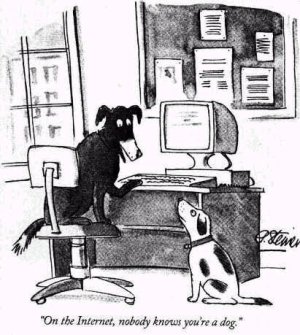
I don’t know how many times over the years I’ve used the punchline from  this comic by Peter Steiner of the New Yorker:  On the internet, nobody knows you’re a dog.  It’s perfect.  Yet, chuckle though so many do at the line, it rarely sinks in. And digital natives and emigres continue to believe because, well, we just can’t believe otherwise.

Thomson Reuters is a major player in legal publishing. It’s a legit company, well known and well regarded because it sells us stuff with the name “West” on it. And West is huge, having lined pretty much every lawyers book case and library since their first day of law school.  If you can’t trust Thomson Reuters, who can you trust?

Except…

Jim Romenesko reveals a bit of a quirk about Thomson Reuters writer Michelle Boatley, who was a mainstay legal journalist of their Australasian Legal Business publication.

A few years ago, Boatley was cranking out stories left and right — short pieces about law firm layoffs, merger deals, and firm expansions.

Then she vanished.

Fired? Tossed to the side by heartless editors? Nah.


The prolific legal writer was not real, but a creation of ALB bosses.

“The names were there to make it look as if the ALB teams were bigger than they really were,” one of my sources writes in an email. “Also, so editors don’t have to use their own names on certain stories (no particular reason).”

See what they did there?  Michelle Boatley had a Facebook account and a gmail address. That was all they needed to create a legal journalist out of thin air.  Want to make your publication look like it’s got a slew of reporters? Just stop by a few websites and, boom, fantasy becomes reality.  Because, as another line that fools embrace informs us, you are what google says you are.

One might have thought that only gutter-dwellers played this game of creating fictional personas on the web,  phony lawyers like David Blade or highly experience and deeply caring lawyers like, well, 90% of the baby lawyers in solo practice.  Or perhaps it’s just about  grabbing eyeballs for social media consequence using anything available, without regard to how monumentally stupid or worthless, because the only thing that matters anymore is to be a rock star on the internet.

But no, even the big boys like Thomson Reuters plays the game.

Of course,  why believe what bloggers have to say when you can rely on legit legal publishers, right?  And clearly everything you find on the internet is true, as everyone knows.  Except Michelle Boatley.