
Category Archives: Uncategorized

Bad Bosses Meet Teacups (Update)

Like so many issues in law, it’s largely a matter of the language used to frame the issue.  The New York Senate has passed a law prohibiting workplace “bullying” with bipartisan support that would expose employers to suit for hurting employees’ feelings.  From the Wall Street Journal :

New York’s anti-bullying bill defines bullying broadly and includes the repeated use of derogatory remarks, insults and epithets, as well as conduct that a “reasonable person” would find threatening, intimidating or humiliating.

The law reflects a popular political trend that’s likely to spread across the country, and covers not only the conduct of supervisors, but those of co-workers, holding the employer liable for hurt feelings whether they derive from the boss or the subordinate. 

According to New York lawmakers, between 16% and 21% of employees have experienced health-endangering workplace bullying, abuse and harassment, and such behavior is four times more prevalent than sexual harassment.

Of course, the term “bullying” is loaded, a pejorative word that no “reasonable” person could dispute is a bad thing.  But that’s how law works these days, characterizing conduct in a way that makes it appear awful so that no one could argue the opposite, that bullying is a good thing.  And obviously it’s not.  The problem is that the law doesn’t merely prohibit bullying, but anything that hurts a person’s feelings.  This is where we get into trouble.

Victoria Pynchon, in her new gig commenting for Forbes, takes up arms.

According to the Journal, the law would “allow workers who’ve been physically, psychologically or economically abused while on the job to file charges against their employers in civil court.”

Economically abused????? The mind boggles.

The bill defines “bullying” broadly as  the “repeated use of derogatory remarks, insults and epithets” that the (mythical and chronically overly sensitive) “reasonable person” would “find threatening, intimidating or humiliating.”

Victoria is one of the nicest people around, frequently chastising me for being insensitive to the teacups.  But this one is too much even for her.

Let’s give this proposal a second thought, particularly in the context of legal practice.  We lawyers do endeavor to “keep calm and carry on.”  We have been known, however, to push ourselves and to be pushed past our tempers’ limits.  We’re human.  We’re under a lot of pressure.  And we’re fallible.

It didn’t happen often to me, but happen it did.  The cutting remark to an associate not performing up to expectation.  The curse made too audibly in the staff room.  The harangue visited upon the hapless secretary who failed for the third time to make the necessary corrections. 

The law seeks to take other workplace restrictions, such as discrimination on the basis of race, down the slippery slope of hurt feelings through the use of charged rhetoric and populist sensibilities.  More people are workers than bosses, and there’s plenty of political capital to be gained by propping up the delicate flowers that have grown everywhere. 

The concept ignores to countervailing concerns: First, jobs are not entitlements.  Hate your boss?  Hate your workplace? Nobody’s forcing you to work there, and you have no right to recreate the job to meet your demands and expectations.  Quit and find one more to your liking.  Can’t find one you love? Bummer.

Second, no business can function well based on the concept of homogenization, catering to the lowest common denominator lest one face litigation and damages by the biggest screw-up in the shop.  It defies human nature, since no one likes to be told that they’re lousy at what they do, and yet too many people are, in fact, lousy at what they do.  The days of excellence are not merely gone, but the target of hatred by the Slackoisie teacups.  Today, businesses aspire to mediocrity.

This law institutionalizes the Happy Dynamic.  People are not merely entitled to job, but one where their superiors and co-workers are legally obliged to make them feel happy.  It’s not bad enough that people confuse unwarranted self-esteem with self-respect, but they should be entitled to it as a matter of law upon pain of damages.

As Vickie notes:

Combating bullying is a worthwhile – even necessary – ongoing business project.  Making a federal (or state) case over the  day-to-day management of any work force and the personal relationships team work requires is just plain nuts. At best, it is a jack-hammer solution to an Emily Post problem.  At worst, it is a new scheme for extortion.

No one is saying that the employer has a right to flog her employees in the business square, or subject them to true humiliation.  But laws that deny our humanity and the ordinary range of human emotions will prove ruinous to businesses, and consequently employees as well.  This is the proverbial shooting of a fly with an elephant gun. 

Employers have a strong incentive to keep the peace in the workplace, or they will lose employees and be incapable of operating.  If an employer harasses his staff, he’s going to be a very lonely boss.  But short of never saying an unpleasant word to an employee, someone is invariably going to be unduly sensitive and take umbrage to criticism, whether deserved or spoken in the sweetest, most dulcet tones ever.  There are overly sensitive people out there (and increasingly more so), and you will never please them all.

I would take it a step farther, however.  The undercurrent of this trend is that we’ve become a society of fragile teacups, ready to shatter any time someone looks askance at us.  We’ve gone from the home of the brave to the land of the delicate.  Toughen up, for crying out loud.  Maybe the reason your boss called you a moron is because you’re a moron.  And if you’re not, don’t cry about it but show her what you can do.  No amount of whining and complaining is going to improve the quality of your work.

Instead, legislators are enacting the Teacup Protection Act.  Respect is earned, not legislated.

Update:  A group calling itself the Workplace Bullying Institute had this to say:

WBI counters the distortions

In the Greenfield (Simple Justice) blog: Equating bullied targets, many who suffer PTSD, with delicate teacups is assinine. Greenfield is a media-seeking lawyer, say no more. My longer response to his insensitivity can be found in the comments linked to the article at his blog. Why not re-name his blog, Justice for Simple Minds. For thoughtful legal mindfulness, visit Minding the Workplace, a blog penned by WBI’s favorite law professor.

They called me names.  They hurt my feelings.  Maybe I should sue?  Nah.  Lame attacks on me and Vickie (who they argue is a corporate tool!) do nothing to make bad law and unsound reasoning better.  Their issue is grounded in false claims, that employees have a right to a job, a right to a work environment that suits their personal sensitivities and a right to remain in that job, enduring what they perceive to be abusive conduct by others, and sue for monetary damages rather than quit and find a workplace more suitable. 

This isn’t, as they would argue, a matter of lacking compassion, but a matter of manufacturing “rights” that impose a duty on others to make them happy.  While Title VII discrimination in the workplace had a conceptual ledge to stop the slide down the slippery slope, immutable and irrelevant characterisistics, this trend is has none.  Everybody has a right to everything they want to make their world happy for them.  And anybody who makes them unhappy is evil and should have to pay.

Indeed, they argue that neither Vickie nor I realize that mean words are “violence”.  So much for words having meaning.  The one things that flows from this insufferably emotional and irrational gang is that they embrace self-serving regulation to the exclusion of personal responsibility.  They have no argument, just wild and silly accusations in the hope that others won’t notice that they are a bunch of irrational teacups.  Thanks for proving it conclusively, guys.

This has nothing to do with compassion or empathy.  Normal people feel badly for anyone in pain, even if they could have avoided it themselves by making sound decisions.  But it doesn’t follow that every individual’s suffering necessarily begets a misguided law. 
Packratt Is Gone as SentenceSpeak Appears

Agility is one of the hallmarks of the web, and the blawgosphere is nothing if not in a constant state of flux.  And so this morning brings news that Packratt, of Injustice Everywhere, is gone, gone, gone. 

I generally try to keep my real name off the site and tend to be uncomfortable having my name associated with the site… though it’s not hard to find my name associated with the site in a number of places already.

The reasons for that have been two-fold. First it would hamper my ability to find and maintain a job in the industry I work in if it were common knowledge that I’m a police accountability activist. Believe it or not, speaking out against police misconduct isn’t looked upon positively by most people in our society.

The second reason is due to the risks anyone takes when they do speak truth to power… being that those people in power that you speak truth to generally don’t like that truth to come out and, sometimes, they decide to use that power against you for doing it.

Unlike blawgers like me, whose work inherently involves the risk of invoking the ire of power, a guy like Packratt took a huge risk in starting his National Police Misconduct Statistics and Reporting Project, a project that has provided an enormous amount of information for the rest of us and proven to be a huge, critical resource.  Still, doing good helps little as the baton descends in its arc toward a skull.

I will shed my pseudonym here and just post under my real name since keeping my name off the site has grown less and less effective as time has worn on. Hopefully, by doing so, it will give the project a little more legitimacy in people’s minds while also allowing me to be more active in speaking to the issues of police accountability and transparency in public settings… even though I know there is likely to be a price to be paid at some point for doing so.

So says David Packman. It takes guts to go from pseudonymous to open, particularly when you realize what drove David to start this project.  Yet he’s made the decision, both because it was happening around him anyway and because he didn’t want the pseudonym to undermine the integrity of his work.  It was a bold move.  Let’s all do whatever we can to make sure that David never suffers for the help he’s provided and the risks he’s taken, if you get my drift.

Elsewhere in the blawgosphere, Berman posted of a new sentencing blog sponsored by FAMM, Families Against Mandatory Minimums.  The blog is called SentenceSpeak, and states its purpose to be:

a forum for educating the general public about sentencing injustices and engaging and finding common ground with “unlikely allies” such as fiscal conservatives, former prosecutors and judges, law enforcement, and members of sentencing commissions. SentenceSpeak is a place for sharing unique perspectives on sentencing policies.

The writing is easily understood and quickly digested, and the content is controversial.  There are two authors of the blog, both pseudonymous.  FAMM has proven to be a highly credible source of information and done some great work in the sentencing field.  As for the blog content, it’s unclear whether it represents FAMM’s position or just that of the unknown authors.  

I would expect that it will be directed toward non-lawyers, and thus be a bit on the simplistic side as shown by this post about sentencing for unconvicted conduct, but still a great resource for those who would otherwise have neither knowledge nor access to this sort of information.  And it uses some pretty interesting graphics to spice things up.

For non-lawyer sentencing nerds (their description, not mine), this is a very interesting blog and something that you might want to let the families of convicted clients know about.

A Vulnerable Position (Update)

The job of parole officer requires a deep understanding and interest in one’s charges.  This interest can go too deep, as alleged against 50 year old Albany P.O. Nicholas Kordas.  From the Albany Times Union :

An Albany-based parole officer is under investigation for allegations he handcuffed and raped a 24-year-old parolee during a visit to her residence in January, and threatened to kill her if she told anyone, court records show.

The woman accusing Kordas of rape served five years in state prison for first-degree assault before being paroled in 2008.

Police records show she went to Albany Medical Center Hospital with her mother immediately after the encounter with Kordas.

This opens the door to many questions and possibilities.  Given that Kordas is 50 years old, it’s a little hard to imagine that he’s suddenly decided to use his authority and entree as a parole officer to commence a life of rape.  Still, it could happen.  Or they could have had consensual sex, and the parolee, having learned the ways of the world while in state custody, is using it to manipulate the situation.  But being on parole generally doesn’t demand a whole lot in the manipulation department.  Or it’s a lie, but the DNA test will show the problem there right quick.  Or it did happen.

Until the DNA test is completed, we won’t know whether there’s anything here at all.  Even after the test is completed, it doesn’t prove that it’s rape rather than consensual sex, still wrong but certainly a different wrong.  What this points to is the vulnerability inherent in the relationship between parole officer and parolee.

A parole officer has the authority, and the responsibility, to have essentially total access to the parolee.  His duty is to make sure that she’s not engaging in crime or otherwise violating the terms of her release.  She has no privacy from him, no right to be free from his searches.  Certainly, this provides ample opportunity for a parole officer inclined to engage in rape to do so.

But the duty also provides an opportunity for the parolee to allege wrongdoing as well.  It would hardly seem surprising that the DNA test of the woman, whose name is being withheld based on the nature of the allegations, will prove positive.  One would surmise that she wouldn’t make an allegation like this, and go immediately to the hospital for testing, if the test wasn’t going to bear her out.

As a person under supervision, a female parolee must be protected from the sexual advances of a parole officer.  But doing so would undermine the male parole officer’s ability to do his job.  One possible answer would be to have only female parole officers supervise female parolees, though even that isn’t an ironclad guarantee that nothing bad will happen.

And then, parolees aren’t necessarily the most honest of sources for accusations.

One point that seems abundantly clear is that no one in a position of supervision over another has any business whatsoever engaging in sexual relations under any circumstances.  Even if they are “in love,” there must be a wall separating them until such time as the parolee has completed supervision, so that there is no suggestion that the relationship is the product of coercion or undue influence.  The potential for impropriety is simply too great, and they can keep their pants zipped until parole is over. It won’t kill anyone.

What a nightmare.

Update:  Via News10 Albany :

Police say 50-year old Nicholas Kordas allegedly raped the 23-year old parolee while conducting a curfew check at her home in Guilderland back in January.

Kordas was arraigned at Guilderland Town Court and released on $75,000.

An investigation revealed no other victims, but the State Division of Parole says they have taken immediate action to assure the safety of all the parolees Kordas supervised.

Guess that clears up the DNA issue.  As Kordas claimed it never happened, it appears he’s sunk himself. 

H/T David Giacalone

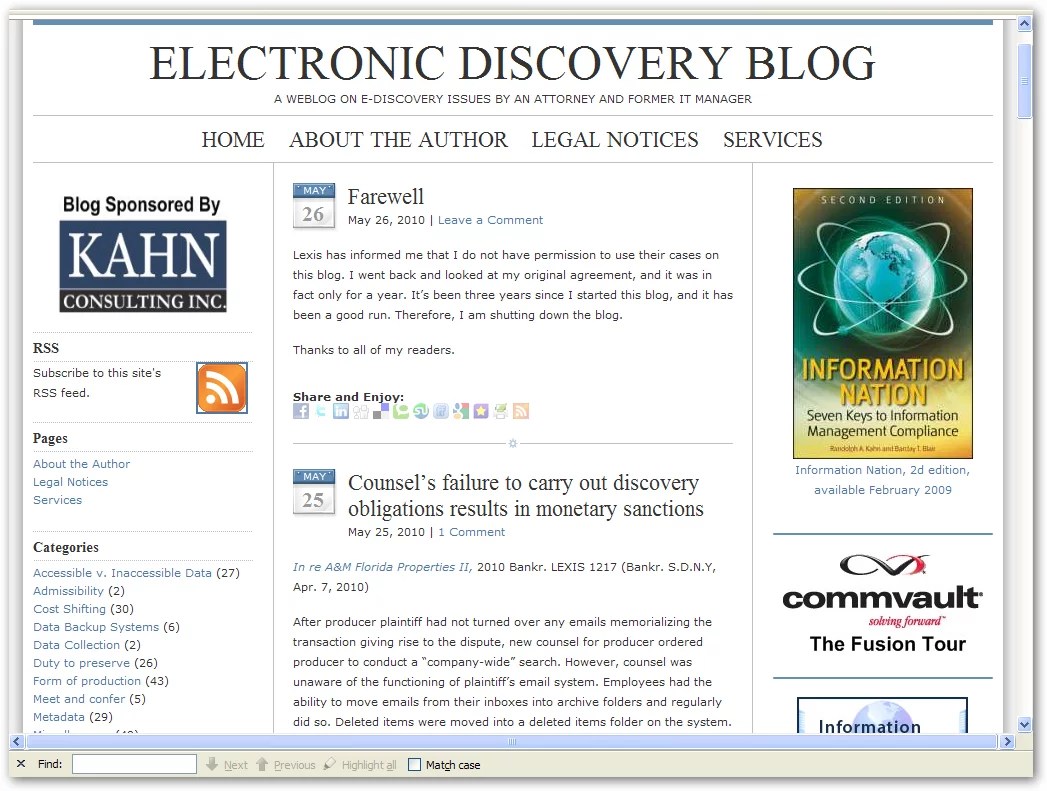
Lexis (Doesn’t Really) Heart Blawgers

Go to any gathering of lawyers and you’ll find someone there from Lexis, whether spinning wheels or handing out umbrellas, with broad smiles to earn our love.  About the only place Lexis shows no love is the blawgosphere, as lawyer W. Lawrence Wescott II found out when he received a love note from its lawyers.

Via Bob Ambrogi,

Until yesterday, the URL www.electronicdiscoveryblog.com led to a blog on e-discovery law written by lawyer W. Lawrence Wescott II. Today, that blog is gone. Wescott took it down after a lawyer from LexisNexis threatened legal action over a claimed unauthorized use of LexisNexis cases. The blog was among the ABA Journal Blawg 100 honorees in 2007.

Chances are the e-discovery, sexy though it may be to so many of us, wasn’t on many people’s radar, and they may not have been regular readers of Wescott’s blawg.  Still, the idea that Lexis would be so deeply offended by his sending readers to a handful of their cases (and wondering what exactly that means, since the content is produced by courts, not Lexis-ites elves in a backroom somewhere) is shocking for all of us. Including me.

When Wescott started his blawg, he obtained permission from Lexis to use up to 1000 of “their” cases per year.  I assume that means court decisions, via Lexis links. Big deal, right? These guys from Lexis are dying to get our business, and Wescott was doing more to put their service in front of people than handing out 1000 umbrellas.  Except when it’s raining outside, but then it never rains in the blawgosphere.

To a large extent, we rely on a wide variety of sources for links to stories, posts and court decisions in the blawgosphere.  For most, it’s a matter of fair use, since we aren’t selling them and provide “value added” commentary about the content.  On the other hand, it’s not like we (as opposed to Lexis) are making the big bucks off this.  I would guess that most blawgers, like me, do it only for the fame, since there’s no fortune to be had.  If some corporation wants to litigate our efforts to death, and suck the life out of us in the process, there’s no incentive to fight. 

It’s occurred to me numerous times that businesses that cater to lawyers, not to mention pay walled news sites, should be begging blawgers to link to their stuff and should give us free, unlimited access to their content.  We promote them, often better than they could ever promote themselves.  But if we can’t get in there, or use them, then they cease to exist for us.  Is that really what they want?  Is the quick buck worth the loss of attention (or outright anger) of the blawgosphere?

So even if e-discovery isn’t your thing, the sad demise of the Electronic Discovery Blog at the hands of Lexis is a shame; a concern for all blawgers and a disgrace for Lexis.

Memo to Lexis:  Hope your savings from the purported unauthorized use is worth it.

The Flat Fee Society

While lawyers like Patrick Lamb travel around the country preaching alternative fees to the billable hour crowd at civil law firms, criminal defense lawyers chuckle.  We’ve always done flat fees, yet the ABA Journal thinks doing the obvious makes one a Legal Rebel (along with not wearing wingtips).  Naturally, this opens the door to Norm Pattis, who wants his very own Legal Rebel skateboard, to challenge the status quo.

There are cross-cutting incentives in a flat-fee case. The client has paid for a lawyer and wants her expectations, no matter how unreasonable or unnecessary from the perspective of the experienced lawyer’s judgment, met. The lawyer, on the other hand, has an incentive in effectively presenting the case in as efficient and cost-effective manner as possible. Both client and lawyer can err given these conflicting imperatives. A client can demand too much; a lawyer can do too little. Discontent lurks at the periphery of every flat fee case once a black hole opens up, sucking time out of the world as if there were an infinite amount of it to be had.

While Norm’s issue may be real, he’s solving the wrong problem.  The black hole of client demands on a lawyer’s time isn’t a fee issue, but a client management issue.

Although this has been discussed here many times, I’ll recap the rationale for flat fees.  The incentive for criminal defendants to pay their lawyers exists up front, when terror strikes and they realize the need for representation.  Many will happily promise more than they can give.  Many want to pay only for results.  Many have unreasonable demands and expectations.  And some are just criminals, as happy to scam their lawyer as anyone else.  They aren’t amenable to threats or lawsuits; they are bloodless rocks.  Get paid up front or not at all.

The fee is based, as Norm correctly notes, on the lawyers’ experience with cases and anticipation of how much time will be required to handle it.  Then comes Norm’s black hole problem, which is really two wholly separate problems.  On the one hand, there can be a development in a case that removes it so far from the norm that the lawyer could not have anticipated the change, demanding a concurrent change in the amount of time necessary to defend.  On the other hand, there are clients and their families who want the lawyer to hold their hands 24/7. 

With regard to the former, a real change in circumstances, unanticipated and unanticipatable, may call for a discussion with the client and reflect a need to modify the fee.  I say “may” because we always recognize that circumstances aren’t guaranteed to be normal.  There is no such thing as normal, and we know that going in. 

It’s not enough that we just happen to need to work a little harder, a little longer, than our best case scenario.  When that happens, the lawyer should eat his time.  That’s not a real change in circumstances, and the whole point of the flat fee is defeated if it’s only a one way street, always favoring the lawyer.  It’s hard work to be a good lawyer, so suck it up and do your job.

As for hand-holding, a certain amount is almost invariably involved in any defense.  Clients have fair questions, and it’s our job to answer.  Clients need to know about one of the most important things to happen in their lives, and it’s our job to tell them, and explain it to them, and sometimes explain it again.  But we also know that some clients demand more, which is where Norm’s conflict comes in.

There is no good way to charge for legal services, I am persuaded. Clients come in need. They are afraid and angry. They want a hero, a savior, a warrior. You offer them what you can. Most often it is enough. But sometimes it is not. A client grows disenchanted, angry, they want what you cannot give. It is a risky thing to agree to represent a person in crisis. You cannot tell where people will turn in the dark of night. What to charge for this work is a topic about which I am not at peace.

This is where it all goes careening off the tracks and into the abyss.  Lawyers are not psychologists, social workers or the pet dog.  Sure, we understand and we’re empathetic, but that doesn’t change the number of hours in the day.  We can either spend our days doing our jobs, or taking phone calls from depressed, frantic, angry, scared clients.  We can’t do both.  When we fail to recognize this, we get both ourselves and our clients into trouble.  Our days are lost to hand-holding, and our clients are not receiving the representation we owe them because we’re too busy holding hands to do our jobs of defending them.

This isn’t a money issue.  This isn’t about allowing clients to talk to us for hours on end, and then charging them for the empathy.  It’s about making our role clear to our clients, that we are not their therapists but their lawyers.  There are therapists out there, better trained and far more capable of dealing with their moods and feelings than we are, and if the client needs one, we should be the first to point them out.  But we need to similarly appreciate our own limitations.  Most importantly, we need to recognize what our job is, criminal defense.

Others argue that lawyers should be faux-therapists, hand-holders, the pet dog offering unconditional love and support.  They are wrong.  They are both narcissistic, in the sense that they believe they can do it all and are half-capable of providing the therapeutic help some clients need, and weak, in that they lack the fortitude to tell a client when he’s crossed the line. 

Many lawyers never want to do anything that could potentially upset a client, and will suffer endless hours of hand-holding just to keep the client happy.  It’s actually quite ironic that a lawyer, given the ability to put an end to a client’s excessive demands for time by simply telling the client that he can either have the lawyer spend his time defending or hand-holding, but not both, will simultaneously want additional money for showing the love. 

What this really means is that the lawyer wants to take the weight off his back for being the bad guy by being able to say, “hey, ask as many question as you like. The clock is running.”  The fact is that sometimes we have to say enough, manage our clients emotions and expectations so that we can perform our work.  We have no business charging clients for hand-holding, as we have no business holding their hands for too long in the first place.  We’re lawyers.  We defend people accused of crimes.  We are not therapists, no matter how empathetic we want to come off to the client. 

Before closing this post down, Jamison Koehler has chimed in, and Brian Gurwitz adds his two cents in the comments to Jamison’s post.  Combining their experience as criminal defense lawyers together, they’ve been at this about 47 minutes. 

For me, without Pattis’ vast experience, the jury is still out.  Yes, the hourly rate does offer many advantages.  It assures that the lawyer is compensated for every hour he or she spends working on the case.  And it prevents the client from paying for hours the lawyer has not devoted to the case.

No, no, no.  It does nothing of the sort. Hourly billing is one of the most notorious scams going, where a lawyer puts down a tenth of an hour (6 minutes) because the client’s name passed his lips, or charges for 12.7 hours for preparing motions when most of the time was spent playing spider solitaire as he pondered the issues.  The same issues, that the client has no clue what the lawyer does except in court, exist, and create the pretense of transparency without any reality. 

At the same time, based on what I know now, I still prefer the flat fee, at least for the type of cases I currently handle.  The flat fee allows the client and me to deal with the money issues upfront and then to put them behind us, without the continuing distraction.

Distraction?  It’s hardly a distraction, but an outright war when there’s a money dispute in the middle of a defense.  Norm fears a conflict?  This is a conflict, the lawyer fighting with his own client over money in the midst of battle.  What Jamison should also note is that he’s paid, as opposed to his client sheepishly telling him, “I know, but I don’t have any more money.”

Jamison says that fees are different for street crime, which is the type of practice he has, and “white collar.”  It’s not so much that the fees are different, as that corporate/financial crime defendants are susceptible to being billed on an hourly basis, as they are more likely to have assets that can secure payment of the fees and are used to paying monthly bills.  It’s got nothing to do with nature of the crime, and frankly most defendants accused of corporate/financial crimes would do far better with flat fees.

The last note to be made is that I haven’t distinguished between true flat fees and hybrid flat fees, with a fixed price for various stages of the proceeding.  I use the hybrid because I consider it inappropriate to charge for work when there’s no clue whether it will be necessary.  This means that there’s a risk of nonpayment when trial comes around, but dealing with that is an issue for another time. 

I raise this only to offer a thought to any defendant who is charged a straight flat fee for a case, soup to nuts.  Take the fee and divide it by a reasonable hourly rate that will cover costs, fixed and variable, and leave a few shekels over to buy the kids new shoes.  How many hours do you get?  If there aren’t enough to cover the time to get to trial and then try the case, guess what you’re not getting. 

Forget about hand-holding. That lawyer has no plans to do anything beyond pleading you guilty the first chance he gets.

Holder “Reaffirms” His Predecessors

Via Doug Berman , Attorney General Eric Holder demonstrated the substantive difference between a Democratic and Republican administration’s approach to imprisoning its citizenry:  Not much.

By Memo dated May 19th, Holder writes:

The reasoned exercise of prosecutorial discretion is essential to the fair, effective and even-handed administration of the federal criminal laws.  Decisions about whether to initiate charges, what charges and enhancements to pursue, when to accept a negotiated plea, and how to advocate at sentencing, are among the most fundamental duties of a federal prosecutor.  For nearly three decades, the Principle of Federal Prosecution, as reflected in Title 9 of the U.S Attorneys’ Manual, Chapter 27, have guided federal prosecutors in the discharge of these duties in particular, and in their responsibility to seek justice in the enforcement of federal criminal laws in general.

What a set-up.  What a start.  And so where does this talk of justice go?

The purpose of this memorandum is to reaffirm the guidance provided by those principles.

Move over Dick Thornburgh.  Step aside John Ashcroft.  Holder’s moving in.

Berman notes that there is a hint of a difference in approach.

Distilled to its essence, it seems that instead of a general policy that federal prosecutors “must” charge and pursue the most serious offense and must advocate a within-guideline sentence, this new Holder memo now asserts that federal prosecutors “ordinarily should” charge and pursue the most serious offense and “should generally” continue to advocate a within-guideline sentence.

It was never exactly true that federal prosecutors in various districts around the nation truly complied with any of the directives out of D.C.  There are always human beings who act in accordance with conscience, propriety and proportionality.  Then there were the zealots, who would have the death penalty apply to everything. 

But as AG (and later Justice) Robert Jackson noted in 1940 ,

The prosecutor has more control over life, liberty, and reputation than any other person in America.  His discretion is tremendous.  He can have citizens investigated and, if he is that kind of person, he can have this done to the tune of public statements and veiled or unveiled intimations.  Or the prosecutor may choose a more subtle course and simply have a citizen’s friends interviewed.  The prosecutor can order arrests, present cases to the grand jury in secret session, and on the basis of his one-sided presentation of the facts, can cause the citizen to be indicted and held for trial.  He may dismiss the case before trial, in which case the defense never has a chance to be heard.  Or he may go on with a public trial.  If he obtains a conviction, the prosecutor can still make recommendations as to sentence, as to whether the prisoner should get probation or a suspended sentence, and after he is put away, as to whether he is a fit subject for parole.  While the prosecutor at his best is one of the most beneficent forces in our society, when he acts from malice or other base motives, he is one of the worst.

Back then, the Attorney General sought to instill in prosecutors a sense of the awesome power they possessed, and the obligation of using it with discretion.  But what did he know, when he could have directed his troops to blindly do as much harm as possible. 

At least Holder allows for the tiniest possibility of humanity to enter into the federal prosecutor’s job.  The question then becomes whether any AUSAs possess such a quality, or have the guts to use it within a culture of highest charge and harshest sentence.

Walking the Walk

A message came in shortly before lunch from a reporter at the New York Law Journal.  The Second Circuit rejected the habeas by Robert Bierenbaum to overturn his murder conviction.  Did I have any comment?

When Marcia Silver and Mark Seiden took up the cause after the conviction was affirmed, I met with them.  I tried the case with David Lewis, and we lost.  It was a bizarre case, with no body, no evidence and a judge bent on conviction.  We tried it to win, and we lost.

The only approach now was to seek habeas relief, and that required a different approach.  They asked me how I felt about the job we did at trial.  I could have explained why everything we did made complete sense at the time, though some of the decisions were simply calls that had to be made on the fly, and were no better or worse than the opposite call based on what we knew.  But I didn’t.

The defendant’s conviction depended on finding a new way to get into court, a new error to blame.  I offered myself to the effort.  In a case like this, a thousand different decisions are made which, in retrospect, could have gone either way.  My position is that my representation must, by definition, have been ineffective given the outcome.  My client was convicted; my job was to win an acquittal.  I did not do my job well enough.

Much time and thought went into detailing and cataloguing things that could have changed the trial.  It’s easy to play Monday morning quarterback, but it’s also necessary and proper to do so when it comes to a trial.  We’re lawyers.  We’re not perfect.  If we’ve made a mistake, our clients should not have to suffer for it.  More to the point, our clients should not have to suffer for our egos, and desire to pretend that our decision-making was perfect, beyond reproach.

Reproach me.  If that can save my client, then call me any name in the book.

Many times, I’ve urged lawyers to shove their egos down their throats and take it like a man when a client claims ineffective assistance of counsel.  They can’t do it.  It’s partially because they can’t admit that they might ever be wrong, and it’s partially because they can’t stand the thought that their name might appear next to a question of their abilities.  Suck it up, children.  It’s not about you, but the guy who’s sitting in a prison cell.

I help write up the list of things I did wrong.  They settled on nine claims of ineffective assistance.  I probably came up with 20 errors that came out of the trial.  I was happy to have it all placed on my back.  Everything that happened was my responsibility, no matter who actually did it, because that’s what it means to be the lawyer.  Whether it was really error, or error only in hindsight, is irrelevant.  It failed to achieve an aquittal, so error it was.  It’s a bit weird when the article attributes conduct to me that was performed by my co-counsel, but it’s not really important.  The only “harm” is that my name is associated with the challenged decisions rather than his, and I can take the punch.

The one thing that annoys me, as news reporters tend to do, is the misquote. 

Mr. Bierenbaum “got a horrible shake out of Leslie Snyder. In my opinion, if my being ineffective would get him a new trial, he can call me ineffective all day long,” Mr. Greenfield said. “The medical examiner’s testimony was entirely speculative. It was an absurd trial. We were fighting a myth, fighting a story, and the fact that they were able to put in evidence of things that are conceptually possible is absurd. Usually, trials are about evidence.”

I never said “in my opinion,” but that “if it will save an innocent defendant.”  If he couldn’t get the names or facts right, why would he get the quote right?  No big deal, though.  It’s not about the story or the quote.  It’s not about ego or blame.  It’s about the guy sitting in a prison cell.  If it will save an innocent defendant, he can call me ineffective all day long.

And Windy Has Stormy Eyes

Chicago’s a pretty town, especially when the weather doesn’t suck.  That alone isn’t a sufficient reason to come here.  Not even the opportunity to meet a bunch of blawgers and twitterers.  I came to make a point to a bunch of in-house counsel, that nobody has a white collar in an orange jumpsuit.

The same themes upon which I tread lightly here were the subject of my presentation.  Three felonies a day.  Corporate and financial crime is still crime, and hiding heads in sand doesn’t prepare one to deal with it.  That corporate executives make lousy defendants, poorly equipped to handle an arrest and prosecution.  The phrase “white collar crime” was dead, and their survival depended on their coming to terms with it.

The controversy came in the message that they didn’t need Biglaw former prosecutors, whose strategy was capitulation because there was no winning or they were really the good guys.  They needed criminal defense lawyers.  They needed to learn what it meant to fight and win.  They needed to believe that the formulaic approach that permeates defense in the hands of people whose only experience is prosecution was the road to perdition, for their executives, their corporation, even themselves.

Did they believe?  I dunno.  There remains a wall between the general counsel and criminal law.  There’s a certain morbid fascination, but no real connection.  They know that other corporations, other CEOs, CFOs, GCs get busted, but that has nothing to do with them.  It will never happen to them.  It couldn’t.  They’re the good guys.

It seems that in-house counsel aren’t a whole lot different than regular folks when it comes to crime.  It never happens to anyone until it happens.  And then it’s too late.

I tried to make that point.  I didn’t hold back.  I suspect that many will agree that there is much they can, and should, do in preparation for the possibility of a criminal investigation and prosecution, but they will never get around to doing it.  They won’t prepare their staff.  They won’t identify counsel.  They won’t have their ducks lined up and when the hammer falls, they will be caught totally unprepared to deal with the most emergent of situations. 

Maybe they will think back to my presentation and say to themselves, I could have prepared for this.  It cost me two days of my life, of my practice, to be here to tell them.  It’s unlikely that anyone has ever told them what I did before, and I’m fairly certain that no one has ever spelled it out as clearly. 

For my part, I tried to help.  It’s really all I can do at this stage, and later, I won’t say I told you so.

Whatever Texas Decides

Churchill said, “history is written by the victors.”  Of course, Churchill was British, and naturally inclined to ignore large land masses.  Texas is one such land mass, and it’s large.  Large enough to drive the content of textbooks across America, and thus tell us what our history is.

Mind you, it’s not like Texas is the first to consider reinventing history.  When my kid asked me to help with African empires in World History class, I was stymied.  There were no African empires when I went to school.  There was Greek and Roman, Ottoman and Byzantine, but no African.  When did this happen?

According to the Washington Post, the Texas School Board commission is up to some shenanigans in an effort to undo years of “liberal bias.

The Texas state school board gave final approval Friday to controversial social studies standards that minimize the separation of church and state and say that America is not a democracy but a “constitutional republic.”

The changes, which passed in a series of 9 to 5 votes, could have reverberations far beyond the Lone Star State’s schools and its 4.7 million students. The state’s large textbook market has traditionally led the way for others; at minimum, Texas students will get very different history lessons than does the rest of the country, as early as next year. Many teachers, academics and politicians on both sides of the aisle have condemned the standards.

This story threw Ann Althouse into a tizzy, not necessarily the changes but the newspaper’s characterization of the changes.

Or at least link to the text. And if you choose to paraphrase and not even link, and I have to look up the text myself, and your paraphrase is not accurate, it is my job to embarrass you by pointing that out.

Let me embarrass the Washington Post. Below, the material from the WaPo article, written by Michael Birnbaum, is indented. After the indented part, I’ve located the relevant quote from the Board of Education text, found here. (I’m searching 3 PDF documents: Economics with Emphasis on the Free Enterprise System and Its Benefits Subchapter A. High School; Social Studies Subchapter B. Middle School; Social Studies Subchapter C. High School.)

Her point is well taken, that if you’re going to criticize something as WaPo has done, the least you can do is link to the source material should others wish to read it and draw their own conclusion.  This led Jonathan Adler at Volokh Conspiracy to come to Ann’s defense.

Based on what Althouse reports, Birnbaum and the Post should certainly be embarassed.

The Adler decided to take his own advice and do some legwork, resulting in an update to his post.

It appears Ms. Althouse may have blogged too soon — and I may have been too quick to repeat her accusations against the Post.  Althouse relied upon the text of the standards as proposed a few months ago, not the final language.  The Texas State Board of Education revised the standards this past week before approving them.  Based on live-blogging by the liberal Texas Freedom Network (see here and here), and the direct quotes (and, in some cases, video they provide), the Post’s characterizations of the final language is much more accurate that Althouse suggested.  I think it’s fair to suggest the Post story should have quoted the relevant language (as this prior story did), but unless there is something inaccurate about TFN’s account, Althouse and I both owe the Post and Birnbaum an apology.

Althouse is a very tricky writer, as I’ve learned to my chagrin.  It’s a gift.  Her ostensible point, that WaPo shouldn’t characterize when it could quote or link, is certainly a valid point. The undertone, however, that it’s some liberal conspiracy to falsely smear the changes approved by the Texas School Board (“but I never said that, did I?”) is plausibly deniable. 

One might quibble by arguing that Althouse complains of the Post’s characterizations, then employs her own in their place, though she does quote rather than paraphrase.  But Adler says, she quotes from the wrong source, making her quotes invalid.  This could just be sloppiness, but if you’re going to quote, the least you can do is quote from the right source.

Althouse too updates her post to note that Birnbaum had written another article, the day before, with quotes that support his characterizations.  She also knocks the Texas School Board for not having the text of what they approved available:

I’m critical of the Board of Education for not posting all the relevant text on its website. And — as should be obvious — I’m not endorsing the standards themselves. The complexity and detail alone tends to show that the Board did not have the best interests of children at the center of their project. And it didn’t seem to care much about the capacity of teachers. The material on law, for example, would be difficult for a law professor to teach to law students.

Having thus exculpated herself, the ramifications of Althouse’s initial crafty critique remain on display in her comments (warning, rough language ahead):

These fuckers lie and lie and lie their asses off. Liberals lie about everything, all the time. There is nothing in modern progressivism that is not a lie. Everything they do is perched on a foundation of lies. Every point they make is wrapped in a blanket of lies. The truth is not in them.

This is a classic example. But you’ve only scratched the surface.

Had this been written elsewhere, some blawgers would have taken the commenter to task, or at least addressed the content.  Others would have just deleted it.  At Althouse’s blog, it stands untouched. 

It’s impossible to divorce the process, the critique and the content of what the Texas School Board has done.   Some, like the above-quoted commenter, will no doubt applaud it with all his heart and soul.  Others will challenge some of the basic premises, such as elevating the Confederacy to equivalent status with the Union in teaching the philosophical underpinning of the Civil War. 

Adler’s comments at VC are, as might be expected, largely dismissive of Althouse and her readers.  But then, they had the advantage of watching some videos of the Texas School Board’s meeting.

And a glimpse at how substantive decisions were reached.

The North may have won the Civil War, but a majority of the Texas Board of Education has won the minds of our children.  Althouse readers are marching on the Washington Post with pitchforks and torches as I write.

The Limit of Good Feelings

I don’t often express disagreement with my favorite marketing philosopher, Seth Godin.  Mostly because I think he’s an awfully wise man, and secondarily because I think he’s smarter than I am, which makes me think that if I don’t agree with him, it’s because I haven’t yet figured out what he already knows.

But Godin’s post about Multiple Dumbness, well, struck me as problematic.  I sat on it for a day, pondering why I was wrong and he was right, but failed to come up with the reason.  Thus, I take a chance and challenge his thoughts, assuming that someone will help me by pointing out the error of my ways.

The gist of Godin’s position is that, much as there are multiple intelligences, the opposite is equally true.

The flip side of this occurred to me the other day, as I was busy judging someone for being really dumb. Of course, no one is really dumb. And certainly no one deserves to be judged as such. If we’re good at different things, we’re also bad at different things, right?

No disagreement that we are bad at different things, though it’s unclear that it follows that no one is really dumb.  Life is patently unfair, and there are people who have no strengths, meaning that they are a bundle of weaknesses.  I know. I’ve met them.  I’ve represented some of them.  Not everybody has a redeeming feature.  The best you can say about them is that one weakness isn’t as bad as another, though none rises to the point of not being a weakness at all.

From this, Godin concludes:

The story people tell about you (and the one you tell about yourself in the way you act) may be broadcasting one of your weaknesses louder than you deserve. We often fail to hire or trust or work with someone merely because one of their attributes stands out as below par. That’s our loss.

I suspect this isn’t the case at all.  We choose not to hire or trust or work with someone because the dumbness at hand is the one that applies to our reason for considering this person in the first place.  If one is hiring, trusting, working with a lawyer, does it matter that he plays a mean jazz piano if he can’t present a persuasive argument?  You might want to go to a club and hear him tickle the ivories, but you don’t want him standing next to you when your life is on the line.

The “I’m OK, You’re OK” culture leads us to be kinder and more understanding to others.  This is a good thing when it comes to our behavior in general, learning to appreciate the positives and strengths of others.  This is a wonderful perspective to have when attending cocktail parties or meeting people on the street.  But Seth employs it as a business tool, something to recognize before separating the wheat from the chaff.

Does this constitute a loss?  Probably not.  Sure, you might hurt someone’s feelings by not loving them as much as they want to be loved, or denying them a job, your business, your trust.  But we are constrained to discriminate upon the basis of competency, and the fact that an “attribute stands out as below par” seems an awfully good reason to do so.

Often, people bemoan the fact that they believe they can do the job, deserve the trust, if only the other person would give them the chance.  It’s because of this cultural expectation that they are entitled to the benefit of the doubt, the shifting of risk from the person who comes off poorly to the person who is seeking a new hire, a trusted advisor, a reliable colleague, that people fail to address their shortcomings. 

Far too many people today celebrate their shortcomings, as if it’s their right to be wrong and they should be proud of their flaws.  While they may well feel that their flaws don’t render them worthless, they similarly aren’t the sort of thing that commands others to trust us.  Suggestions like Godin’s, that it’s wrong to decide that someone who doesn’t play piano particularly well isn’t the right person to book for Carnegie Hall, because he may have some alternative talent that doesn’t immediately appear, encourage this sense of entitlement.  Some people are dumb.  Some people can’t play piano.  It may not be shameful, but it’s no good reason to hire them either.

Perhaps dumbness, in its various forms, is a Darwinian form of protection, steering people away from the things they do poorly and toward the things they do well.  This doesn’t help those people who do nothing well, or are dumb in all things, but I suspect society even has a place for them.  If so, then Seth is fighting nature, and that’s a battle that even Seth Godin will lose.