
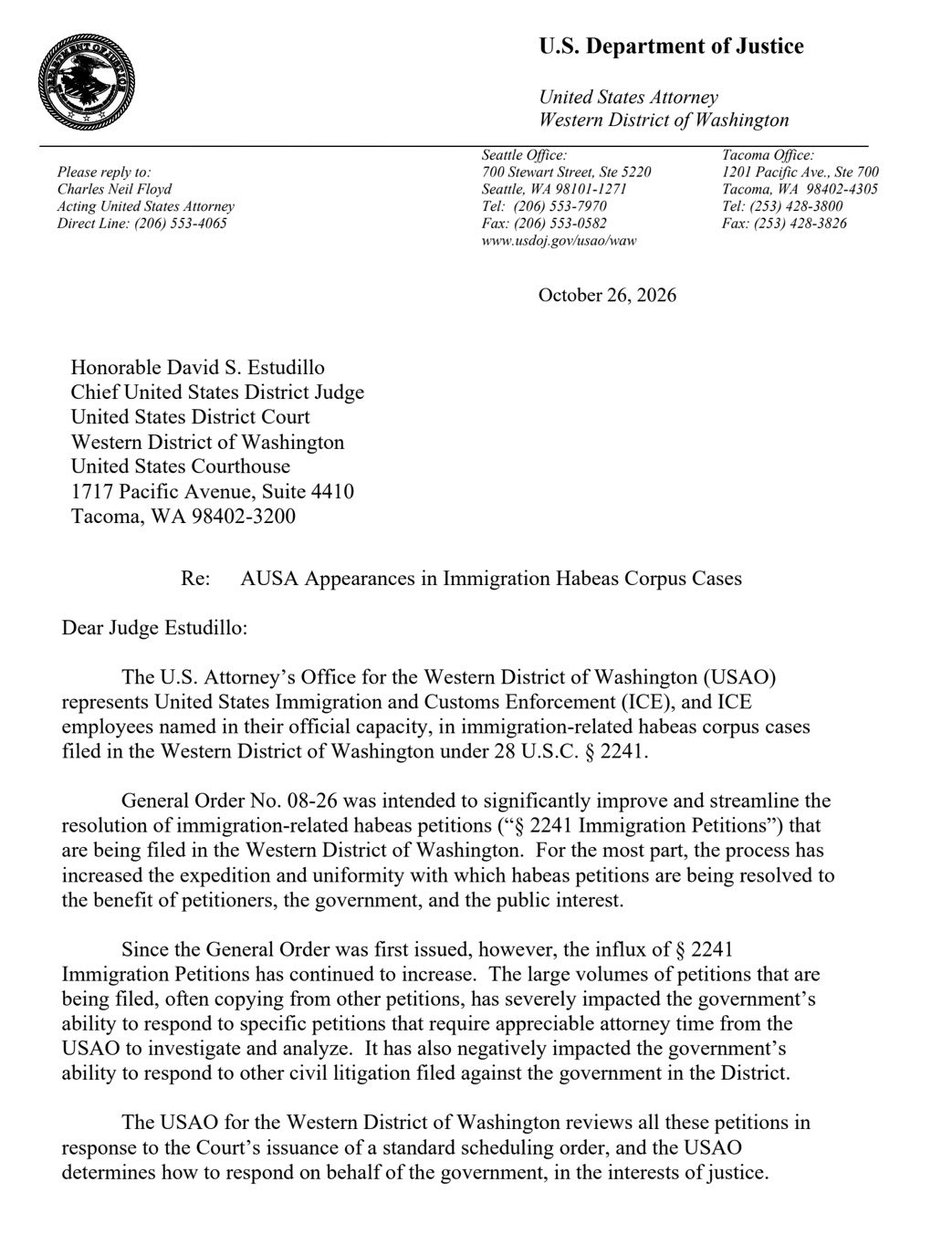
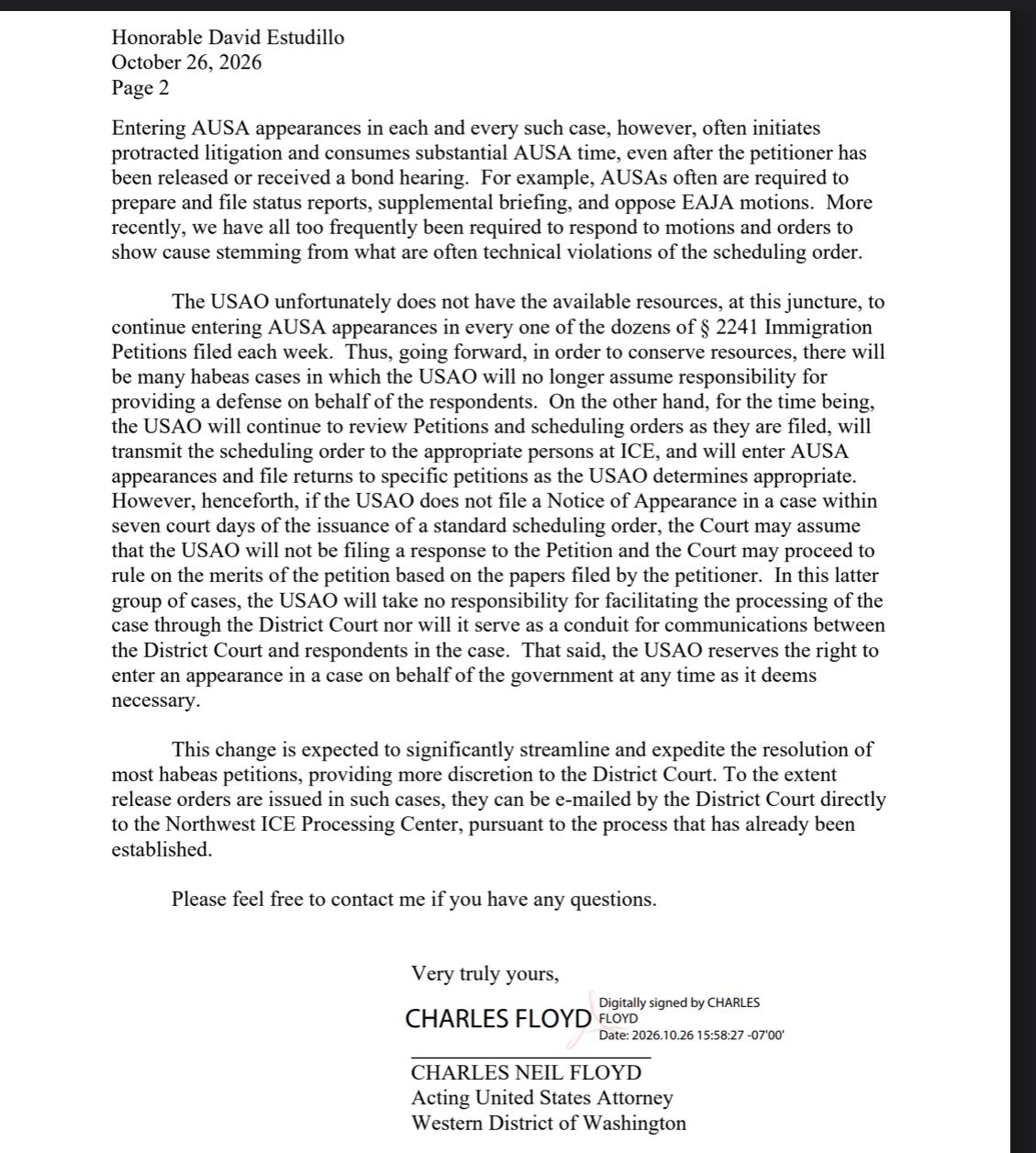
Acting United States Attorney for the Western District of Washington Charles Floyd reached the breaking point. He sent a letter to the district’s chief judge saying his office lacks the manpower to defend the United States against the avalanche of habeas corpus actions brought by immigrants held in ICE custody.
(Here is the letter sent, page 1 and page 2.)
There are severe personnel problems throughout the Department of Justice, as experienced career AUSAs have either been fired for doing their job when the targets of their prosecutions were Trump or Trump-adjacent actors, or fled the department as its focus changed from enforcement of law to persecution of Trump’s enemies or scapegoats. But never before has a United States Attorney openly asserted that he neither can nor will perform the functions of the office because it has become overwhelmed by the sheer volume of cases.
Acting U.S. Attorney Charles Floyd said in a letter to U.S. District Judge David Estudillo that habeas corpus cases initiate “protracted litigation” with numerous hearings, briefings and motions that consume prosecutors’ resources.
“Thus, going forward, in order to conserve resources, there will be many habeas cases in which the USAO will no longer assume responsibility for providing a defense on behalf of the respondents,” Floyd wrote.
The backlog has “severely impacted the government’s ability to respond” to immigration petitions and prevented prosecutors from dealing with other unrelated civil litigation, he said. As a result, his office will decline to defend “many” habeas cases. He didn’t specify how many cases could be affected.
While the letter states that it applies to “many,” meaning not all, cases, it means that many, if not all, will go without a defense of the United States. Many of us would see this as a good thing, as most of these cases involve needless, and in some instances shocking, detention of people who have been in the country for decades, have no criminal history, worked hard and paid taxes and raised families with American citizen children, some of whom served in the United States armed forces. Many of us would argue that these are people who should never have been seized or detained at all.
But US Attorney Floyd’s predicament raises two other issues. The first is how the Trump immigration policy has created an untenable situation for the USAOs and federal courts, swamped with more than 85,000 pending habes.
Judges have often ruled against the administration in cases filed by tens of thousands of detainees arguing that they were being held illegally by U.S. Immigration and Customs Enforcement. It has been a source of great frustration to administration officials — and to judges and advocates who say ICE has trampled on individual rights amid the Trump administration’s hardline immigration agenda.
Last week, U.S. border czar Tom Homan told Fox News that courts have been weighed down by about 85,000 immigration habeas cases as the government carries out a sweeping crackdown.
The second problem is that the diversion of attorneys, not to mention others involved in federal law enforcement, away from more serious work to focus on the removal of huge masses of immigrants who pose no criminal threat, has left the nation exposed to corruption, foreign interference and other serious crimes historically addressed by the Department of Justice. If they’re all tied up with immigration actions, they’re not doing the work that kept the AUSAs busy before. While that may well be considered a good thing in some instances, it’s hardly adequate for the safety and security of the nation.
So what can be done about it? One solution might be to hire a great many new AUSAs, but that’s more easily said than done. Not only would it be a huge public expense, but the Department of Justice is having bigly problems hiring staff, as it’s no longer a prestigious job (and may well spell the end of a legal career in a post-Trump universe) and there aren’t that many baby lawyers capable of passing its political litmus test.
Another answer is to take the Menckian road of suspending habeas corpus because the MAGA faithful hate “illegals” and don’t believe they deserve due process, or any other constitutional right for that matter. But is America ready to eviscerate the Constitution?
A third fix is to just let it go, let the immigrants bringing habeas actions have their day and trust judges to do both their jobs and the job of the government in vetting which actions are meritorious and which are not. Of course, that puts the judges in a conflicted position, serving as both prosecutor and arbiter.
Now that the system is overwhelmed and at least one United States Attorney has come out and admitted that his office just can’t deal with it and he’s given up, what if anything should be done?
*Tuesday Talk rules apply.
Discover more from Simple Justice
Subscribe to get the latest posts sent to your email.
ICE enforcement funding keeps going up. Congress repeatedly adds tens of billions of dollars for arrests and detention. The agency has a larger budget than all other US law enforcement agencies combined. And far over $100 billion of its money remains unspent.
But the administration, acting with its usual incompetence, didn’t see a need to save some of this money for courthouses, judges, proper holding facilities, and Assistant US Attorneys. After all, the deportation push was intended as political theater, and nothing beyond the street actions against immigrants was central to that intent.
So the government has made its bed, and federal judges should accord the administration’s actions their due. In any case in which the government fails to appear or does not meet the court’s schedule the judge should summarily grant the petition. That, by the way, puts on the Department rather than the judges the onus of choosing which cases deserve to be defended.
More than one Swamp judge has told me the same thing, and for at least a year.
What should be done? Knock it the fuck off. The show has been made and the midterms are over.