Because The Judges Already Know (Update)

While it’s gone on forever, it really wasn’t official until the Supreme Court decided Whren*.  That’s where Justice Antonin Scalia concluded it was just too unwieldy for judges to ascertain truth, so instead held pretext stops lawful.  The word “pretext” makes it sound sanitary. What he meant was that police were officially entitled to lie in order to circumvent the Fourth Amendment.

It was just a hop, skip and jump to  knock and talk, where consent to enter and search a home could be obtained by lies.  Who needs a warrant when you can convince someone to willingly open the door?  So what if they did so because you lied about some fake emergency that was about to threaten their life, or some benign problem that needed an easy fix?  It could have been true, and that’s close enough for government work.  That “knowing, voluntary and intelligent” waiver stuff is for kids.

So this is our world, with the law held hostage to whatever means is most effective.  But we know this.

Have a few beers with a judge, or a prosecutor past his three year commitment, and they will tell you. They know it. They’re not stupid. This is not an epiphany. You haven’t discovered anything new. They know it.

Radley Balko posts a few paragraphs  from a decision by Volusia County, Florida Judge Joseph G. Will.  This was part of the underlying posts that gave rise  to my slice discussing the reasons why cops lie.  Judge Will includes some language that will cheer up the choir.


What are the costs of teaching the community that law enforcement officers, whom ideally deserve the trust of the citizen, cannot be trusted to tell the simple truth? That no one is wearing the white hat anymore? That the ends justify the means? That the virtue of honesty is essential in our families and individual lives, but that same virtue is optional for the executive branch of our government in the exercise of its police powers? A nation founded on the notions we find in our Constitution is surely better than this.

Great stuff, as is the rest of Judge Will’s opinion. Reading it will validate your anger and frustration, and force your anguished cries about what they have done to your beloved Nation.

Note that I say “your” and not “our.”  It’s not that I don’t applaud Judge Will’s decision. I most certainly do. And not merely the underlying concept, but the way in which he expressed it as well.  It is a great decision.  It’s just that it’s nothing new.

There is a putative line that the court pretends exists between the fully approved use of lies to circumvent constitutional rights and the truthfulness of police testimony on the witness stand.  In other words, cops lie to us but not to judges.  And, of course, it’s nonsense, as everybody knows.  Once the court enshrined lying as a valuable law enforcement tool, the game was over.

It isn’t a question of the public, or the courts, believing that lying is morally reprehensible.  Everybody is in agreement about that, at least in a vacuum.  But the countervailing need to use every effective means to investigate, prosecute and convict the guilty is more important. It’s a value judgment by our legal system, and lying has already won. 

The Supreme Court ascribes the ability to police,  long before the  New Professionalism canard became the excuse, to distinguish between those times when it was acceptable to lie and those times when police officers would recognize their duty to tell the whole truth. 

But no one seriously believed that police would adhere to the distinction. Lying is easy and effective. Truth screws things up, and besides, we can’t handle the truth.  It’s ugly and hard to catch the bad guys, and it’s their job to make it happen. Just close your eyes and let them do their job.

So the die has been cast: lying works. Judges are well aware that lying works.  Judges even tell it to the jury so that those too naive to realize that lying works will understand that it’s necessary to the functioning of our system. 

Judge Will agues that the police, who seek the trust of the public, cannot obtain it by lying to them.  Maybe nobody told Judge Will that the public doesn’t want to trust police to tell the truth, but to trust the cops to do whatever they have to do to convict the bad guy.  After all, “the truth shall set you free,” and as the Supreme Court made clear, we can’t have that. 

* Your mileage may vary, but I blame Whren.

Update: Via the Daytona Beach News Journal (H/T  Tom Fielding), Daytona Beach Police Chief Michael Chitwood responds to Judge Will’s decision:


In closing, do not confuse deception with lying during court proceedings, falsifying official documents and evidence or lying during internal investigations.


No police administrator would tolerate this behavior which destroys an officer’s ability to perform their official duties in a moral, ethical and just manner.


And to the judge directly (cc to the paper), Chitwood expresses his outrage at Will’s “bias,” invoking the words of John Adams: “Facts are stubborn things.”  And if his cops say they’re facts, then dammit, they’re facts.  So there you go. It could never happen. It just wouldn’t be tolerated. Sleep easy, folks.

Right Answer, Wrong Problem (Update)

There is no lack of things to find abhorrent with New York City’s stop and frisk policy, which is on target to nail more than 700,000 people this year, having fallen just shy last year.  The program has police officers deciding that someone needs to be tossed, and so they stop ’em and do what needs to be done, whether it’s throwing them against a wall, or putting their face into the asphalt with a boot on their neck or just the old friendly surround ’em and make them empty their pockets.  All for fun.

The argument for it is that you find stuff this way, which only makes sense since it allows police to pluck any person off the street and see the things they couldn’t otherwise see. The thing Police Commissioner Ray Kelly says they really want to find is guns, but they don’t find too many.  Mayor Bloomberg says this proves it’s a great idea, since people don’t carry guns for fear of being rousted for nothing, just as it was argued that it’s a great idea when they find one and take it off the street.

The trick has always been to keep stop and frisk in neighborhoods where black and Hispanics live, because white folks would get really upset for being tossed without reason.  Black and Hispanic politicians know all about it, but keep their heads low so they get invited to white folks’ cocktail parties where party donors and political club brokers hang out. It’s a great system all around, provided you aren’t one of the 700,000 who get tossed.

Though they may not find many guns, they do tend to find a lot of people walking around with small, personal use quantities of pot.  This isn’t a crime in New York, until the police make them empty their pockets, at which point it the pot is publicly displayed and criminal.  It doesn’t make much sense logically or legally, but these low level busts go through the system so quickly and painlessly that nobody bothers with them, especially the judges who have the authority to dismiss them.  That would piss off the Mayor, District Attorney and Police Commissioner, and they wouldn’t get invited to the cocktail parties either. We elect judges in New York, you know.

But Governor Andrew Cuomo feels the pain.  From the New York Times :


The governor will call for the decriminalization of possession of small amounts of marijuana in public view, administration officials said. Advocates of such a change say the offense has ensnared tens of thousands of young black and Latino men who are stopped by the New York City police for other reasons but after being instructed to empty their pockets, find themselves charged with a crime.

Reducing the impact of the Bloomberg administration’s stop-and-frisk policy has been a top priority of lawmakers from minority neighborhoods, who have urged Mr. Cuomo, a Democrat, to pay more attention to the needs of their communities. The lawmakers argue that young men found with small amounts of marijuana are being needlessly funneled into the criminal justice system and have difficulty finding jobs as a result.

The wording is careful, so if you missed it, here’s the important detail: Cuomo wants to “reduce the impact” of stop and frisk by decriminalizing possess of small amounts in “public view.”  This is going to really upset things in the City, as it accounts for about 50,684 arrests last year, which proves what a great job the cops are doing and how society was  saved from rapes and murders by law enforcement diligence.

But Cuomo is the governor, and he can throw his own cocktail parties.

That it never made any sense for judges at arraignment to entertain the charge of unlawful possession of marihuana (because we spell it different in New York) when the only reason a joint saw daylight is official compulsion doesn’t mean we don’t need a new law.  After all, if the judges won’t do anything to stop the wheels of justice from grinding, it’s appropriate for the other branches to step in and do their job for them. 

Yet, what will this do for the nearly 700,000 people forced up against the wall?  Impact is one problem. The fact that the New York City Police Department has openly and flagrantly chosen to ignore DeBour (that’s the New York flavor of Terry v. Ohio) doesn’t seem to trouble anyone, Cuomo included.

This presents problems all around, however. How will cops make their numbers?  What will cops do to push up their overtime hours before retirement?  How will courts keep busy enough to justify giving judges raises?  How will institutional defenders and 18b lawyers make a living?  What if it turns out there just isn’t that much crime to be had if the police played by the rules, and all these parts of the finely honed machine of the criminal justice system had to find something else to do?

But let’s not rush to ridiculous conclusions.  Though Governor Cuomo may throw a roadblock up in front of New York police, don’t underestimate their ability to come up with an alternative plan to keep the holding cells full and the wheels moving.  They’ve done it before. They did it again. They aren’t called New York’s Finest for nothing.

They’ll come up with some way to keep those numbers climbing. They always do.

Update:  Apparently, Bloomberg and Kelly have hopped aboard:


New York Mayor Michael Bloomberg and NYPD Commissioner Ray Kelly both expressed support for Cuomo’s plan Monday.  Last September, Kelly issued a department-wide directive to stop arresting people for possessing small amounts of marijuana, unless the drug was displayed in plain view.  But arrest rates did not drop significantly, according to drug policy analysts.


Mayor Bloomberg said in a statement on Monday morning that Cuomo’s measure “strikes the right balance by ensuring that the NYPD will continue to have the tools it needs to maintain public safety — including making arrests for selling or smoking marijuana.”…

So the arrest rate continues, as does the pleasant scene of young men being thrown against the wall for a quick search, as the right balance has been struck.  There is now nothing to stop them from reaching 700,000 this year, How long before it’s one million New Yorkers per year under the “right balance”?


Trade Offs

In the comments to a  Sentencing Law & Policy post about a  bizarre trade-off for a stone killer, a guilty plea on a case where he had been acquitted in exchange for life imprisonment rather than the death penalty, Bill Otis from  Crime & Consequences explains our worst nightmare.

The impetus for Otis’ comment was one by someone who goes by the handle California capital defense counsel, who took issue with an earlier Otis comment trivializing the plea of the innocent  Norfolk Four to avoid the death penalty.

There are thousands more innocent men and women in prison. Yet, you continue to beat the drum in favor of incarceration nation.

Otis responds:


That is because “incarceration nation” has helped save, not thousands, but millions of citizens from being victims of murder, rape, robbery, aggravated assault, carjackings, theft and the other wonderful undertakings of your and many other defense lawyers’ clients. I have previously put up the startling numbers of crime reduction over the years of “incarceration nation” and will not do so again since all you have to do is look it up. I have also put up the studies showing that incarceration was the single most important factor (a quarter or slightly more) or the massive decrease in the numbers of these crimes.


And let’s just end the charade, shall we? Your rote invocation of the allegedly innocent is just cover for your desire to change the system so that it will be increasingly incapable of punishing the overwhelming mass of defendants you know full well are guilty. That incapacity, and the resulting increase in crime it will bring about (as it did in the sixties and seventies) is exactly what you seek.


There are bad people out there, for sure.  While we chisel  Blackstone’s ratio over courthouse doorways, that it’s better that ten guilty go free rather than one innocent be convicted, Otis informs us that’s a charade.


There is no system on this planet, now or ever, that will ALWAYS avoid the occasional erroneous conviction. If you were ever to become an adult, you would understand that settling on a particular criminal justice system involves a choice among trade-offs. The trade-offs we have now result in some erroneous convictions and some erroneous acquittals. We could change the mix by tilting the rules one way or the other, sure. But the other thing we have now is a joyous overcoming of the skyrocketing crime and crime victimization of the sixties and seventies. Our citizens now enjoy a lower crime rate than they have at any time for more than 50 years.


This notion has been expressed, ridiculed, supported, and debated a thousand different ways, with the notable caveat that it’s a facile view provided it’s not you or your loved one who’s asked to take one for the team. 

But Bill Otis, for all his bluster, is no fool.  He knows that people will not merely accept, but embrace a system that sacrifices our rights for their safety.  The folks more inclined to read blogs like SJ rather than C&C, or even Doug Berman’s Sentencing Law, where he accepts the death penalty as a necessary final solution, may not accept the idea that our ideas of the relative weight of civil rights and constitutional freedoms aren’t universally shared.  They make so much sense to us, that it’s almost impossible to imagine that others see things differently.  Yet they do.

As we spend a great deal of time focusing on police, prosecutors and courts, and can’t understand why there are people who don’t seem concerned about the flawed system, inherent corruption or even the net result, an incarceration rate that makes the rest of the world look good, we refuse to see one fairly fundamental thing: Most people tend to agree more with Bill Otis than us.

There is a reason why tough-on-crime politicians get elected.  There is a reason why the citizens aren’t storming the Bastille.  This isn’t the most important issue they face in their everyday lives, and, well, it’s just not that bad as far as they’re concerned.  As long as the sacrifice of rights and innocence belongs to someone else, and they sleep safely at night, it’s okay. 

No, not great. Few would argue as vociferously as Bill Otis that constitutional rights are a charade to protect the guilty, or that any erroneous conviction rate shy of half is acceptable to keep the millions of citizens safe at the cost of a few thousand innocents.  They would certainly want a better system, and rights respected. They will “tsk” at police misconduct and senseless violence, and shake their heads in dismay.

But they will not take up arms against it.  Not a chance.  Not even close.  The truth is that they would like a better world, a better system, a system without its warts.  But the one we have now, flawed though it may be, isn’t bad enough for them to suffer a paper cut, no less lose their life over. 

We spend a good deal of time in an echo chamber of people who are both deeply concerned about these matters, and inclined toward the side of civil rights and individual freedoms.  We think about the Constitution a lot, and its place as a limitation on government.  We are not inclined to sacrifice innocent people for our own protection.  But that’s us.

Meet Bill Otis. While we may completely and totally disagree with everything he says, we can’t ignore it or deny that his views reflect what is happening in our nation more than ours. Sad, but painfully real.

Tricks of the Trade

In a fascinating article, psychologist and Lieutenant with the Los Angeles County Sheriff’s Department, Brian D. Fitch, offers an explanation of why cops lie.  He begins with the mandatory caveat:


Most law enforcement professionals are, at their core, good, ethical, and caring people. Despite the overuse of a popular cliché, many officers do in fact enter law enforcement because they want to make a positive difference in their communities. Officers frequently espouse strong, positive moral values while working diligently—in many cases, at great personal risk—to bring dangerous criminals to justice.

From there, he goes on to provide a cogent and comprehensive explanation of the forces that turn a “good cop” into a liar.  They are summed up in this chart:


Table 1: Rationalizing Misconduct
Strategy Description
Denial of Victim Alleging that because there is no legitimate victim, there is no misconduct.
Victim of Circumstance Behaving improperly because the officer had no other choice, either because of peer pressure or unethical supervision.
Denial of Injury Because nobody was hurt by the officer’s action, no misconduct actually occurred.
Advantageous Comparisons Minimizing or excusing one’s own wrongdoing by comparing it to the more egregious behavior of others.
Higher Cause Breaking the rules because of some higher calling—that is, removing a known felon from the streets.
Blame the Victim The victim invited any suffering or misconduct by breaking the law in the first place.
Dehumanization Using euphemistic language to dehumanize people, thereby making them easier to victimize.
Diffusion of Responsibility Relying on the diffusion of responsibility among the involved parties to excuse misconduct.

After this well-conceived explanation of the rationalization tools used by police to allow them to lie any time, anywhere, while believing with absolute certainty that they’re the good guys, Fitch offers a “remedy” to the problem.


Before officers can act ethically, they must recognize the moral nature of a situation; decide on a specific and, hopefully, ethical course of action; possess the requisite moral motivation to take action; and demonstrate the character necessary to follow through with his decision.

For most of us, this lesson is learned in nursery school.  Apparently, a requisite of becoming a cop is to have been denied this formative year of education.


To further complicate matters, even the best of intentions can be thwarted by peer pressure or fear of retaliation.
Because there is always one bad apple who makes all the good cops behave poorly.


Research has demonstrated that ethics education can assist officers in better navigating moral challenges by increasing ethical awareness and moral reasoning—two critical aspects of ethical decision making. However, conducting meaningful ethics education requires more than lengthy philosophical lectures on the importance of character. Rather, instructors should focus on facilitating a dialogue that challenges officers on key moral issues and assumptions; tests their reasoning and decision-making skills; and allows them to share their experiences in a safe, supportive environment.

While I’m as much of a fan of empirical evidence as the next guy, I have to wonder why teaching police officer that it’s wrong to lie demands rigorous training in a “safe, supportive environment.”  What’s wrong with smacking them across the face with “don’t lie”?  But then, I’m no psychologist, and likely not as supportive of the difficulties of being a good cop as Fitch.

Via Radley Balko and Pete Eyre, by way of an interesting post by  Howard Friedman at  CopBlock. Whew.

Seizing Defeat From The Jaws of Victory (Update)

It was a see-saw ride for a while, as bits of information came out, then disappeared, then reappeared in sufficiently different form to make it appear that if George Zimmerman wasn’t exactly good, he wasn’t sufficiently bad to be guilty of murdering Trayvon Martin. 

After what was thought to be the bulk of the evidence was brought to light, Jeralyn Merritt at  TalkLeft did the math.


Zimmerman should prevail on classic self-defense at trial regardless of stand your ground. Raising stand your ground before trial gives him the possibility of a quicker win, and the opportunity to preview the state’s strategy before it gets to a jury.

Jeralyn makes a terrific barometer, given her credentials as criminal defense lawyer and her unabashed liberal politics.  But then, that was the calculus as of last weekend, This weekend is different.

George Zimmerman has been  remanded upon the prosecution’s motion, based on the allegation of two lies told in order to obtain a reduction in bail.  The first was about the funds collected via paypal, and knowledge of how much was available and who had access to them. The second was about Zimmerman’s passport.


Prosecutor Bernie De la Rionda complained Friday, “This court was led to believe they didn’t have a single penny. It was misleading and I don’t know what words to use other than it was a blatant lie.” The judge agreed and ordered Zimmerman returned to jail by Sunday afternoon.


“Does your client get to sit there like a potted plant and lead the court down the primrose path? That’s the issue,” Lester said. “He can’t sit back and obtain the benefit of a lower bond based upon those material falsehoods.”


At the time of the bail reduction hearing in April, Zimmerman’s fortunes looked pretty bleak.  Things have improved since then, but no one could have anticipated the swing. As is often the case, defendant’s would rather be safe than sorry, and figure they can outsmart the system.  Ah, yes.  Those fools will never know.

That they knew where every dime collected by paypal was, and had made sure it was accessible to Shelly, George Zimmerman’s wife, comes as little surprise.  Her testimony at the bail hearing, that she really knew nothing about it, struck me as silly at the time.  It’s easy to disclaim knowledge, since it’s usually hard to prove otherwise.  Unless, of course, you talk about it on a recorded jail phone.

But then, they used code to conceal their conversation.  Because nobody ever thought of that before.

What strikes me as far more damning is Zimmerman’s having turned over an out-of-date passport, while retaining a second valid one (obtained on the claim that the first was lost or stolen) in a safe deposit box.  There is no wiggle room on this, and its utility to a fellow who might not like the way his case is going is as clear as can be.  This is a lie that can’t be explained away.

I envision Mark O’Mara banging his head against his desk.  Things couldn’t have been going better for the case, and while there was still a fight ahead, the tide had turned and his client was no longer the most despised man in America.  And now this.

No doubt O’Mara thought his client had provided him with sufficiently accurate information at the time of the bail reduction to do his job.  There is no allegation by the prosecution that O’Mara knew anything about the lies or was in any way complicit in misleading the court.  And frankly, there was no way O’Mara would have been foolish enough to have even a pinkie in such a bone-headed scheme. 

But defendants?  They knew better. They come up with plans and bet that no one will ever figure it out. They think that no other defendant in the history of the criminal justice system has ever tried to pull a fast one on the court and the prosecution.  No one will look. No one will know. No one will figure it out.

It’s a fool’s bet, and fool’s usually lose.

The defense against the charges of second degree murder has yet to come.  And when the case is tried, O’Mara likely planned to call George Zimmerman to the witness stand to testify that he did what he had to do because he was in fear of his own life.  And now George Zimmerman is a liar.  A lying liar.  And he will be cross-examined in excruciating detail about being a lying liar. 

Not just a lying liar, but a lying liar to the court. On this case. For his own benefit. That he would lie to this court under oath in this case to save himself. A lying, lying liar.

And Mark O’Mara will now have to visit George Zimmerman in jail, where he won’t be able to use his valid passport or any money raised on the internet, just in case things didn’t look good.  And the price of keeping that option open may be a not guilty verdict.  Bummer.

Update:   Reports now state that Zimmerman turned over his valid passport to his lawyer after his release on bond, so the judge accepted that it was not concealed for the purpose of misleading the court.


Along with conversations about their finances, prosecutors also told the Judge that Zimmerman was hiding a second passport from authorities that he acquired shortly after the Martin shooting and had stored in a safety deposit box.


But after his bond he did turn the second passport into his attorney who quickly notified the court. The judge agreed with his attorney, that the second passport, which was never used, was not being hid maliciously.


H/T Brian Cuban

The Meaning of Speedy

The Sixth Amendment to the United States Constitution says something about a “speedy trial.”  But neither the text, nor the cases addressing the phrase like Singer and Taranovich, provide much guidance. Like so many constitutional questions, there are things to consider that allow a court to do exactly as it pleases.  In Kentucky, that includes keeping a guy in jail since 2007 without trial.  And there seems to be a strong chance he’s innocent.

Via Radley Balko,


Last month, a prosecutor asked a judge to seize Carlos Lagantta’s shoes, suggesting that they might tie him to bloody footprints left at a crime scene in Old Louisville.


But given that the crime, a young woman’s stabbing death, occurred on Aug. 31, 2007, and that Lagantta had been in jail, awaiting trial for murder for nearly five years, Jefferson Circuit Court Judge Audra Eckerle was not pleased with the request.

Murder is different, of course. No statute of limitations. No statutory speedy trial limitations. No bail requirement.  Essentially, the defendant can be held in jail forever awaiting trial.  Except for that 6th Amendment thing.

But why is it taking so long?
A judge had ordered the DNA tested in 2009 — yet it took nearly three years to get the tests done and results back. And instead of implicating Lagantta, the DNA matched a key witness against him, John Burkhead, a man who had a relationship with Tatro, discovered her body and told police Lagantta was the last person he had seen with her.

By my calendar, 2009 is still two years after the arrest, left unexplained.  As for three years to get test results, the prosecution explains.


[The original prosecutor, Jason] Butler, who is in private practice now, acknowledged it took a long time to get the DNA testing, but denied dragging his feet. He argued that getting DNA tests is a lengthy procedure exacerbated in past years in Kentucky, as labs were unable to keep up with soaring demand.


Butler added that the testing was drawn out even longer by the problems in getting samples taken from [witness for the prosecution] Burkhead and another man, as requested by the defense. At one point, Butler said, Burkhead and the other man showed up for the samples to be taken but were mistakenly sent home by a sheriff’s deputy. He said they then refused to come back, delaying the case because they had to be tracked down.


And the prosecution chalks the delay up to the defense for requesting DNA testing, and further requesting that the prosecution’s prime witness be tested?  How dare the defense do its job!  How dare they expect the state to do its. 

The current prosecutor, Alice Jones takes the critical position, “it’s not my fault.”


Jones, who is the third lead prosecutor in the Lagantta case, defended her handling of the case to Eckerle in April, saying there had been no delays on the commonwealth’s part since she took over late last year.

This is always a fun point, that while the prosecutor’s before may have been dilatory and negligent, don’t blame me.  As if this is all about one individual rather than a representative of the state. 

While the defendant has been moved from the jailhouse to house arrest in Louisville, the prosecution drags on and he remains under the court’s custody.


“This case has dragged on for five years,” Eckerle said. “It’s not fair. The commonwealth has an obligation to bring him to trial. Five years … is inexcusable.”

Apparently, we not only have different definitions of “speedy,” but of “inexcusable” as well.  If there can be no excuse for this ridiculously lengthy delay, which has clearly prejudiced the defendant both by his pre-trial (used in the broadest sense) incarceration combined with the impact on witness availability and memory, then it should not, as a matter of constitutional law, be permitted.

If only Kentucky had a judge presiding over this case who might use the authority of her office to do something about this inexcusable delay?

Of course, if the court was to dismiss the indictment, it could wreak havoc on the system. Sure, there being no statute of limitations, the prosecution would always be free to conduct any investigation it wants and, in the event they come up with evidence that doesn’t point away from the defendant they want to prosecute and directly at their primary witness, they could re-indict.  But then, that would mean they couldn’t keep Lagantta under their thumb.

He might flee the jurisdiction. He might flee the country. He might stay right where he is thinking that the DNA test is pretty darned helpful to his defense and fully prepared to beat the case should the prosecution decide to ignore the evidence and prosecute him anyway.

No matter. It’s only five years of Carlos Lagantta’s life lost awaiting the State of Kentucky to get off the dime.  It’s not like anybody really cares.  And speedy is such a relative word, right Judge Eckerle?

The Unsophisticated Client

Over at Above the Law, (which, incidentally, has added  Eric Turkewitz to its stable of columnists, along with  Brian Tannebaum) my fellow curmudgeon, Mark Herrmann, raised an interesting point.  After regaling us with a story that reeks of omission of critical detail, the absence of mention of donut or bacon being the obvious, Mark gets to the punchline.

“Because you can tell good from bad. You worked in private practice for 25 years, and you’ve labored in my field. I suspect that, back when you were playing the game, you could write a pretty good brief. When an outside lawyer sends a bad brief to you, you may criticize it, but at least when a lawyer sends a good brief to you, you’ll recognize that it’s good. I work with an awful lot of clients who can’t distinguish good work from bad.”


Yet another dirty little lawyer secret revealed.  And in Mark’s story, it was about civil litigators trying to pass off crappy legal work to inside counsel at corporations, because though they were lawyers, their lack of practice experience left them easy prey. In the scheme of clueless clients, inside counsel is at the very top rung.

Criminal defendants are not so high on the ladder.

Many defendants are barely literate, if at all.  Put papers before them with page after page of black marks on white and they are overwhelmed with your legal brilliance. They haven’t got the slightest clue what the words mean, whether your caselaw is relevant or whether your argument holds any water at all, but they feel the weight of the paper, the see the exhibit tabs, they fondle the heft and are impressed.  You produced all these pages just for them. You must be a good lawyer.

We know better. Even before the days of computers, a great many lawyers did nothing more than change the names when they had to produce motions.  But now, with every word every written stores on a hard drive, cranking out papers, with wordy paragraphs and string cites of utterly no relevance to the case or consequence to the client, is a button-push away. 

Only the lawyers too lazy or stupid to make sure that he hasn’t left in the name or charge of some former client gets caught, and then only occasionally.  Otherwise, the client basks in the warm glow of believing you did all of this just for him. He’s elated. He’s impressed. He thinks he got his money’s worth. 

Are you proud of this?  You fooled your client.  You tricked the person who has entrusted his life to you, who you know to be wholly unsophisticated in the ways of the law.  Aren’t you special.

While Mark speaks to a clientele who is far more capable of distinguishing good from bad that most criminal defendants, his “rules” still apply:


First, produce precisely the same quality legal work, no matter the skill set of the client. As a matter of ethics (or perhaps it’s “morals”), you should not produce lower-quality work simply because you can get away with it. And, as a matter of reality, if you file bad briefs or generate crappy deal documents, the proof will ultimately come out in the pudding. You’ll win fewer cases, or see your corporate transactions explode, if you produce poor quality work. Whether or not you can get away with it, you must still produce top-notch work.

But, you say, the “proof” rarely comes out in criminal cases. The likelihood is the case will end with a plea and no one will be the wiser.  True, but there remains that “ethics” thing, the part where you get to sleep at night knowing that you aren’t a sleazeball.

And then, there are other ways for the proof to “come out in the pudding.”  The judge reads your papers, Co-counsel read your papers. An appellate court may read your papers. They will see what sort of lawyer you are. 


Second, be kind to your less-knowledgeable clients. If those clients don’t understand a strategy, a process, a word, or a contingency, do some tutoring. Most clients will appreciate the education and many, once educated, will also hold your legal work in higher regard.


Some clients, especially those who spend hours pouring over law books in the jail house library, care about their lives to the extent they want to participate in the strategy. Yes, they can be a royal pain, harping on irrelevant technicalities (“it doesn’t say “In God We Trust” over the bench, so they can’t convict me!”). It may not be your job to teach them to be a lawyer, but it is your job to explain to them why decisions are made in their case, and how those decisions are executed.  And they will appreciate the actual thought you’ve put into their lives, which is likely more thought than anyone else has ever put into them.


Third, if you’re working with less legally sophisticated clients, then personal relationships may take on added significance. (I’m a little odd in that regard: I’ll retain the right litigator for a case, whether or not I like the person. Then again, I’ve been heard to say: “Attila the Hun? The guy’s got a mean streak, but he’s pretty darn good at his job. Hire him.”) If a client can’t distinguish good legal work from bad, then the client will necessarily be judging lawyers by some other metric. That metric may be cost (which appears to be easy to assess), or it may be results (which isn’t a crazy metric), or it may be personal presence (“Smith is a very impressive guy; let’s use him”), or it may be pure personality (“I interviewed six lawyers. I’m hiring the guy I’d most like to have a beer with.”). Once pure legal skill is no longer the focal point, be acutely sensitive to other aspects of your relationship with your client.

It is painfully common in criminal defense that clients stick with the lawyer they like, the ones who makes them feel comfortable and special.  These may not be the best lawyers (and are often some of the worst around), but the unsophisticated client wouldn’t know quality if it bit him in the butt.  He does, however, know trust, even if misplaced. 

This is one place where the marketers know what they’re talking about, that any blithering idiot lawyer who can pass himself off as friendly and trustworthy can overcome gross incompetence without breaking a sweat. But this can be overcome by educating the client about the difference between the lawyer whose sole skill is hand-holding and sweet-talking, as opposed to the lawyer who can provide excellent legal representation.

And there is nothing about providing great representation that precludes being otherwise trustworthy and caring toward your client.  While there are times when a conflict arises between these purposes, in which case friendliness gives way to fulfilling the hard obligations of lawyer, there need be no reason the client ever believes you are placing his interests first.  And indeed, the client’s interest is always paramount.

The criminal defendant may not be capable of appreciating the thought and effort you put into his defense, particularly since it doesn’t guarantee a win and may ultimately mean nothing at to outcome, but it doesn’t mean you don’t try. Do it for the judge and your co-counsel.  Do it for your client. Do it for yourself. Just do it.

If You Say So

Some clients want to tell their lawyer everything under the sun, using tens of thousands of words to express thoughts that require maybe a dozen. Some answer questions posed to them succinctly and clearly.  Some don’t say much.  Some lie.

The liar isn’t malevolent. He’s manipulative.  Maybe he survived on the street by his wits, and can’t quite give up the tools that kept him alive thus far.  More likely, he believes, as many do, that if he convinces his lawyer that he’s an innocent man, his lawyer will love him more and represent him better.  It’s not that he views his lawyer as the enemy (though that often becomes the case as the lawyer is the messenger for a miserable system, and comes to personify all the client comes to hate), as much as he can’t quite bring himself to trust someone. 

And so the lawyer asked the client questions, and the client responds.  The lawyer knows that the client isn’t being forthright with him, and pushes the client. Sometimes, he even tells the client that he’s lying, and that his lies won’t serve his cause. 


Do you really want your lawyer to be the stupidest guy in the room?

They can’t help it. This isn’t an intellectual choice, but an emotional one. The believe they can beat the system, outwit it, by lying to their lawyer. 

It doesn’t occur to them that there is evidence that will prove the story to be a lie, and it will eventually do down in flames.  It doesn’t occur to them that thousands, tens of thousand, of other young men have tried to lie their way through; they think they came up with this magical way to win for the very first time and no one has ever though to lie before.  They think that their story, perhaps sufficient to appeal to a parent or spouse, will overwhelm a government that doesn’t love them.

And so the lawyer tells them, again and again, to answer the questions truthfully, so that he possesses the information necessary to confront the evidence against the defendant.  Give the lawyer a fighting chance to develop a strategy.  Give the lawyer the opportunity not to be the stupidest guy in the room.

And the client insists that he’s telling the truth.  He said nothing, He did nothing. He’s pure as the driven snow. It’s all a huge mistaken, and the lawyer should just keep pounding away at his complete innocence.  Even after being confronted with the evidence against him, the defendant persists in trying to explain it away, weakly, unpersuasively, but tenaciously.  He will not give up. If he just stand firm, it will somehow work.

The lawyer shakes his head as he walks away.

Eventually, the time comes for a decision to be made.  Plea or trial.  Neither offers much comfort.  The defendant looks at his lawyer, the defendant’s eyes misty, asking why?  Why didn’t they drop the charges? Why are they being so harsh?  Why didn’t the lie work?

It’s hard to say afterward how things would have gone had the client not pursued this course.  Sometimes, it wouldn’t matter, as the evidence was so overwhelming and serious that there was no viable defense.  But then, it’s often not a matter of guilt or innocence, but of degree.  Information is the tool with which lawyers fight.  Lack of information leaves a lawyer unarmed.  An unarmed lawyer can’t defend you properly, despite his best efforts and intentions.

If a client insists on lying to his lawyer, then the lawyer is left with no option but to work with what he’s been given.  If after being told that his story is a lie, he insists it’s the truth, there is little left for the lawyer to do than shrug and respond, “if you say so…” 

This doesn’t reflect agreement or acceptance, but resignation. The client has convinced no one but himself.  Any opportunity to gather contrary evidence is squandered as the lawyer takes a path that leads nowhere.  His arguments evoke laughter from the prosecution, who holds out hard proof of the silliness of the lie.

As the options are presented to the client, the horrible plea or the hopeless trial, the initial tears are replaced by anger and resentment. “You failed me,” the client says aloud. 


“You were supposed to win my case. You’re the lawyer. You were supposed to win. And now I’m going to jail forever because of YOU!”

If you say so.

Fighting Lawfare and Unintended Consequences

Last week was Blog about Brett Kimberlin Day, and it apparently raised a some serious consciousness.  It also raised some mindless anger, with some people across the internet allegedly retaliating against Kimberlin with death threats.  Impropriety and stupidity knows no politics. 

But the gravamen of the exercise was that people across the political spectrum would not allow Lawfare to murder free speech, regardless of whether the speaker was on your side, the other side, or no side.  The story that  gave rise to this was that of Aaron Walker, who blogged as Aaron Worthing at Allergic2Bull.  Calling upon those who believe that free speech shouldn’t be shut down by outrageous use of police and the legal system seemed like a pretty good idea at the time.

As it turned out, this may not have been the case.  Aaron Walker was  taken into custody yesterday because of it.  Via Eugene Volokh :

  David Hogberg (Investor’s Business Daily Politics and Markets Blog) reports that the arrest was indeed based on Walker’s blogging, which would mean that it is indeed a First Amendment violation (see, e.g., this recent case):


This was the second peace order that Kimberlin has filed against Walker, demanding that Walker cease any contact with Kimberlin. In it, Kimberlin claims that Walker has “continually harassed” him with “alarming posts, tweets, alerts that arrive in my email box, which I consider threats to me personally and to my business.” Kimberlin came to court with pages upon pages of threatening emails and tweets that he claimed had resulted from Walker’s blog posts about him. None of them, though, were sent by Walker….


Here’s what seems to have happened. Although Kimberlin’s first peace order against Walker was eventually thrown out on appeal, it appears that while it was in effect Walker wrote a blog post about Kimberlin. This triggered a Google Alert that Kimberlin had set up. Kimberlin filed criminal charges based on that, apparently claiming that constituted “contact.” The court apparently agreed, and Walker was arrested….


It seemed like Walker did himself in when the judge asked, “Where do you see this case going?”


Walker, who has tried to get the Maryland State Attorney to file charges against Kimberlin for filing what Walker claims are false criminal charges against him (see here), replied, “I hope to raise enough consciousness to get the State’s Attorney to file charges.”


“How are you going to do that?” Vaughey asked.


Walker replied, “I’ve been raising awareness. There’s now 400,000 posts on Google discussing him (Kimberlin), and I’m guessing 300,000 of them are not very pleasant. These are people calling for charges to be filed.”

At this point, those of us who understand what Walker is talking about are nodding, “see, it works.  The internet did what it’s supposed to do, galvanize a few hundred thousand people who stand together to support free speech and abhor abuse of the system.  This strikes us as a good thing.

But then, we’re not a Maryland judge.

If you are a judge who knows very little about the Internet, Walker has just made it sound as though he’s able to generate all of this Google traffic against Kimberlin. And Vaughey seemed to believe that is what caused Kimberlin to get death threats….


The judge then said that Walker was the type who didn’t want to get into it “mano-y-mano” with Kimberlin but “you want to get together with all of your friends, who have nothing else to do with their time, in this judge’s opinion … and you are creating a conflagration, and you don’t care where it goes. And so you get some freak out in Oklahoma with nothing better to do with his time, so he does the nastiest things he can to this poor gentlemen (Kimberlin). What right does he have to do that?”


Speech creates a conflagration?  Sometimes, on a really good day, it creates a conflagration of ideas.  And is it possible that “some  freak out in Oklahoma with nothing better to do” will say nasty things to “this poor gentleman?”  It is possible.  As we are already too well aware of the fact that they sell keyboards to the stupid and psychotic alike, it’s very possible that someone who sees something on the internet will be inflamed and write nasty words.


“He has no right to do that, your honor,” Walker replied.


“But you incited him,” Vaughey said….


At the end, the judge said, “All I’ve learned here is one guy hides behind the sheets while the other guy suffers. I don’t care what (Kimberlin’s) background is. A prostitute can also be raped. He’s an individual, he’s entitled to his own privacy and can’t be threatened. What I didn’t like is these death threats that are coming and his children are reading it. That is nasty and wrong.”


The judge signed off on the peace order, which means that Walker can’t say one word about Kimberlin for six months.


“I find that this is worse than harassment. It’s a nasty, dirty thing to do to somebody … you’ve got people all over writing these things. He’s got 54 pages that he says come directly from you, and he’s got volumes of people who are doing it.”

And so Aaron Walker got what he wanted, consciousness raised, and what he didn’t want as well.

While many of us, myself included, came at this from a distance to fight the overarching issue, Walker had his feet on the ground.  He went in without counsel. He faced a judge who, as should come as little surprise, misapprehended the nature of what happened, see what happened on the internet not as an exercise in 300,000 acts of individual discretion, but as the cybermob under the Svengali-like control of the evil Aaron Walker.  Even people who should have the flimsiest grasp of the internet make such an absurd mistake, so this is hardly a shock.

The raising of consciousness of the use of SWATing and Lawfare to shut down free speech was, and is, a worthy cause. As a tactic for an individual facing a “peace warrant” in a local Maryland court, it may not have been such a good idea. 

Eugene Volokh opines that if this happened as it’s currently understood, then it’s a clear violation of the First Amendment, to sanction Aaron Walker for public speech, and for the public speech of others.  Eugene urges Walker to file an “emergency mandamus petition or some Maryland equivalent.” Given the courtroom prowess Aaron Walker has shown thus far, this seems a stretch.

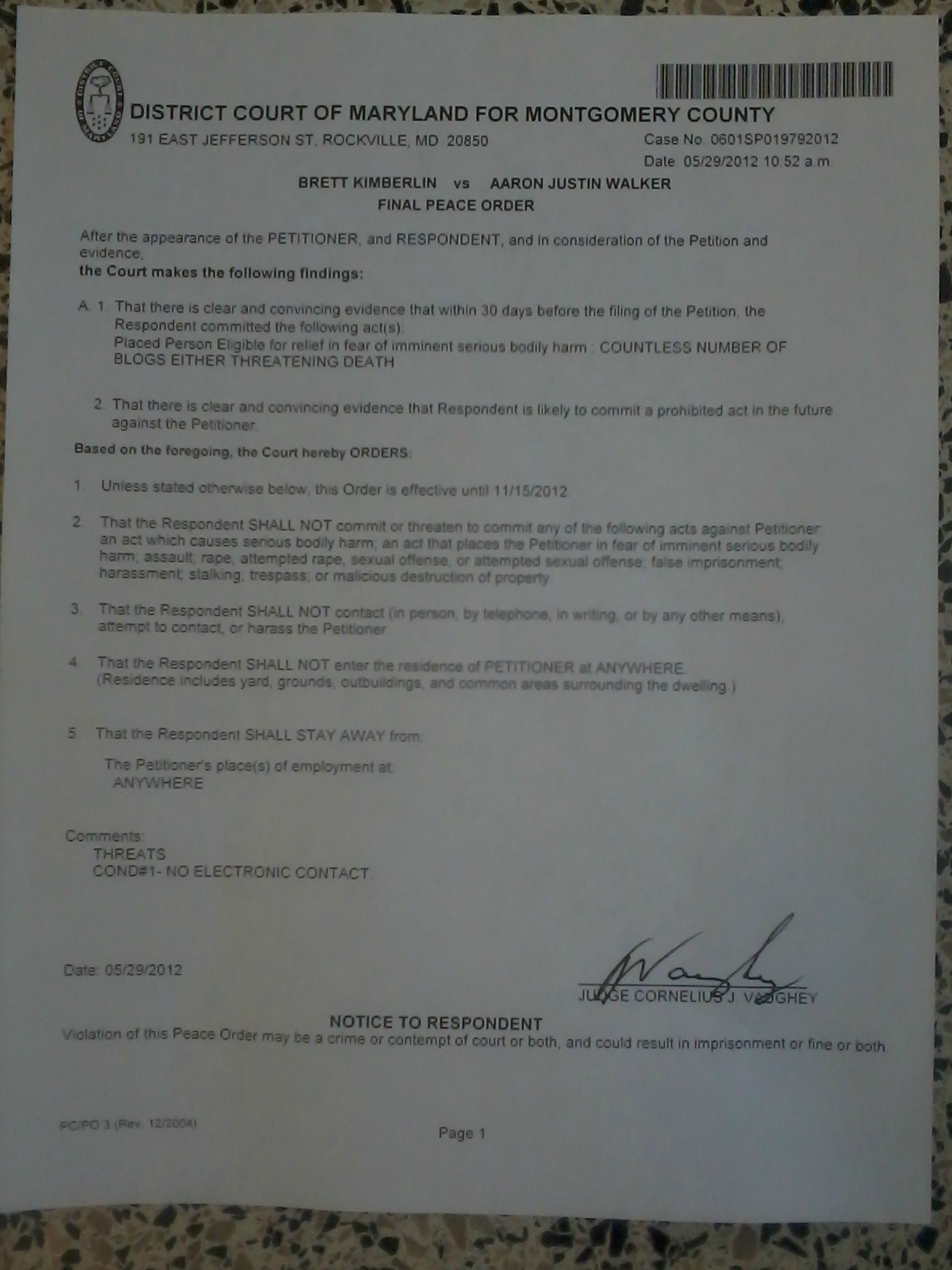
The  judge’s order against Aaron Walker begins with a finding that speaks volumes:
That there is clear and convincing evidence that within 30 days before the filing of the Petition, [Walker] committed the following act(s):

Placed [Kimberlin] in fear of imminent serious bodily harm: COUNTLESS NUMBER OF BLOGS EITHER THREATENING DEATH [sic]

Ironically, the First Amendment, and our right to enjoy it, is in far worse shape today than it was a week ago.  So too is Aaron Walker.  This wasn’t what anybody had in mind when we spoke out in support of the constitutional right of free speech and the outrage used to thwart it.

ALM Claims its Streetcorner

American Lawyer Media has been a trusted source of news and commentary for the legal community, from such “must-read” publications as the Legal Intelligencer and the New York Law Journal to such sketchy ones as the American Liar and the National Law Journal, And then there’s its web presence, with such mainstays as  Legal Blog Watch, Blog of Legal Times and its best named domain, Law.com.

The problem with ALM, however, is that for all it has, it’s never been a hugely profitable company, and it’s always been limited by its universe, the legal community.  As a business, like any business, the goal of profitability is at its core, and certainly no one can blame it for that.  In fact, it says so right under the title “Our Core Values“:


As a dynamic global business ALM is committed to the development and success of the people we work with and the communities we serve. We aim to deliver the highest standards of integrity, fair-dealing and quality in the services we provide.

There you go, profit. And I, for one, have no qualm with that.  I do, unfortunately, have a qualm with this :


ALM, known as a leading provider of news and business information to the legal and real estate industries, announced last week the formation of a Marketing Services team that will work with law firm clients to plan, execute and measure a comprehensive marketing campaign.


The objective of the new team is to deliver greater return on investment for clients by offering a full suite of marketing services from a single source, reducing the need to engage with multiple vendors to acquire new leads and build customer relationships. The team will meet with clients to assess their overall marketing goals, then customize a package of services – including market research, national and regional advertising, live events, Webcasts, email marketing, advertorials, and other ALM offerings – in order to build a turnkey marketing campaign, and finally to provide lead management and measure campaign results.


How thrilling to learn that a business built on providing information, news and commentary to lawyers can also provide “new leads” and “customer relationships.”  Notice that there is no mention of the arcane and archaic word “client.”  There’s gold in them thar leads, and ALM wants to mine it.

Over time, I’ve gotten to know a good number of folks who work or are related to ALM, and for the most part, they’re good people and many are good lawyers.  They handled themselves with integrity, and never let their association with ALM sway what they wrote or who they wrote about. There was often some question as to what their relationship to ALM meant, given that it wasn’t exactly a great payor and when trouble happened, was the first to leave the sinking ship.  But they didn’t strong arm their people to do their corporate bidding, which reflected well upon the integrity of ALM’s publications.

But then look at what happened with other businesses that began as honest brokers and ended up walking the boulevard.  Findlaw comes immediately to mind.  Not Yodle, as was never considered an honest broker, nor a host of others who staked out their street corners already.

Granted, the toxic combination of ignorance and desperation makes this move by ALM a good business decision from the perspective of scarfing up those marketing dollars that would go elsewhere, perhaps to a less “dynamic” business.  But as Kevin Vermeulen, senior vice president at ALM and the head of this new venture says, he has the “other ALM offerings” to sell, to use to bolster your one stop marketing behemoth.

Does this mean that Legal Blog Watch will now be an integral part of ALM’s lead generator?  Bruce Carton probably gets a bunch of press releases and tips every day from people who want him to take notice of their incredibly important bloggy news, and promote the living crap out of them.  While I can’t imagine Bruce selling his keyboard, I can easily imagine his handing off the reins to another who might be more amendable to the corporate good.

This would never happen with an honorable company, you say?  Consider Exhibit A, the law firm of Womble Carlyle  announces that it was “ranked #1 for social media outreach among law firms reviewed.”  The ranking was done by Adrian Dayton, who turned “social media guru” after his eight months practicing law didn’t work out too well.  And for whom does Adrian guru?  Womble Carlyle! 

As it happens, Adrian is also a social media writer for The National Law Journal.  And the NLJ just happens to be owned by whom?

While this might be an appropriate opportunity to explain, again, why a quarter million websites proclaiming their lawyers to be caring, experienced and aggressive isn’t going to work.  As each tries to outdo the other, to take another step down the slippery slope of deceit and slime and SEO hegemony, there will never be a winner.  But I will resist the temptation to mention these problems.

Instead, consider that even trusted sources of news, information and commentary want to make sure that they have a hand in your pocket, and a street corner to call their very own.  Let no lawyer be untouched by marketing.  Let no “lead” or “customer” be missed by the business that once was a profession.