Via Above the Law, A Public Defender and Defending People, the criminal law firm of Lindeman, Alvarado, and Frye has been taken to task for it’s website that uses tasteless, if not offensive, photographs to give their marketing a bit of punch. There’s a bit of debate between Bennett and Gideon about whether this was the product of Findlaw’s professional marketing assistance, or whether the firm chose its own direction.
Gideon makes a painful point by offering an alternative approach; if you want to induce vomiting, he’s got a murder photo that will really get people talking. I won’t post it, or even link to it. If you’re inclined to take a look, the actual website photos are available at ATL and the nasty murder pic is on A Public Defender. Go there and take a look, if that’s what you want to do. There are some sick people out there who would pay to look at photos like these.
Instead, I want to talk about effective marketing. After all, why market if it isn’t effective, if it’s not going to persuade someone checking out your website to call you, talk to you, hire you. That’s the point of marketing, after all.
My brethren make the point that this is scum marketing. Forget dignified, this is as ugly as it gets. But is it effective? The images are very professional, and certainly spice up a website that would otherwise be indistinguishable from ten thousand others. You can take comfort in your dignified website, with appropriate photographs that meet the approval of your friends at the bar, but if it doesn’t bring in clients, so what? Marketing isn’t about making your friends happy. Marketing isn’t about getting the dignified lawyer of the year award. It’s about business.
Internet marketing is still in its relative infancy. In the very beginning, only a handful of lawyers had websites. They look pretty much the same, and generally say the same nice things about the lawyers. We’re experience, aggressive and fight hard for our clients. Woo hoo. Some of the early adopters created websites designed to mislead or deceive consumers, making claims that were either technically true but deceptive, or just incorporating outright lies into their websites. It’s not like anybody check them for accuracy.
Over time, the websites became more slick, more professional. The cookie cutter websites offered by enterprises that catered to lawyers gave way to greater innovation, as lawyers no longer wanted a website that looked exactly like every other lawyers website. The only difference tended to be the name at the top. Not a particularly effective way to market.
While no one wanted to be the only kid on the block without an internet presence, as it made you look as if you weren’t “real” if you didn’t have a website, they didn’t do much to bring in the business. Some paid for placement at the top of Google’s search list, but everybody can’t be on top.
So the question over time is what can be done to distinguish one lawyer’s marketing effort from another’s. And the website of Lindeman, Alvarado, and Frye was born. While they are being excoriated for their tastelessness, what did you expect? There’s going to be a race to the bottom, to come up with the concept that’s going to distinguish one lawyer from another. This is just the start.
How much worse can the lies and deception get? How much more tasteless and salacious will the photos get? I’m quite certain that I lack the imagination to foresee where this is all going. It will be far worse than I would ever believe. It’s got to, for anything less will just be mundane and ineffective. While the Lindeman, Alvarado, and Frye website stands out for the moment, it’s just a matter of time before someone else uses far more tasteless pictures to suck clients in.
There are a lot of criminal defense lawyers out there. Each one wants/needs business. That’s how we feed our families. What will we do to get it? We’re still a long way from finding out where the bottom is.
Author Archives: SHG
Trust Your Price
Charles Green, whose writes about trust, posed a provocative post about what to do when a potential client tells you that your price is too high. His assumption is that the statement will be met with confusion:
When you hear those words—“your prices are too high”—you probably have one reaction in your mind. “What? How can (s)he possibly think our prices are too high? What are they talking about? We’ve trimmed them already; I know they’re not too high, other firms have got to be that high, and our costs are barely covered here, we’re absorbing a lot—how can they say our prices are too high?”
In other words—you really do not understand what they mean.
If you are a lawyer of any worth at all, you’ve experienced the client who tells you this. But as a criminal defense lawyer, this should never be your reaction. I don’t address other fields of law, which may not have the same concerns, but this is remarkably common for criminal defense lawyers.
Green explains the various scenarios that drive the client to make the statement, and seeks to offer a way to turn an uncomfortable situation for both lawyer and client into a more positive experience, one that creates greater trust between the two.
Green explains the various scenarios that drive the client to make the statement, and seeks to offer a way to turn an uncomfortable situation for both lawyer and client into a more positive experience, one that creates greater trust between the two.
And if you can be the one that turns a difficult one into a pleasant, curious, customer-focused question, then you are the one that gets credit for transforming the conversation into greater trust.While the creation of deeper trust, better understanding, has much to commend it, this is a pivotal moment for a criminal defense lawyer. Unlike a manufacturer of goods, we have no cost of production and distribution against which to weigh the customer’s concern. We have only time. Like it or not, time has no intrinsic value. An hour without work is lost forever, but costs us nothing.
Your intent, as always, is to develop a deeper relationship with the customer, and to do the right thing for that customer. You can never control the outcome of a price conversation; but being curious and honest about it increases the odds, and pays relationship dividends in future.
The question for the criminal defense lawyer faced with the potential client who says your price is too high is very simple. If you’ve valued your time well, the only response is to say, “thank you for coming in and I wish you the best of luck with your case.” Or as Bennett more succinctly put it, “okay”. Accept the fact that your fees will be too high for some potential clients. In fact, expect that some can’t afford any fee, but that doesn’t stop them from wanting your services. It happens regularly. It’s part of the deal.
I’ve known many lawyers who won’t let a person with cash in their pocket walk out the door. Some of these lawyers have made a fortune this way, as even pennies add up when you put enough of them together. If you’re hungry enough, you may chose this path. It’s not the path of good lawyering, as it leads to the quick plea and abdication of anything resembling integrity, but that’s why you get on the cheap.
My view is that lawyers who strive for excellence should never compete on price, but on quality. It’s a corollary to the notion that lawyers should never lie to clients in order to get the case, even though they would be happy to pay if only you will tell them what they want to hear. Get used to the fact that you will not score every client who calls or walks through the door. Unless you are willing to sell your integrity for whatever jingles in their pocket.
You can have a nice, trust-inducing conversation with clients to learn why they tell you that your price is too high. It only costs you time. While the talk may be interesting, and the client may trust you far more after the conversation is over, they still won’t be able to pay your fee. Unless you plan to take them on anyway, at whatever price they can afford, get used to it. It’s the nature of our work.
All The Trimmings
For the first time in, oh, 30 years, my entire clan will be at my home for Thanksgiving today. Four generations under my roof, and I’m absolutely thrilled about it. The plan of action is simple. Between Dr. SJ and my son, the pastry chef, there will be apple pie, pumpkin pie, cherry pie, pecan pie, cheesecake and profiteroles. There’s been talk about some bird as well.
My Thanksgiving post from last year is still relevant, and, unfortunately, still rings true. Times are still tough, though it feels better to be looking downhill than up. I realize that many can’t see it that way, but one thing you come to realize after having lived through tough times is that they eventually end. The trick is surviving long enough to get the better days.
Of the many guests coming to join me for dinner today, a few have suffered quite a bit over the past year. Lost jobs and homes are hard for anyone to endure, especially when it seems as if it was all driven by external forces with no fault of their own. Yes, there has been pain in my extended family as there has with so many others. Like so many others, my millennial niece is living in her mother’s basement, with her husband and daughter. Oh yes, and her Ph.D.
The problem is that it’s not exactly true that the pain we’re enduring is all external, or that there’s no fault to be found. I’ve written quite a bit over the past year about young lawyers, those I call the Slackoisie, and for the most part, they haven’t liked what I’ve had to say. No one likes to hear that they create their own problems, even in part. But they do, just as the young in my family who have suffered this year have made choices that resulted in their circumstances.
My generation has tried to provide a good education, love and support to our children. No, not everyone, but for the most part, we have raised a generation that is far better educated than any before it and far more secure in their belief of their self-worth. In some ways, this has been a successful experiment in child-rearing. In others, it’s been a terrible failure. We’ve raised a generation of narcissists who hold a dangerous belief in their entitlement to everything the world has to offer, both material and intellectual.
What we have been unable to successfully accomplish is to instill the notion that, at some point, they need to grow up and take responsibility for themselves, their choices, their actions and inactions. Stop looking to us for approval and start recognizing for themselves that they must bear the consequences of their choices. You can’t spend your lives expecting mommy and daddy to fix every problem you face, or to tell you that it’s okay, you’re not responsible for you childish choices.
The waggish retort from the children is that their failings are our fault. Yes, they are, to a large extent. But so what? Do they plan to spend the rest of their lives complaining about it, or do they plan to get off their butts and improve their own situations? We gave you too much, we comforted you too long, we watched you whenever you wanted our attention, we never spanked you or told you that your ideas were, well, dumb. We never wanted to hurt your self-esteem, and in the process, created little monsters filled with your own self-importance.
We hoped you would grow out of it and realize that the rest of the world didn’t love you as much as we did. That you were not quite as brilliant and wonderful as we led you to believe. That not everybody gets a trophy in real life, or a house, or a BMW, or recognition by all who look at you that you are the most beautiful, brilliant, wonderful child ever. In fact, aside from us and a few of your close friends, nobody really cares much about you at all. They are all too busy thinking only of themselves and their own self-importance.
I’ve been largely unsuccessful in conveying this message to readers. I’m not sure whether it’s because of my failure to send a clear message or their inability to receive the message I’ve sent. I imagine it’s some of both. They’re surrounded by a wall that took a generation to build, and a few harsh words from some jerk on a blawg won’t easily break through.
My motive is to help them to survive and thrive in a tough world. We depend on them to pick up where we left off, at least as far as the good things we do. I’ve written that I truly care about kids, and I’ve been told in response that I’m full of it. They’re understanding of caring is blind support and comfort. Granted, they won’t find that here, but then that’s not what they need. They’ve had a lifetime of coddling and it hasn’t served them nearly as well as we had hoped. It’s time for a good smack to wake them up to the reality that they’re not 12 years old anymore.
A terrific twit came across my screen yesterday that made an important point.
“Wise beyond your years” is valued until you’re 30. At that point, wisdom is expected and performance is demanded.mktgdouchebag Marketing Douchebag
The Thanksgiving Whine List
Miami criminal defense lawyer and screw-top wine connoisseur, Brian Tannebaum, has a special tradition for Thanksgiving. He puts together a list of things he’s thankful for. It reads remarkably like a list of complaints, artfully phrased in the positive but leaving no doubt about his point.
I don’t blame Tannebaum. It’s always a good idea to work toward one’s strengths, and we generally find much more to complain about in this line of work than not. So I checked out Brian’s list to see whether he was “thankful” for the things that I complain about as well.
While his list has ten items on it, number 2 immediately struck me.
I was paired up with some old codgers once when I went out to play golf on my own. We eventually got around to talking about what we did for a living. When I told them that I was a lawyer, one responded that he was a reformed lawyer. By this, he meant that he was a judge. He was a lot of fun to play golf with, as he was one of the two or three that I was able to beat. This is why no one who knows me wants to play golf with me. I’m just awful.
The judges who come out of government offices don’t remember standing where I do. They never did. They’ve never had to deal with a scared and miserable client, or their spouse or children. They’ve never had to worry about where the next case was coming from, or how they were going to make it to the next courtroom before the judge blew a gasket. They never wondered, as they spent three days working on motion papers, whether anybody would even read them before denying the motion. Or being cut off three words into an argument by a judge who presumes to know every argument ever made and has long since decided the defense loses.
The bench looks very different when you’re first starting out, and the men and women sitting on high appear older, more dignified, scarier. Years later, they look like the men and women who got sloppy drunk at holiday parties, fudged the truth in responsive pleadings and couldn’t frame a rational argument if their life depended on it.
I remember sitting down with a dear old friend who had become a judge. It was during the 12 minutes that I considered it as a possibility, before the local political boss explained to me that fellating the party was expected. The judge hated being a judge. Nothing about the job was what was anticipated. There was no sense of power, no sense of the ability to do good. The institutional pressures were entirely different than expected. The job was far more administrative than judicial, and to the extent it was judicial, it was banal. The job sucked the life out of her.
I no longer wonder if a judge remembers standing where I do. I remember where they stood before they sat. Even if I didn’t know them back when, I know that they were once normal, human, regular. And I know that they have since taken on a job that very few people are capable of doing, and even fewer doing well. They don’t have the stamina or the guts, and if they did have the guts, they would be marked quickly as unjudicious and shunned by their brethren.
But they don’t fool me. I know there’s a person inside the judge. Somewhere. Whether they remember or not, I do. And when I look them in the eyes as they go through the routine of being judge, I know whether they remember when they used to be people. The ones who do avert their eyes, because they remember what it was like to be standing where I stand and looking up at the judge. They remember what it was like to need a judge to be a judge, and they know that they don’t have the heart for it.
Brian Tannebaum is thankful for those judges who remember. I’m thankful for those judges who, despite everything they’ve gone through, still care.
I don’t blame Tannebaum. It’s always a good idea to work toward one’s strengths, and we generally find much more to complain about in this line of work than not. So I checked out Brian’s list to see whether he was “thankful” for the things that I complain about as well.
While his list has ten items on it, number 2 immediately struck me.
[2] Judges who say “I remember standing where you are,” and actually do.This is one of those grand ironies of practicing law. All judges were lawyers once. That doesn’t mean they once stood where we do, in the well on the side opposite the jury (and before anybody says so, your mileage may vary, so don’t tell me that in your courtroom, you get the other side; that’s not the point). Many come to the bench straight from the a government office, more often than not the District Attorney’s or United States Attorney’s office. Many others served as law secretaries to a judge before “ascending”.
I was paired up with some old codgers once when I went out to play golf on my own. We eventually got around to talking about what we did for a living. When I told them that I was a lawyer, one responded that he was a reformed lawyer. By this, he meant that he was a judge. He was a lot of fun to play golf with, as he was one of the two or three that I was able to beat. This is why no one who knows me wants to play golf with me. I’m just awful.
The judges who come out of government offices don’t remember standing where I do. They never did. They’ve never had to deal with a scared and miserable client, or their spouse or children. They’ve never had to worry about where the next case was coming from, or how they were going to make it to the next courtroom before the judge blew a gasket. They never wondered, as they spent three days working on motion papers, whether anybody would even read them before denying the motion. Or being cut off three words into an argument by a judge who presumes to know every argument ever made and has long since decided the defense loses.
The bench looks very different when you’re first starting out, and the men and women sitting on high appear older, more dignified, scarier. Years later, they look like the men and women who got sloppy drunk at holiday parties, fudged the truth in responsive pleadings and couldn’t frame a rational argument if their life depended on it.
I remember sitting down with a dear old friend who had become a judge. It was during the 12 minutes that I considered it as a possibility, before the local political boss explained to me that fellating the party was expected. The judge hated being a judge. Nothing about the job was what was anticipated. There was no sense of power, no sense of the ability to do good. The institutional pressures were entirely different than expected. The job was far more administrative than judicial, and to the extent it was judicial, it was banal. The job sucked the life out of her.
I no longer wonder if a judge remembers standing where I do. I remember where they stood before they sat. Even if I didn’t know them back when, I know that they were once normal, human, regular. And I know that they have since taken on a job that very few people are capable of doing, and even fewer doing well. They don’t have the stamina or the guts, and if they did have the guts, they would be marked quickly as unjudicious and shunned by their brethren.
But they don’t fool me. I know there’s a person inside the judge. Somewhere. Whether they remember or not, I do. And when I look them in the eyes as they go through the routine of being judge, I know whether they remember when they used to be people. The ones who do avert their eyes, because they remember what it was like to be standing where I stand and looking up at the judge. They remember what it was like to need a judge to be a judge, and they know that they don’t have the heart for it.
Brian Tannebaum is thankful for those judges who remember. I’m thankful for those judges who, despite everything they’ve gone through, still care.
At Least One Rule Applies
Given the sort of problems that surround Blackwater, gang-raped employees and massacred Iranian civilians for example, one might suspect that this shady enterprise, it’s hardly surprising that the company changed its name to Xe in the hope that no more tales about it could come out if no one knew how to pronounce its new name. It’s pronounced “Zee” by the way. It’s so much easier to change the sign on the door than deal with the rules.
The problem is that in Blackwater’s business, there are no rules. At least none that Blackwater felt constrained by. Apparently, this sense extended beyond its covert operations on foreign soil funded by American taxpayers, all the way to its lawyers.
Defense attorneys for five U.S. security contractors heading to trial on charges of killing 14 unarmed Iraqi civilians in 2007 got into BIG trouble Monday with the federal judge presiding over the case.
No, they didn’t leak classified information.
No, they didn’t spout off in court.
They filed court papers in single space.
For those who don’t know better, formal papers filed in court must be double spaced. Every lawyer know this. It’s not a personal choice. It doesn’t matter whether you prefer the look of single spacing, or even space and a half. Double spaced is the rule.
“Paragraph 1 of the Standing Order provides all submissions ‘should be double-spaced, in 12-point Times Roman or Courier font,’” U.S. District Judge Ricardo M. Urbina wrote in a short notice filed on the court docket Monday. “In disregard of this provision, the defendants failed to double-space their memorandum, in an apparent attempt to include more information in their submission than would otherwise be permitted.”
Judge Urbina makes not note of what additional information the Blackwater attorneys sought to include that wouldn’t otherwise fit in their papers, or why they couldn’t just spend the time to edit it down to a reasonable length. The papers themselves were filed under seal, precluding scrutiny of what was so important that the Blackwater lawyers would risk the wrath of the court for their attempt to sneak in a single spaced memo.
But no matter who was raped or murdered, he was determined to make sure that they would not get away with single spacing in his courtroom. Oh no, that wasn’t going to go unnoticed.
Having made his point, however, Judge Urbina was careful not to let form trump substance.
But no matter who was raped or murdered, he was determined to make sure that they would not get away with single spacing in his courtroom. Oh no, that wasn’t going to go unnoticed.
Having made his point, however, Judge Urbina was careful not to let form trump substance.
Urbina declined to sanction the lawyers, writing that he was “loath to strike the defendant’s submission given the nature of the litigation and the proximity to trial.”Ouch. I can almost hear the smack from here. You can bet your bottom dollar that those lawyers for an enterprise that allows gang rape and massacres by its personnel, then covers it up or buys it off, are shaking in their Gucci loafers.
“The parties, however, are put on notice that any further failure to meet the standards set by the court will result in sanctions,” Urbina added.
The Circle Closes, At Least For The Moment
Not long ago, I received an email from a fellow at the Heritage Foundation asking if I would be interested in working with them. The Heritage Foundation? A conservative think tank? Me? I couldn’t pass up an opportunity to find out what this was about, so we spoke. The message was clear: They were into overcriminalization, and they wanted me to work with them.
One of the names thrown at me was that of former Attorney General under Ronald Reagan, Ed Meese. Many years earlier, I met with another former Attorney General, Ramsey Clark, who served under Lyndon Baines Johnson, also about working with him. The two could not have been more different in their tenures. How was it possible that now, almost 30 years later, a common thread existed between Meese and Clark?
Adam Liptak at the New York Times writes that the left and right have come together over a common enemy, overcriminalization.
“It’s a remarkable phenomenon,” said Norman L. Reimer, executive director of the National Association of Criminal Defense Lawyers. “The left and the right have bent to the point where they are now in agreement on many issues. In the area of criminal justice, the whole idea of less government, less intrusion, less regulation has taken hold.”
Yet another temporal oddity, Norm’s office was down the hall on the 13th Floor from my first office, when he was partnered with Frank Gould and spent much of his time defending marijuana cases. He was a young lawyer back then, though much older and more experienced than me. And here he was, talking about how our old struggle somehow stretched far enough to take in our former nemeses, Ed Meese and Dick Thornburgh. It would have been fantasy, a joke, to even think this day would come.
Edwin Meese III, who was known as a fervent supporter of law and order as attorney general in the Reagan administration, now spends much of his time criticizing what he calls the astounding number and vagueness of federal criminal laws.
Mr. Meese once referred to the American Civil Liberties Union as part of the “criminals’ lobby.” These days, he said, “in terms of working with the A.C.L.U., if they want to join us, we’re happy to have them.”
But as Radley Balko points out, let’s not hold hands and sing Kumbaya too quickly.
If Meese had had a late in life epiphany on the proper balance police and prosecutor powers and the rights of the accused, I’m happy to hear it. But this is just inaccurate…In fact, browsing the index of Smoke and Mirrors, Dan Baum’s excellent history of the drug war, during his time as Attorney General, Meese pushed for, among other policies….• Expansion of federal asset forfeiture laws, including giving police the ability to seize before an indictment, and “substitute assets” provisions.• More power to hold suspects without bail.• Repeal of the Miranda requirement and the Exclusionary Rule.• The power to issue administrative subpoenas to require defense attorneys to snitch on their clients.• The federal reporting requirement on cash transactions over $10,000.• Stripping drug suspects of all their assets so they can’t afford to hire a defense attorney.
This isn’t about Ed Meese having a late-life epiphany. This is at best a marriage of convenience, a convergence at the fringe of overlapping interests where, for a brief and shining moment, the rhetoric of both sides coincides. One side concerns itself with the overcriminalization for all, together with the concomitant ignorance of constitutional rights, the other relies on the United States Chamber of Commerce to represent its views that federal regulation, the overreach of government into the lives of businesses, is ruining the land of opportunity.
Believe me, if both sides brought their respective clients to a party, their defendants wouldn’t slow dance with each other.
It’s not that this mating of odd bedfellows doesn’t serve the interests of both sides, at least for the moment. And it’s not that there isn’t merit to the arguments made at the overlap. It’s that no one should mistake that they are both on the same team. The left and right will hold hands only as long as there is a common enemy, but the nature of each hasn’t change a bit.
The point is best shown by Liptak’s explanation of the genesis of this pairing.
The distinction, unmentioned in Liptak’s piece, is that the right wants to cleanse the federal criminal law of the thousands of regulations that criminalize free market conduct by business, and liberate corporations from the shackles of a system that penalizes the good American businessperson as if he was some common street thug. As for the common street thug, he can rot in prison forever, for all they care.
While the two sides may share common rhetoric about overcriminalization, there’s really very little, if anything, that they truly agree upon. The right has no interest in the plight of the common criminal under traditional criminal law, and the left isn’t all that worried about CEOs going to Club Fed for failing to deliver honest services. But it’s better that they work together, if only for the moment, to stem the tide of ever-increasing criminalization than not.
I told the fellow from the Heritage Foundation that he was free to parse my posts here for whatever served his interests, no charge. But I wasn’t comfortable hooking up with Ed Meese, no matter how enlightened he’s suddenly become. I thought of the old story of the venomous snake, near death and cared back to health by the kindly old man. As soon as the snake was well, he turned and bit his savior. The old man asked as he was dying, “Why would you do this to me after I saved your life?” The snake responded, “It’s my nature. You knew what I was when you took me in.”
Believe me, if both sides brought their respective clients to a party, their defendants wouldn’t slow dance with each other.
It’s not that this mating of odd bedfellows doesn’t serve the interests of both sides, at least for the moment. And it’s not that there isn’t merit to the arguments made at the overlap. It’s that no one should mistake that they are both on the same team. The left and right will hold hands only as long as there is a common enemy, but the nature of each hasn’t change a bit.
The point is best shown by Liptak’s explanation of the genesis of this pairing.
The roots of the conservative re-examination of crime policy might also be found in the jurisprudence of Justices Antonin Scalia and Clarence Thomas. The two justices, joined by liberal colleagues, have said the original meaning of the Constitution required them to rule against the government in, among other areas, the rights of criminal defendants to confront witnesses.But as our justices have made painfully clear, it’s not that they don’t repose ultimate trust in our “new professional” cops, or note an exception to the Fourth Amendment that doesn’t meet their approval. If these are the vanguards, as Doug says, then I don’t want to stick around for Roberts and Alito bringing up the rear.
“Scalia and Thomas are vanguards of an understanding by the modern right that its distrust of government extends all the way to the criminal justice system,” said Douglas A. Berman, a law professor at Ohio State University [not to mention blawger at Sentencing Law and Policy].
The distinction, unmentioned in Liptak’s piece, is that the right wants to cleanse the federal criminal law of the thousands of regulations that criminalize free market conduct by business, and liberate corporations from the shackles of a system that penalizes the good American businessperson as if he was some common street thug. As for the common street thug, he can rot in prison forever, for all they care.
While the two sides may share common rhetoric about overcriminalization, there’s really very little, if anything, that they truly agree upon. The right has no interest in the plight of the common criminal under traditional criminal law, and the left isn’t all that worried about CEOs going to Club Fed for failing to deliver honest services. But it’s better that they work together, if only for the moment, to stem the tide of ever-increasing criminalization than not.
I told the fellow from the Heritage Foundation that he was free to parse my posts here for whatever served his interests, no charge. But I wasn’t comfortable hooking up with Ed Meese, no matter how enlightened he’s suddenly become. I thought of the old story of the venomous snake, near death and cared back to health by the kindly old man. As soon as the snake was well, he turned and bit his savior. The old man asked as he was dying, “Why would you do this to me after I saved your life?” The snake responded, “It’s my nature. You knew what I was when you took me in.”
Dan Hull: Post Traumatic Slacker Envy
He was never quite the same after the tragic kiln explosion, or the death of disco, but that never stopped J. Daniel Hull from doing what was right. A beacon in a sea of mediocrity, the guiding light of What About Clients?, Hull had learned the lesson of the 70’s and would never again succumb to transitory whims. Until now.
Boomers: They just don’t [heart] tech enough. For a lawyer, and especially one born between 1946 and 1966, I’m not too bad at science, or even math. Geometry came easily. Calculus not so easily.
It always starts this way, A personal disclosure, a glimpse into the bleeding heart, as if Dairy Queen’s issues with Mr. Softee taint us all.
Same with the new Digital World. And Word Processing, Document Management, Graphics. Frankly, I don’t like any of “it”–and prefer others (always younger) do “it” for me. Documents especially. I do not like to type them, create them, edit them, manage them, store them and retrieve them. Secretly, I do not even like computers, cell phones, video-conferencing, anything electrical–and never will. I like humans, voices, winks, laughs, sneers, grimaces, smiles, flirtations, handshakes, and bodies in the room.
So what if Hull never touched the IBM Selectric III? So what if wet paper copiers got your hands all dirty? They were just tools, and a good mechanic never blames his tools.
But hating computers is hurting me–and wasting the time of others who I demand do it for me. I am working more and more on my tech. (If you think by the way that operating a blog is “technical”, think again; the blogging platforms available make that all very easy.)
Gen-Y and Gen-X are very right about one thing: many Baby Boomers really are babies, and often arrogantly helpless cretins, about Tech. We are above it, we think. Well, we are not above it. We cannot be.
What? Hull finally got an ipod and he’s “loving it?”
The tools of the digital world–creation, management, storage, retrieval and shipment of documents–may not make the work product better. But it does make work easier. The over-45 crowd must stop relying on younger people to do that work. And we must quit whining about Tech, and having to learn it. We cannot afford to be above it any longer.
Granted, the charm of saying “I wouldn’t touch that computer if my life depended on it,” is gone. The days of claiming only sissies use remote controls to change the vertical hold on their TVs is over. But has Hull gone over to the Slackoisie, the very term he coined to denigrate those who think the ability to photoshop entitles them to show up for work at their convenience?
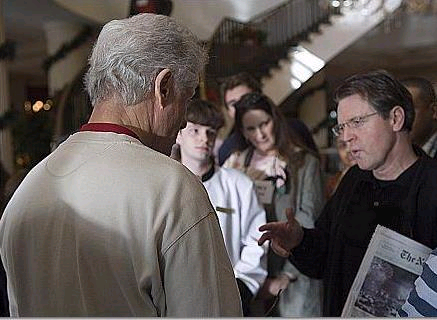 No computer will ever win a case. No gadget will replace the mind that drives the fingers that push the buttons. My old friend Hull has come to his senses.
To make this point as painfully clear as possible, consider the example of this hard-copy New York Times reading Boomer (on the left, with only three fingers on his right hand) speaking to a prematurely wrinkled, yet distinguished man with bed head. The nuanced look of disdain at the older man’s ill-fitting sweater would never be recognized in an email or twit.
But more importantly, look at the eager glances of the youngsters in the background, trying to figure out what these two men are doing, standing face to face while their mouths emit sounds.
That’s called talking man to man. Dan Hull still does it. Do you?
I still prefer Boomers for co-workers, having given up on younger generations for the time being. Boomers will work long and passionately into their sixties, seventies and even eighties. They are never offended by hard work or complex problems. They don’t think that digital toys make your work better–and they are right about that. Boomers like complexity, ambiguity, and genuinely hard problems. Gadgets? They just make you coffee, or give you a copy.
I’d rather work with a 50-year-old than anyone because he or she, generally, will go on until the last dog dies. Never prissy. Always engaged. Nothing is too hard. Boomers are “Foxhole People” to the core.
No computer will ever win a case. No gadget will replace the mind that drives the fingers that push the buttons. My old friend Hull has come to his senses. To make this point as painfully clear as possible, consider the example of this hard-copy New York Times reading Boomer (on the left, with only three fingers on his right hand) speaking to a prematurely wrinkled, yet distinguished man with bed head. The nuanced look of disdain at the older man’s ill-fitting sweater would never be recognized in an email or twit.
But more importantly, look at the eager glances of the youngsters in the background, trying to figure out what these two men are doing, standing face to face while their mouths emit sounds.
That’s called talking man to man. Dan Hull still does it. Do you?
“Against The Popular Will”
Via the WSJ Law Blog, Middle District of Pennsylvania Judge A. Richard Caputo issued a decision that, by his own description, is “against the popular will.” Did he free a horrific murder because his constitutional rights were violated? Hardly. He granted immunity to “Cash for Kids” judges Michael T. Conahan and Mark A. Ciavarella. Black really does cover many flaws.
Writing that judicial immunity does not operate on a “sliding scale,” Judge Caputo ruled that the judges are protected by immunity from facing legal action for their courtroom acts. “The degree of corrupt behavior is not the touchstone of the immunity doctrine’s application,” Caputo wrote, acknowledging that his ruling runs contrary to “popular will.” He added: “The doctrine holds that judges with bad intentions, as well as those with good intentions, are immune from suit.”
The fallacy of the slippery slope is that it can always stop at a conceptual ledge. Or, one can be slave to blind precedent, and just slide, slide, slide. As immunity has come under scrutiny for prosecutors who engage in affirmative wrongdoing, it appears that the judiciary remains safe in its black-robed cocoon, untouched and untouchable.
While Judge Caputo did what he could in his decision to distinguish between judicial acts and administrative acts, holding that no immunity was conferred for the latter, he missed an enormous opportunity to distinguish between a judicial act, with or without intentions, and the intentional commission of a crime. They are not coextensive.
Some men steal with ski masks. Some steal with black robes. It’s not a question of sartorial choice; both are stealing. Stealing does not fall within a judge’s job description.
Judge Caputo’s “sliding scale” analogy shows how he’s gone conceptually awry. Placing children in kiddie prison for a kickback is not on the same scale as choosing to credit the testimony of a police officer despite being contradicted by ten civilian witnesses, seven of whom are priests and one a cardinal. That’s the low point of the sliding scale, for which immunity remains intact. Using a courtroom as a criminal enterprise simply because they can puts their conduct on another scale altogether. There is nothing, absolutely nothing, judicial about what Ciavarella and Conahan did.
The commission of a crime makes for a perfect bright line test. The judicial function does not encompass an intentional crime. Would this threaten judicial independence? Would this threaten judicial integrity? Is this the nature of conduct that requires protection? It’s hard to fathom that any judge could come up with a rationale that compel them to protect a criminal simply because they sit on a bench while engaged in their criminal enterprise.
Worse still, by conferring immunity on these two, Judge Caputo has not merely elevated the protections for judges beyond any legitimate societal interest, but beyond anyone else in government save the President. There are a lot more judges than presidents, at least at any given time. Are judges worthy of that level of protection? Not when they use their office to commit crimes. There is simply no reason why they need to be endowed with immunity from suit by their victims, any more than any other criminal.
Curiously, Judge Caputo made little effort to explain the justification for his leap over the conceptual ledge on the slippery slope. Instead, he relied on the tried and true fallback position of the courts.
Judge Caputo’s decision held firm to the rule that no judge can be exposed to civil liability for any act engaged in while wearing the robe. After all, what would the rule of law mean if judges who committed crimes under the guise of their office were stripped of immunity and held fully accountable? It must be far more of a problem than I realize.
Maybe I would find this resort to precedent, this elevation of platitude over reason, more convincing if the adherence to the rule of law occasionally worked in favor a defendant who wasn’t a judge. Maybe.
While Judge Caputo did what he could in his decision to distinguish between judicial acts and administrative acts, holding that no immunity was conferred for the latter, he missed an enormous opportunity to distinguish between a judicial act, with or without intentions, and the intentional commission of a crime. They are not coextensive.
Some men steal with ski masks. Some steal with black robes. It’s not a question of sartorial choice; both are stealing. Stealing does not fall within a judge’s job description.
Judge Caputo’s “sliding scale” analogy shows how he’s gone conceptually awry. Placing children in kiddie prison for a kickback is not on the same scale as choosing to credit the testimony of a police officer despite being contradicted by ten civilian witnesses, seven of whom are priests and one a cardinal. That’s the low point of the sliding scale, for which immunity remains intact. Using a courtroom as a criminal enterprise simply because they can puts their conduct on another scale altogether. There is nothing, absolutely nothing, judicial about what Ciavarella and Conahan did.
The commission of a crime makes for a perfect bright line test. The judicial function does not encompass an intentional crime. Would this threaten judicial independence? Would this threaten judicial integrity? Is this the nature of conduct that requires protection? It’s hard to fathom that any judge could come up with a rationale that compel them to protect a criminal simply because they sit on a bench while engaged in their criminal enterprise.
Worse still, by conferring immunity on these two, Judge Caputo has not merely elevated the protections for judges beyond any legitimate societal interest, but beyond anyone else in government save the President. There are a lot more judges than presidents, at least at any given time. Are judges worthy of that level of protection? Not when they use their office to commit crimes. There is simply no reason why they need to be endowed with immunity from suit by their victims, any more than any other criminal.
Curiously, Judge Caputo made little effort to explain the justification for his leap over the conceptual ledge on the slippery slope. Instead, he relied on the tried and true fallback position of the courts.
“This is, however, about the rule of law,” Caputo wrote. “It is about the rule of law in the face of popular opinion which would seek a finding directly contrary to the result the rule of law dictates.”The “rule of law” is that judges are immune for acts performed in their judicial capacity. The rote application of the rule transcends all else, as long as one can conveniently discard the rationale. Of course, if it wouldn’t offend the rule of law to hold that “judicial capacity” doesn’t cover the use of one’s judicial trappings to commit intentional criminal acts, then we would have a whole new ballgame.
Judge Caputo’s decision held firm to the rule that no judge can be exposed to civil liability for any act engaged in while wearing the robe. After all, what would the rule of law mean if judges who committed crimes under the guise of their office were stripped of immunity and held fully accountable? It must be far more of a problem than I realize.
Maybe I would find this resort to precedent, this elevation of platitude over reason, more convincing if the adherence to the rule of law occasionally worked in favor a defendant who wasn’t a judge. Maybe.
Finality or Innocence
In light of Judge John Cataldo’s decision in the dismissal of murder charges against Fernando Bermudez’s based upon “actual innocence,” State Senator Eric Schneiderman has proposed a bill that would allow judges to ignore procedural roadblocks that would inhibit a defendant from presenting belated evidence of innocence. From the New York Times :
Mr. Schneiderman is one of the sponsors of a bill introduced in the Senate last month that would add a provision to state law allowing judges to overlook procedural errors in a defendant’s case and overturn a conviction when the evidence before them “conclusively establishes” innocence.
An “actual innocence” statute, experts said, would give judges the leeway to excuse procedural violations, missed deadlines and other mistakes if the evidence is strong enough.
“It elevates substance over form,” said Glenn A. Garber, a Manhattan defense lawyer and founder of the Exoneration Initiative, an organization that focuses on innocence claims that lack DNA evidence. “If they know they’re required to engage in actual innocence analysis, it sends a message to courts that they have to do more when they’re confronted with compelling evidence of innocence.”
On its face, this hardly seems a controversial proposition. Certainly no one wants innocent people punished, which of course means that the guilty go unpunished. So what’s the issue?
Opponents of the actual innocence doctrine, however, have stressed the importance of finality in the justice system and fear that these statutes could lead to myriad frivolous claims by desperate prisoners.
While on its surface, the fear of “myriad frivolous claims” hardly seems sufficient to counterbalance the imprisonment of the innocent, but it’s not as inconsequential as some might think. New York, like elsewhere, has an awful lot of people in prison for many, many years. They have an enormous amount of time on their hands and access to a law library. There is nothing to lose by trying to argue, reargue, and reargue again, the proposition that they are innocent.
The burden that this could place on the system isn’t just a problem for judges with enough to do, but could crowd out legitimate claims of actual innocence, not to mention those cases that are otherwise winding their way through the courts. If you’re a fellow in jail awaiting trial, would you be thrilled by the prospect of your trial being delayed by months because the judge is busily reviewing a pile of actual innocence petitions from inmates, most of which are utterly frivolous?
Though “actual innocence,” a phrase that is disturbing to many as it suggests that everyone who can’t prove “actual Innocence” must be actually guilty, is possibly the case far more frequently than most would acknowledge based upon DNA reversals and the odd decision like Judge Cataldo’s, they still remain a very small percentage of the cases that go through the system and the defendants who find a new home courtesy of the state. Even if the wrongfully convicted comprise 10% of the prison population, that leaves 90% with too much time on their hands. That’s a problem.
But the answer isn’t to turn a cold shoulder toward the innocent, or elevate the importance of finality over freeing the innocent. Nor should judges toss the pro se petitions in the circular file and concentrate only on those few defendants who are fortunate enough to have captured the pro bono attention of a lawyer.
The proposed amendment, on the other hand, is hardly a panacea. The bar for consideration of an actual innocence petition is almost insurmountable:
As much as I have no answer to the conundrum, the problems recognized by this bill, and its opponents, could be significantly reduced if judges were to take their responsibility far more seriously prior to conviction. My preferred resolution to the problem of innocent people in prison is to stop convicting innocent people. While this is hardly a complete solution, it’s a good start. And it won’t even require passage of a new law.
The burden that this could place on the system isn’t just a problem for judges with enough to do, but could crowd out legitimate claims of actual innocence, not to mention those cases that are otherwise winding their way through the courts. If you’re a fellow in jail awaiting trial, would you be thrilled by the prospect of your trial being delayed by months because the judge is busily reviewing a pile of actual innocence petitions from inmates, most of which are utterly frivolous?
Though “actual innocence,” a phrase that is disturbing to many as it suggests that everyone who can’t prove “actual Innocence” must be actually guilty, is possibly the case far more frequently than most would acknowledge based upon DNA reversals and the odd decision like Judge Cataldo’s, they still remain a very small percentage of the cases that go through the system and the defendants who find a new home courtesy of the state. Even if the wrongfully convicted comprise 10% of the prison population, that leaves 90% with too much time on their hands. That’s a problem.
But the answer isn’t to turn a cold shoulder toward the innocent, or elevate the importance of finality over freeing the innocent. Nor should judges toss the pro se petitions in the circular file and concentrate only on those few defendants who are fortunate enough to have captured the pro bono attention of a lawyer.
The proposed amendment, on the other hand, is hardly a panacea. The bar for consideration of an actual innocence petition is almost insurmountable:
1 Section 1. This act shall be known as the “actual innocence justiceIt’s not easy to “conclusively establish” much of anything, no less innocence. In fact, it’s nearly impossible, and likely means that the vast majority of innocent prisoners will have no recourse under this bill. It won’t stop anyone from trying, but it will mean that few will have even the slightest chance of prevailing. The bill thus offers the worst of all possible worlds, too high a bar for the truly innocent and an open door for every frivolous claim that find its way to paper, thus sucking up the limited time and attention of the courts.
2 act of 2009″.
3 S 2. Subdivision 1 of section 440.10 of the criminal procedure law is
4 amended by adding a new paragraph (i) to read as follows:
5 (I) THE DEFENDANT IS ACTUALLY INNOCENT OF THE CRIME OR CRIMES OF WHICH
6 HE OR SHE WAS CONVICTED. FOR PURPOSES OF THIS PARAGRAPH, A DEFENDANT IS
7 ACTUALLY INNOCENT WHERE THERE EXIST SUFFICIENT EVIDENTIARY FACTS AND
8 INFERENCES, PRESENTED BY SWORN AFFIDAVIT OR OTHER RELIABLE AND RELEVANT
9 PROOF, THAT, WHEN VIEWED IN LIGHT OF THE RECORD AS A WHOLE, CONCLUSIVELY
10 ESTABLISH THE DEFENDANT DID NOT COMMIT SUCH CRIME OR CRIMES.
As much as I have no answer to the conundrum, the problems recognized by this bill, and its opponents, could be significantly reduced if judges were to take their responsibility far more seriously prior to conviction. My preferred resolution to the problem of innocent people in prison is to stop convicting innocent people. While this is hardly a complete solution, it’s a good start. And it won’t even require passage of a new law.
Duty To Twit
While the name Justin Bieber draws a total blank around here, apparently he’s got something that makes pre-adolescent juices flow. Enough so that about 3,000 young women, with their parents since someone had to drive them, came to Roosevelt Field Mall in Nassau Count, New York. Apparently, the nice people who run the mall, and were aware that 15 year old Mr. Bieber would be making a personal appearance, were caught unprepared for such devotion.
The police, fearful of the unconstrained crowds, decided that things had gotten out of hand and were, appropriately, fearful that bad things were going to happen. So they turned to James Roppo, 44, an executive with Island Def Jam records, and told him to twit :
Police said that Roppo, senior vice president for sales for Island Def Jam Records, was at the mall Friday and hindered crowd control by not cooperating when police requested that he send a Twitter message asking the crowd to leave.
Diane Peress, Nassau assistant district attorney, said that Roppo created a “very dangerous situation” by failing to help police disperse the fans gathered on a second-floor balcony.
“Young people were being pressed up against the glass,” Peress said. The group pressed against a railing so hard that it was bent, she said.
People could have fallen from the balcony or the rail could have collapsed, Peress said. “It’s a miracle more kids and more people weren’t injured.”
There’s little doubt that this could have turned to tragedy, with potential harm to many young people. But to blame this “very dangerous situation” on James Roppo is hard to comprehend. Clearly, he didn’t cause it. There’s no allegation that he engaged in any affirmative act that either gave rise to a danger or contributed to a danger. What he did, according to the police side of the story, is fail to twit. This raises a simple question: Is there a duty to twit?
Roppo was arraigned on a string of charges on Saturday.
| Charge | Detail | Disposition/Sentence |
|---|---|---|
| PL 195.05 00 | A Misdemeanor, 1 count, Arrest charge, Arraignment charge Description Obstrct Gvrnmntl Admn 2nd | |
| PL 260.10 01 | A Misdemeanor, 1 count, Arrest charge, Arraignment charge Description Act Manr Injur Child < 17 | |
| PL 120.20 00 | A Misdemeanor, 1 count, Arrest charge, Arraignment charge Description Reckless Endangerment 2nd | |
| PL 240.45 01 | B Misdemeanor, 1 count, Arrest charge, Arraignment charge Description Endangering Health Of Oth | |
| PL 120.05 03 **TOP CHARGE** | D Felony, 1 count, Arrest charge, Arraignment charge Description Aslt- 2:int Caus Ph Inj To Off |
The top count, assault in the second degree, provides:
3. With intent to prevent a police officer . . . from performing a lawful duty, he causes physical injury to such police officer.
Nowhere in the reports of the fracas is there any information about Roppo causing physical injury to a police officer. As to the lesser charges, each involves the commission of an act. If the police claims are accurate, which Roppo denies, his offense was one of omission, not commission.
Even with that, it appears that the allegations may be wrong. As Peter Kafka at Media Memos shows, twits were indeed twitted to tell the young ladies to scram.
Slightly confusing, because Bieber’s Twitter account–presumably the one the cops wanted Roppo to use–does indeed show that he asked his fans to leave at 4:30 pm Eastern :

But apparently that was too late :


There appears to be absolutely no legal basis whatsoever to support the prosecution of James Roppo, whether one believes the police that he’s a terrible man for failing to do as they told him or not. There simply isn’t any duty to twit, nor any argument to support the allegation that his failure to do as he was told by police violated a duty imposed on him by law.
While it may well be the right thing to do to help police to disperse a crowd of unhappy girls, full of whatever flows through their bodies at the thought to Justin Bieber, the failure to do so isn’t a crime. This didn’t stop First District Judge Anthony Paradiso from imposing $50,000 bail, apparently in order to assure that Roppo didn’t flee to Tasmania to avoid the charges. Perhaps he feared that Roppo would be a threat to society by not twitting again. The reasoning is unclear.
It’s hardly clear that a twit by Roppo, or by Justin Bieber as the case may be, would have had any impact on this situation, and there’s little doubt that it had the
potential for danger. Given the demographics, it’s hard to imagine that most of the young ladies would have been aware of a twit had it been sent. Of course, perhaps the mothers and fathers present would have gotten it and told their kids that it was time to go home. If anything, a twit by Justin Bieber would have certainly been more likely to convey the point than one by Roppo.
But regardless of the efficacy of the twit, the police cannot manufacture a duty to act, upon pain of criminal liability, just because they want to. It doesn’t matter whether the twit would have helped or not, whether the situation is dangerous or not. The police sought to impose a duty on Roppo to twit as he was told. No such duty exists, and criminal liability is imposed for an act, not an omission. Even in Nassau County, which has long had its share of twits, even before twitter was invented.
H/T Ed. at Blawgreview, who has taken quite a shine to this story.